In 2009, Kim Kardashian told the world that you don’t put a bumper sticker on a Bentley, and it was, at the time, a perfectly reasonable-sounding take. Sixteen years later that line reads like a fossil from a different OS version. Tattoos went from borderline-taboo to so normal that the interesting question has stopped being whether to get one and become which of a hundred hyper-specific styles you’re committing to. That’s the arc I keep thinking about: 2025 was the year tattoo trends splintered into a swarm of micro-niches, and 2026 is the year those forks became the main branch.
The look right now is intentional choices, clean execution, more vibe than personal saga. A curated build, not a manifesto.
So instead of another style roundup, I’m doing something more useful. For every trend below, I’m giving you a staying-power verdict and, where it matters, the actual dollar-and-session cost of changing your mind later. Because the honest counterweight to any trend report is that ink is the only aesthetic decision you can’t uninstall without specialized hardware.
Key Takeaways
Tattoo culture splintered into hyper-specific niches in 2025, and in 2026 each of those niches has moved to the front of the line. Leading styles: fine line, microrealism, sticker-style, American traditional, neo traditional, and blackwork.
Jes Valentine’s test for any trendy tattoo: will it still matter to you in eight or so years? Worth asking, since roughly 1 in 4 tattooed US adults express regret and full removal runs 6 to 12 sessions at USD 200 to 700 each.
Cybersigilism is the newest polarizing trend, already predicted by JustINKD to be showing up on cover-up consult lists 10 to 20 years from now, while heritage-rooted styles like t? moko and Irezumi sit entirely outside the trend cycle.
Table of Contents
Gen Z’s vibes-over-backstory shift
Every trend below runs on the same demand-side engine, so it’s worth understanding it first. Pew Research found that Gen Z gets tattooed more than any other generation, which is itself remarkable: the most-tattooed cohort in history is also the one supposedly allergic to deep meaning. Here’s the contradiction that makes 2026 interesting. Pew’s same data shows 69% of tattooed adults say honoring or remembering something is one of their reasons. So this generation claims vibes, visuals, and flexibility over big backstories, and still wants meaning. It’s not anti-meaning, it’s low-pressure meaning, configurable meaning.
That tension explains why this year’s styles lean customizable: sticker collections, two-parameter pet lockets, placement-as-trend fine line work. The market isn’t rejecting significance. It’s shipping it as an option flag instead of a required field.
Sticker-style tattoos
Will sticker-style still look good in ten years? Depends, and the deciding factor isn’t the format, it’s your intention behind it. Jes Valentine, a NYC-based artist who owns Haven Tattoo Studio in Brooklyn, is the voice of trend caution here, and Emmanuel Fortunato, another New York City-based artist and Hustle Butter ambassador, is the counterpoint: own it with intention. The regret numbers back both of them up, which we’ll price out later. The good news for sticker-style specifically is that the format itself hedges your downside: because pieces are small and additive, regret arrives one modest piece at a time rather than as one giant error.
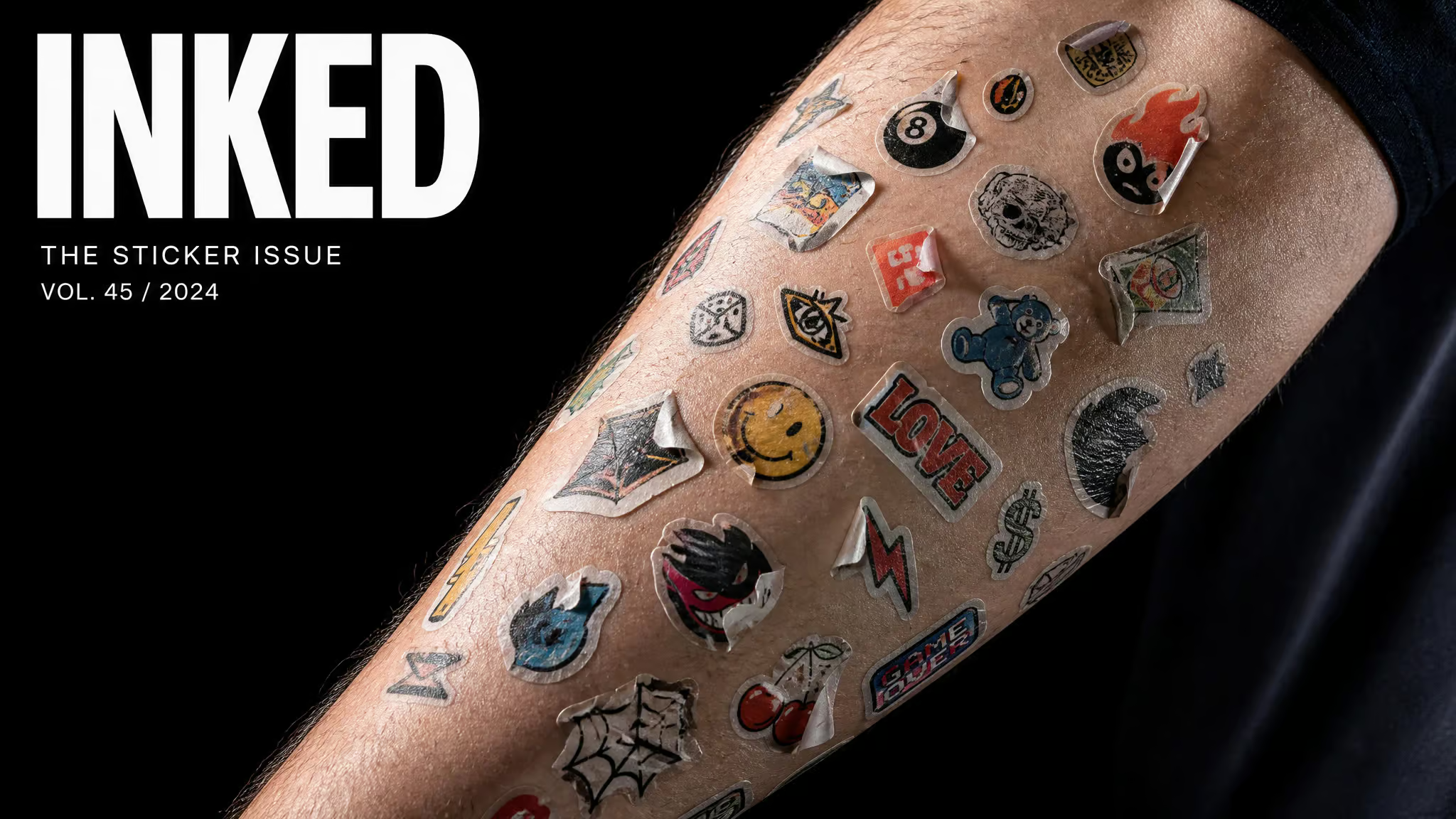
The delight first. Sticker-style tattoos look exactly like what the name says: a sticker collection on skin. Bold outlines, playful imagery, slightly chaotic placement, arranged like a desk that’s cluttered yet deliberately so. The trick that makes people stop scrolling: they look peelable. They aren’t. Artists add peeled corners and lift to sell the illusion that the adhesive is wearing off, and the permanence of that temp-looking fake-out is honestly kind of elegant.
Richard Meggison is the artist spearheading the style, and worth crediting the way you’d credit the dev behind a cool repo. The low-pressure appeal is structural: clients build collections over time instead of commissioning one monolith. Less a centerpiece, more a curated sketchbook you wear. Longevity rests on the eight-year test, not the format.
Fine line and minimalism: placement is the trend
Fine line never left, it just keeps shipping updates. Fine-line florals, butterflies, delicate script, soft ornamental accents are all still going strong, and what’s changed in 2026 is where they live. Collarbones, fingers, and wrists aren’t just placement options, they’re part of the trend itself: spots that photograph beautifully and wear well over time. Think of it as a durability spec baked into the aesthetic.
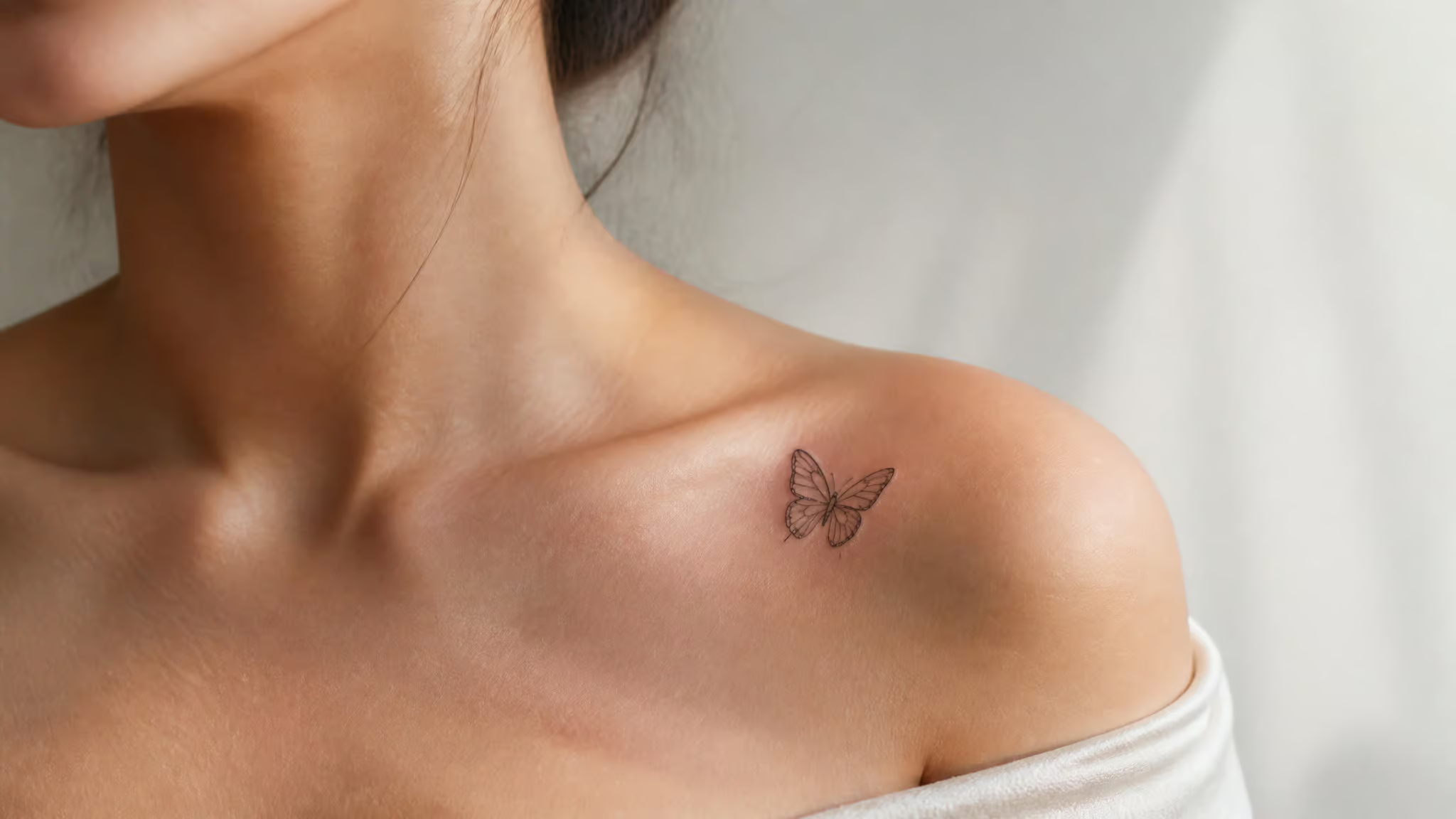
Ed Sheeran, Ariana Grande, and Lady Gaga all wear small fine-line and micro pieces, which tells you how mainstream this got, but celebrity visibility isn’t the backbone here, the craft is. Jojo Lu of Playink Tattoo Studio in Orange County puts it well: “This style of tattoo shows just enough negative space to highlight both the artwork and the person wearing it.” That’s negative space doing real work.
There’s a common consultation pattern artists describe that says a lot about where this trend’s head is at: the conversation is mostly placement and aging, not subject matter. People are asking where will this still look good in a decade, not “what should it mean.” That’s also why Gen Z gravitates here: fine line holds up over time with a skilled hand, offers plenty of room for customization, and works as a sensible v1 before committing to a bigger build.
Microrealism: the flex, and its warranty-voiding conditions
Microrealism is the flex section. Portraits, animals, ultra-detailed objects are getting smaller while getting more impressive, which is basically chip shrink for skin: detail density goes up as size goes down, and at some point you’re looking at a two-inch portrait rendered like a photolithography demo. The names to know for the black-and-gray miniature work: Oscar Åkermo, Balazs Bercsenyi, @da24ink, and Dr. Woo. Kaia Gerber and Kylie Jenner wear tiny expressive micro-tattoos, briefly noted for visibility, moving on.
Here’s the part nobody mentions in the highlight reels: the maintenance conditions. Kayla O’Connor of Fleur Noire Tattoo in San Diego notes microrealism, which she says works in full color or black and gray and suits anyone choosing a small-scale tattoo. But placement matters more than for almost any other style, and her cautions read like warranty-voiding conditions. Avoid high sun exposure, which rules out the top of the forearm as a forever spot. Avoid friction from tight clothing, which means bra line and waistline placements will degrade faster than the portfolio photos suggest.
Placement also amplifies the payoff. A micro animal on the wrist gets read up close, like a UI element held in focus; the same piece on a shoulder blade disappears into scenery. Where you put it changes how it reads. That’s UX for skin.
Fine line vs. microrealism for a first tattoo
If your first tattoo is happening in 2026, fine line carries the smaller risk; microrealism rewards it only when placement and artist skill are right. Both styles age well when done correctly, and both work as first tattoos. The real difference is anatomical: fine line is delicate line work; microrealism is hyper-detail rendered tiny. Fine line is more customizable and more forgiving of an imperfect spot or a less-experienced artist. Microrealism demands more from the artist and from the placement it lives on, since fine detail is the first thing sun and friction eat.
If you’re torn, know that placement and skill matter more than the style choice itself. A great fine-line piece in a good spot beats a mediocre microrealism piece every time, and O’Connor’s cautions apply with extra force to anything detail-dense.
American traditional: re-appreciation, not revival
American traditional is the style with bold lines, classic motifs like eagles, roses, and daggers, and a deliberately limited color palette. Its distinguishing fact in 2026: it never left. This is re-appreciation, not a revival, and the distinction matters, because revivals imply a gap.
Younger clients are rediscovering it for reasons that hold up under scrutiny: it ages well and photographs cleanly. In an era of feeds rewarding maximum detail, a style whose constraint set was basically bold enough to survive on a sailor’s arm in the 19th century reads almost countercultural. Harry Styles and Zac Efron wear it. The sailor roots go back to the 19th century, and we’ll come back to why that lineage matters at the end.
Scanning for what’s popular with men right now? American traditional leads, and it fits anyone who wants durability, clean photography, and designs that scale from small to full coverage. The trade-off is real, though: bold lines are hard to undo, so this is the anti-hedging choice. Blackwork and blastover, covered below, also serve that same demand if traditional’s motifs don’t speak to you.
Neo traditional keeps evolving
Changelog for neo traditional, 2026 edition: expanded palettes, finer details, and illustrative and ornamental influences layered onto the classic skeleton. What’s new is expressive range; what carried over is the structure. Artists keep pushing contrast, depth, and storytelling while holding onto the underlying framework, which is the ideal kind of update: more features, no breaking changes.
Valerie Vargas is the name to know here, working in bold feminine motifs with saturated, painterly color. One-line takeaway: classic foundations with modern punch. If American traditional is the anchor, neo traditional is the playground.
Blackwork gets louder and cleaner
2026 blackwork leans hard into high contrast, negative space, and geometric and ornamental influence, and the negative space is the clever bit: what’s not inked carries as much of the design as what is. Credit where due, Boris Bianchi and Roxx brought the style mainstream through large-scale celebrity work.
The style is versatile and unapologetic in a way few others are. It scales from a subtle accent all the way to a full sleeve, and geometric designs pair with it naturally. This is also a strong pick for readers looking at bolder men’s trends: if traditional’s motifs feel too classic, blackwork gives you big, high-contrast commitment with a more contemporary visual language.
Pet portraits in heart-shaped lockets
Jes Valentine reports more and more requests for pet portraits inside heart-shaped lockets, and honestly, of course people want this. The trend driver is pure customizability: it’s a two-parameter design space. Parameter one is the pet’s portrait, toothy smile or otherwise. Parameter two is the locket itself, ornate or understated. Tweak either one and it’s still unmistakably yours.
The locket framing is what turns a classic pet tattoo into this year’s trend. Same subject, new container.
Nostalgic themes: the ’70s to early-2000s revival
What’s trending in 2026 nostalgia ink comes down to one causal takeaway: artist interviews say the year is shaping up nostalgic and romantic, and the throwback window runs from the ’70s through the early 2000s. Lindsee Boyer, owner of Bee Tattoo Studio in Minneapolis, sees growing interest in that imagery across all ages, including tribal designs, cherries, and bows. And notably, plenty of the people getting this ink never lived those eras. Boyer’s take is that young people get excited because the style feels new and fresh to them.
New to you is real. It’s the same reason discovering retro games as a teenager is a genuine discovery, not a lesser one. Valentine’s seeing the late-’90s and early-’00s end of the pool too. Specific requests so far this year include the Titanic’s “Heart of the Ocean,” a Lisa Frank dolphin, and soaring angel-number flash.
Yes, these are real requests. Yes, the Lisa Frank dolphin.
For readers looking at trends for women specifically, the practical read: fine-line florals, bows, cherries, ornamental work, and neo traditional (Vargas’s bold feminine motifs being the exemplar) are the leading styles, chosen for customizability and delicacy. The trade-off is that delicate work ages on a shorter leash, so placement discipline matters more than with bolder styles. And the Y2K placement revival, tramp stamps included, is genuinely back in rotation, per Vargas and the broader trend coverage, reported here without judgment. The key caveat on all secondhand nostalgia: its emotional shelf life is untested. You’re adopting someone else’s era, and the eight-year test applies hardest here.
Ornamental tattoos, and the appropriation line
Does getting an ornamental or cultural-symbol tattoo amount to cultural appropriation? Depends on one condition: whether you’ve researched the motif’s origin and meaning before inking. That’s the line, per Emmanuel Fortunato, and it’s a reasonable one, research applies whether you’re choosing a mandala, a Celtic knot, or even browsing Star Wars tattoo ideas for inspiration. Before committing, read up on what the design carries. Treat it as the readme-before-you-install step, not a lecture.
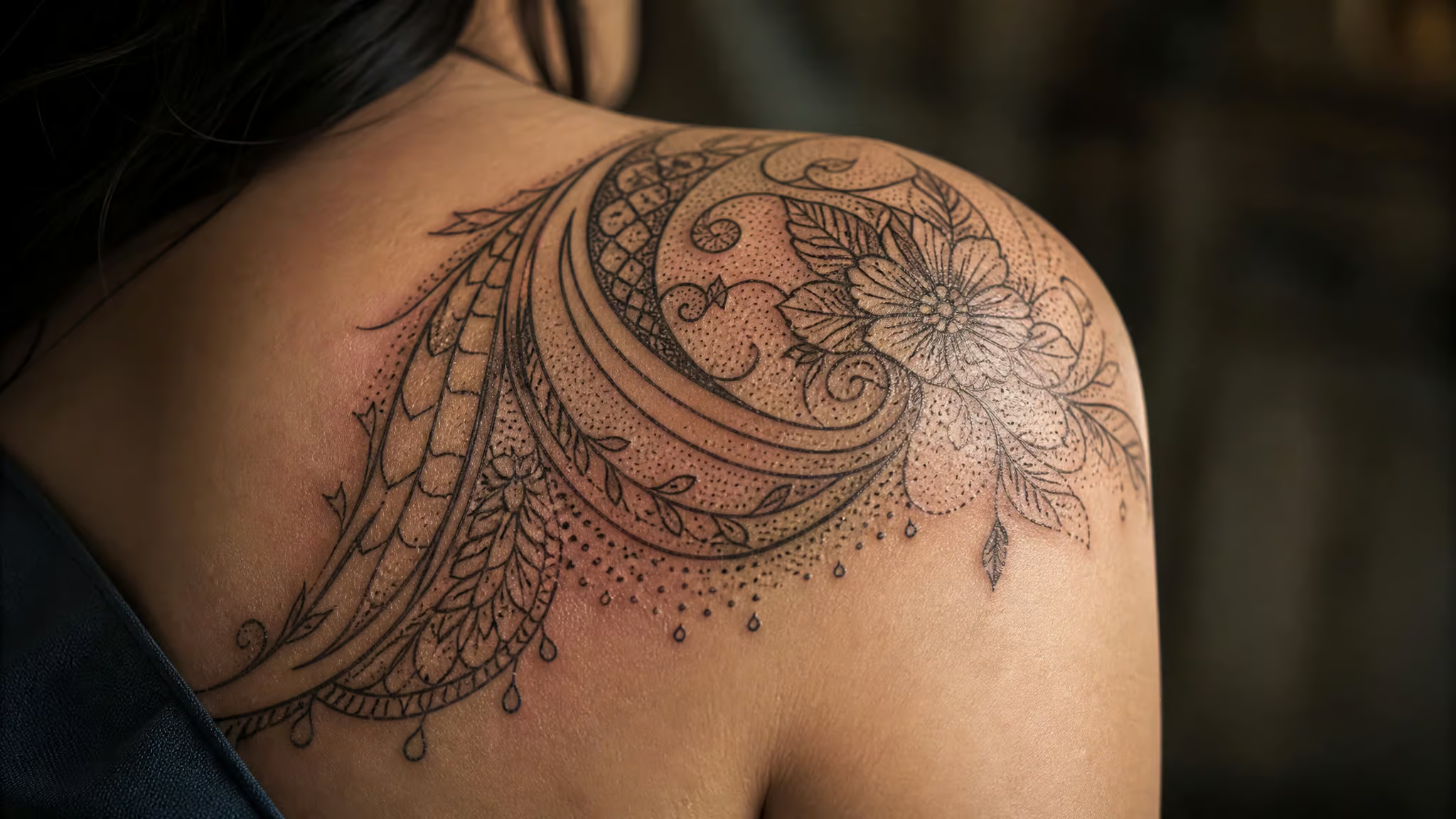
The craft itself deserves the attention it’s getting. Ornamental work uses fine lines, pointillism, and shading to adorn and enhance the body’s contours, so the design follows your anatomy rather than sitting on top of it. The reference points are Art Nouveau and lacework, which explains both the detail density and the appeal. Fortunato says sacred geometry carries a meditative, near-spiritual quality where every line has a purpose. Nothing decorative by accident.
Some of these motifs connect to living heritage practices, and that thread matters for where this article ends up, so hold onto it.
Cybersigilism, geek ink, and the ‘intellectual’ microtrend
Cybersigilism is the newest polarizing trend of 2026, and it’s the freshest item on the board alongside sticker-style, intellectual diagrammatic tattoos, and pet lockets. Quick definition: cybersigilism is sharp, thorned, tech-adjacent sigil work, and JustINKD frames it as the polarizing 2020s equivalent of the tribal tattoo era. That tech-adjacent current runs wider than sigils, touching everything from Star Trek tattoo ideas to other fandom iconography. It surged through the 2020s alongside post-ironic and memetic tattoos and religious iconography, all growing at the same time as Y2K placements came back, tramp stamps, bicep tattoos, back tattoos. Old placements, new iconography.
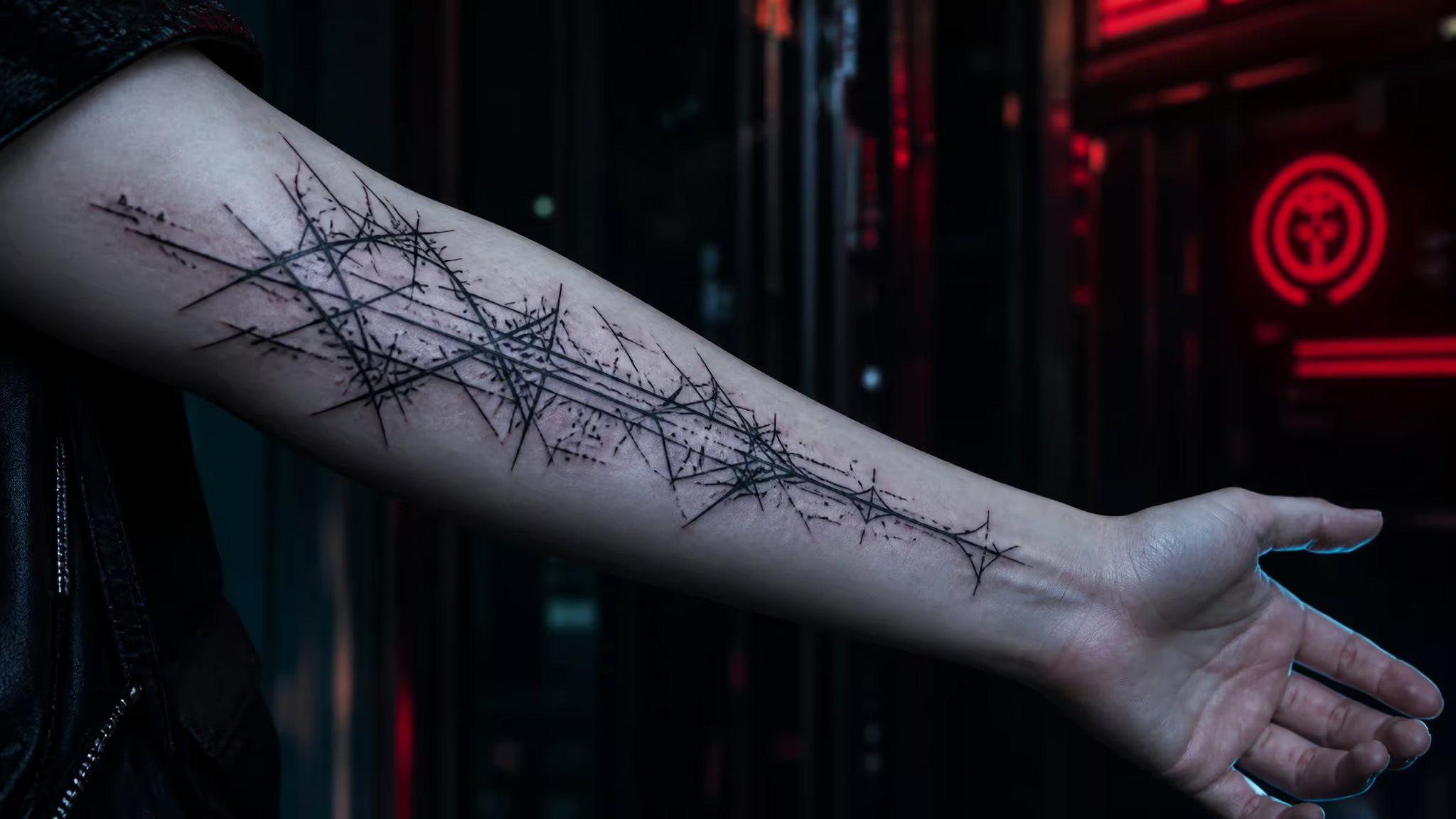
Now, the part I find genuinely interesting as someone who’s been watching this space: here’s where geek ink gets interesting. Nerd tattooing right now sits at the intersection of three of these currents at once. There’s fine-line fandom work, there’s cybersigilism’s aesthetic language, and there’s the diagrammatic “intellectual” tattoo microtrend, ink that looks like a diagram of an idea, a circuit, a formula’s structure, a schematic of a feeling. The wearers position it as a pushback against AI-era homogenization, a deliberate human fingerprint against generated sameness, and whether or not you buy the whole thesis, the intent is the tell: people are choosing ink partly as an argument about taste, the same impulse running through every corner of planned nerdy tattoo ideas from fandom to formula. That’s the same debate every creative field is having right now, and it walked straight into tattooing.
The honest counterweight: JustINKD predicts cyber sigilism ends up on cover-up consult lists 10 to 20 years from now. That’s an artist’s judgment, not fact, but the logic is sound. The same polarization that makes it feel fresh now is exactly what may date it, for the same reason tribal-era work reads as era-stamped today. Jenz is an artist fully committed to the style, so the execution ceiling is clearly high; the question is whether the aesthetic has a decade in it.
And there’s a consultation dynamic artists will recognize: the will-you-still-want-it conversation, happening right before the needle. Pew’s data, that contradiction between vibes-forward framing and the 69% who still want meaning, is the tension sitting underneath ironic ink. Even the post-ironic tattoo wants to matter.
Edge trends and illusion work
Now the full JustINKD rundown, thirteen trends at the fringe, each with a verdict. And one framing thesis worth stating up front: several of these styles are really a repair economy. Paint smear, rectangle tattoos, and blastover exist largely to fix the last trend wave’s mistakes. That’s the clearest signal you’ll get about which current trends will need fixing next.
Snake-wrapping-collarbone and tattoo-of-a-tattoo
The snake wrapped around the collarbone works via angles and negative space creating a weaving illusion, and credit where due, the illusion is clever engineering. But it’s judged overdone and likely to fall off, because that fine detail is exactly what degrades first. The related tattoo-of-a-tattoo idea, ink depicting your other ink, adds real personalization, and the hope is it becomes a long-term style rather than a stunt.
Tattooing over blackout and blastover
Remy tattooed full-color illustrations over his own blackout bodysuit, which settles the old claim that blacked-out skin is untattooable. Turns out it’s a canvas with a very dark base coat. Blastover takes the opposite approach: new work applied intentionally on top of existing tattoos so the old ink shows through as a layer. Old art becomes texture.
Paint smear and rectangle cover-ups
Paint smear tattoos, trending since 2024, mimic the thickness and gloss of actual paint, and they double as cover-ups, which is not a coincidence. Rectangle tattoos keep 80 to 90% of the design within the frame, and the JustINKD host sees them multiple times daily. That frequency tells you it’s genuinely popular, not just algorithm-famous.
Skin-tone ink touch-ups
Touch-ups over bled-out tattoos using skin-tone ink are being floated, but there’s no long-term healing data on how they settle. That’s the whole verdict. Plainly: nobody knows how these look in five years.
Embroidery patch tattoos
These mimic sewn fabric patches, complete with thread texture, and they’re realistic enough that viewers report wanting to tug the threads. That’s the bar for a texture illusion: trigger the physical instinct.
Anesthesia tattoos, Euro Trash, sticker versatility, joint-bending designs
Anesthesia tattoos, getting inked while unconscious, are expensive and controversial, with some artists viewing them as cheating, and at least one reported death is associated with the practice. That last part deserves to be said seriously and left there. Demand may stick around unless it’s banned outright, but the risk profile isn’t trivial.
Euro Trash started in Europe around 2019 to 2020 and has drawn criticism for looking scratchy. Sticker tattoos, as covered above, offer real design versatility, which is why they appear on the fringe list too. And joint-bending tattoos transform as the body moves: a design at rest is a different design at full flex. Tiny wizardry, honestly.
The regret economy: what undoing a trend actually costs
Let me pay the bill I ran up in the intro, because I’m qualified for this section in the worst way. My first tattoo came at 16: my sister’s name in my own handwriting with an arrow, thoroughly Tumblr-inspired, which was simply the aesthetic at the time. The 2010s defaults were small line drawings and handwritten words, so that’s what everyone’s skin filled up with. In early adulthood I added kitchen-table tattoos from a Slovakian skater, told plainly and with a shrug.
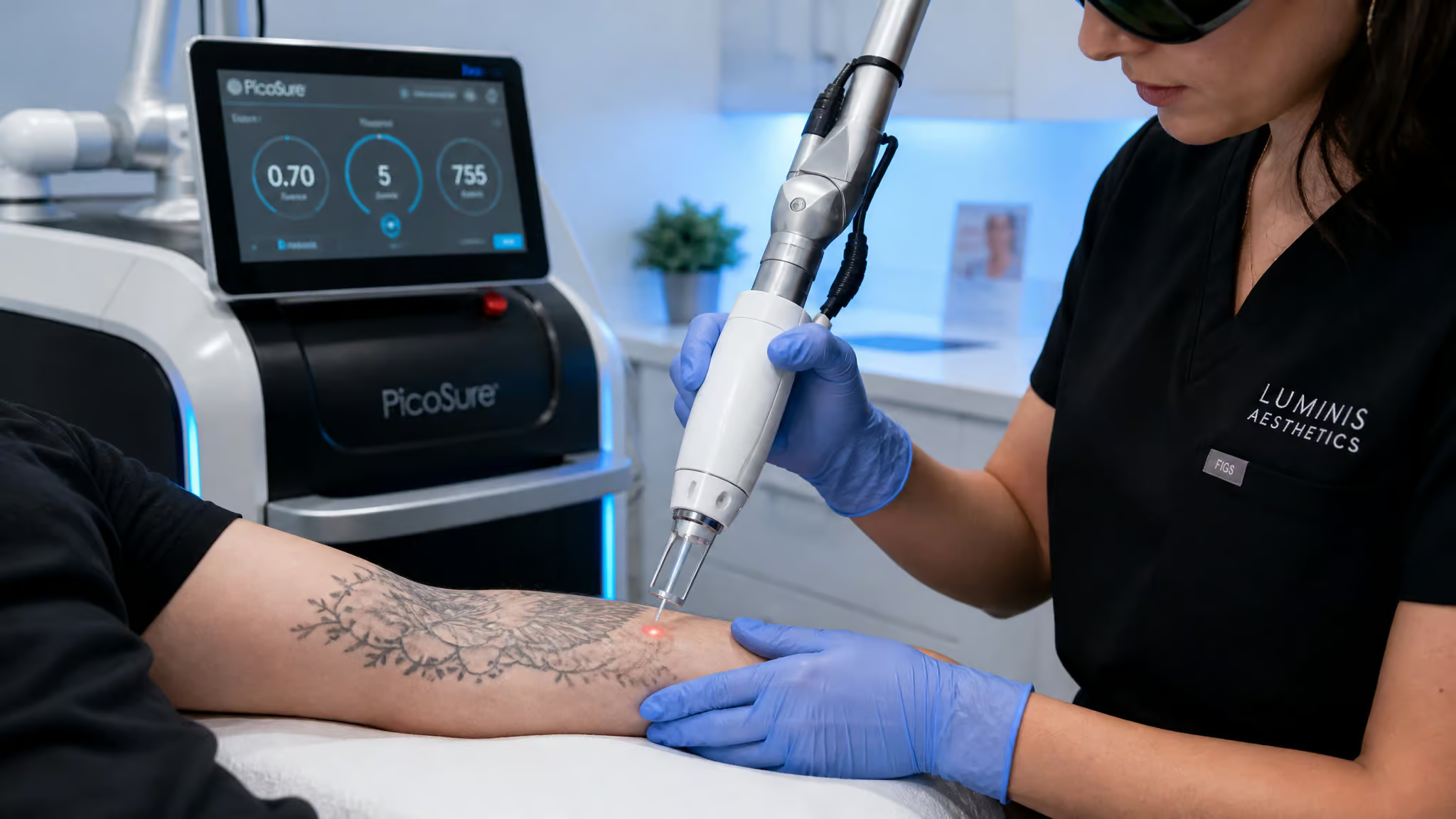
I’m now lasering almost all of it off, and the honest sensory report is that it feels like someone tracing a hot poker over your flesh. The one I’m keeping: Spice Girls ink on my left bicep. Zero regrets, wrong to speculate.
And here’s the thing about trend regret, an archaeology of the recent camera roll. The fingerstache is a 2011 fossil, pure hipster-and-twee era, worn now with varying degrees of irony. The lavender sprig colonized forearms after 2015. The disco ball boom hit in 2020, possibly linked to Taylor Swift’s “Mirrorball”, kept hedged because fandom-adjacent causation claims deserve the
Angel-number flash has been soaring for the last couple of years, current-era artifact, no sneering. Every one of these felt like a forever decision at the time. Removal artists describe a pattern: people come back years later wanting fading or lightening before a cover-up, the trend-to-touch-up pipeline in the flesh.
So, do TikTok-era trends actually last? Mostly no, and the decisive condition is whether the design has meaning that outlives its moment. A trending style functions as what 6th House calls a cultural tomb: it marks a moment, a shift, a collective memory, which is beautiful if you chose the timestamp deliberately and grim if the timestamp chose you. The disco ball boom is the case study.
My Tumblr tattoo is the receipts. And the scale isn’t anecdotal: nearly 1 in 4 tattooed US adults express regret, and 20 to 30% of tattooed people consider removal. That’s not a personal failing, that’s base rates.
What tattoo removal costs in 2026
The numbers, first, because the sticker price is not the real price. A standard laser session runs USD 200 to 700. Picosecond sessions run USD 300 to 1,000. Most tattoos need 6 to 12 sessions, which puts the all-in total at roughly USD 1,200 to 8,400. That’s the real cost of a trend that didn’t stick.
Cost check: A full removal bill is sessions multiplied, not a single quote: 6 to 12 sessions at USD 200 to 700 each can total USD 1,200 to 8,400.
And the feelings part is normal: nearly 1 in 4 tattooed US adults express regret, and 20 to 30% consider removal. You’re in a large cohort, not a cautionary tale.
The market behind this is substantial and worth reading correctly, because the two headline numbers describe different things and get conflated constantly. The broad removal market, all modalities, was USD 980.39 million in 2025, heading toward USD 2,103.08 million by 2034 at an 8.85% CAGR. The laser-only segment is smaller and slower: USD 269.1 million in 2026 growing to USD 410.0 million by 2036 at 4.3% CAGR, with growth decelerating from a 6.8% historical rate, which reads like a maturing market curve, not a dying one. North America held 39.57% of the share in 2025; Asia Pacific is the fastest-growing region at 11.04% CAGR, and Bangkok in particular has grown into a medical-tourism aesthetic hub serving patients from Australia, the Middle East, and across ASEAN. The growth use case is interesting: partial removal and lightening to enable cover-ups rather than full clearance, with devices like PicoWay from Candela Medical used for controlled pigment reduction. Artists now collaborate with clinics to lighten old work before redesigning, a genuine pipeline between the chair and the clinic.
And, without conspiracy framing, recurring multi-session revenue is a big part of why the market looks the way it does. Med spas are the fastest-growing channel at 10.47% CAGR across more than 10,000 US locations, and Removery has scaled to 150+ locations as the size benchmark.
Picosecond vs. Q-switched lasers
Think of this as a hardware generation gap. Q-switched lasers are the legacy platform; picosecond lasers are the current generation, cutting required sessions by up to 30 to 50% and handling the stubborn green and blue inks that older systems struggle with. More than 60% of advanced US aesthetic centers have already moved to multi-wavelength systems. And here’s the honest reconciliation: FMI still shows Q-switched holding 68.0% of 2026 product share. Both facts are true at once.
Q-switched owns the installed base; picosecond owns the adoption curve. Classic legacy hardware versus replacement trend.
Recent hardware drops worth knowing before you sit in anyone’s chair: PicoSure Pro+ from Cynosure, which needs precise parameter control, meaning the operator matters as much as the box, Cutera’s Discovery Pico+, and Fotona’s StarWalker MaQ+ dual picosecond/nanosecond platform. Country growth rates, briefly: India at a 6.7% CAGR and Thailand at 6.2%, with the USA at 3.2%, the US number driven by picosecond replacement demand.
Ultrasound removal and the skin-type equity gap
The laser stack has a real gap, and saying so plainly matters. Laser removal risks include hyperpigmentation, hypopigmentation, blistering, and scarring, and those risks hit Fitzpatrick IV through VI skin types hardest, which has measurably limited adoption in Asia and Africa. This is an access-equity issue: the dominant tool for undoing ink works worst for a large share of the world’s skin. Ink composition varies and practitioner expertise varies, both of which add complication risk.
The promising alternative is ultrasound-based removal: acoustic energy plus saline lifts pigment without heat, a non-thermal mechanism with a different failure mode entirely. It’s positioned for darker skin types and laser contraindications, growing at a 9.68% segment CAGR, useful for gradual fading of deep tattoos, and cheaper to run for small clinics. Combination therapies stack laser with topical ink-binding agents, fractional resurfacing, and healing enhancers to reduce inflammation and shorten healing, and clinics use that stack to differentiate and charge premium prices. The business logic is straightforward and worth knowing before you’re quoted one.
What escapes the trend cycle: cultural roots and intentionality
How do you choose a tattoo style you won’t regret? The honest answer, up front: you choose something tied to lineage or chosen with genuine intention, and you accept Valentine’s eight-year test before the needle touches you. Everything below is the evidence for that answer.
Heritage practices outside trend cycles
Some codebases never get deprecated. M?ori t? moko carries ancestry, status, and spiritual identity. Japanese Irezumi and Tebori are traditional practices with their own long lineage. Among Indigenous Americans, tattooing has long carried deep cultural weight, and in some communities it functions as a coming-of-age practice, though it’s worth keeping that scope honest rather than flattening many distinct traditions into one.
Madison, the LA handpoke artist behind Piiiinkslip, draws on Filipino heritage and the traditional handpoke practice called Tatak, and her wrought-iron-inspired work traces back through Andikra symbols, originating in Africa and popularized in American architecture by African American blacksmiths. That whole chain stays intact; the lineage is the point. Her view on whether these styles cycle out: there will always be a space for them, and she doesn’t think she’s ever heard of a style being cycled out.
American traditional is the popular-style proof of the same principle. Its roots run to 19th-century sailors, making it the longest-running stable release in the catalog. And notice what the divide is actually made of: it’s structural, not aesthetic. Styles tied to lineage can’t be cycled out because they were never riding the cycle in the first place.
Owning a trend with intention
Choosing a trend knowingly, as a deliberate timestamp, is the regret-prevention move, and it’s the contrarian position that resolves this whole article. The Berlin studio 6th House, tattooing there since 2020, works in a decayed, ruin-like aesthetic built on gothic architecture, faces, geometric shapes, organic vines, jewelry, mixed shading, imperfections embraced rather than erased. Post-Covid, their framing was that structure and certainty had been challenged, and their phrase for it, clearly theirs, is that the clean line lost its claim to truth.
Their thinking on trends is the useful part: a trend is a collective movement happening outside your body, and once a style turns into a trend, it takes on the role of a cultural tomb, marking a moment, a technology, a mood, a collective memory. Their client approach follows from that: clients are encouraged to meditate on internal shifts, language, and aesthetic preferences before choosing anything. Read the docs before you deploy. They frame tattooing as an extension of memory and a way to heighten waking life, with a parallel they draw to Buddhist teaching about staying present with yourself regardless of what’s trending, and their condensed argument is that a trend you aren’t actively choosing can sit badly with your longer relationship with your own body.
Then two working tests, and they coexist rather than compete. Jes Valentine’s is the eight-year question: will that thing matter to you in eight or so years? Emmanuel Fortunato’s is the ownership clause: if a lavender sprig speaks to you, customize it, adjust the design, add texture, work in meaning, and the goal shouldn’t be to avoid trends, because your story makes the tattoo timeless. The goal was never trend avoidance. It’s choosing on purpose.
Which lands where this whole piece was headed: the drift in 2026 is toward craftsmanship over virality. Clients want ink that’s intentional, flexible, and well-executed. Less trend-chasing, more taste-driven, which is how it should have worked all along.
tattoo trends: quick answers
Are tattoos going out of style in 2026? No. Pew’s data shows the most-tattooed generation ever still getting inked, and 2026’s story is re-appreciation and style shifts, not decline. The habit isn’t going anywhere; the default styles are changing.
What are the most popular tattoo styles in 2026? The most popular tattoo styles in 2026 are fine line, microrealism, sticker-style, American traditional, neo traditional, and blackwork.
- Fine line: delicate florals, script, and ornamental accents where placement is part of the trend, collarbones, fingers, and wrists leading.
- Microrealism: portraits, animals, and objects at absurd small-scale detail, demanding careful placement away from sun and friction.
- Sticker-style: bold-outlined, peel-look pieces built as a collection over time, spearheaded by Richard Meggison.
- American traditional: eagles, roses, and daggers in bold lines and limited palettes, aging well and never having left.
- Neo traditional: classic structure with expanded palettes and finer detail, exemplified by Valerie Vargas.
- Blackwork: high contrast and negative space, scaling from accent to full sleeve.
What’s the newest tattoo trend? Cybersigilism leads, with the diagrammatic “intellectual” tattoo microtrend right behind it. Both are polarizing, both are fresh, and one of them, if the JustINKD prediction holds, will be a very busy cover-up category by the 2040s. Choose accordingly.
Frequently Asked Questions
What are the most popular tattoo styles in 2026?
Fine line, microrealism, sticker-style, American traditional, neo traditional, and blackwork lead the board. Fine line and microrealism dominate the small-and-delicate end, while American traditional and blackwork serve demand for bold, high-contrast durability.
What is the newest tattoo trend?
Cybersigilism — sharp, thorned, tech-adjacent sigil work — leads, with the diagrammatic ‘intellectual’ tattoo microtrend right behind it. Both are polarizing, and JustINKD predicts cybersigilism will be showing up on cover-up consult lists 10 to 20 years from now, so choose accordingly.
Why is cybersigilism so popular and will people regret cyber sigilism tattoos?
It’s popular because it feels fresh and tech-native — JustINKD frames it as the polarizing 2020s equivalent of the tribal tattoo era, surging alongside post-ironic and memetic ink. The regret question is real: the same polarization that makes it feel current is exactly what may date it, which is why it’s predicted to become a busy cover-up category in the 2040s.
How do I choose a tattoo style I won’t regret later?
Choose something tied to lineage or chosen with genuine intention, and apply Jes Valentine’s eight-year test: will it still matter to you in eight or so years? Emmanuel Fortunato’s ownership clause helps too — if a trend speaks to you, customize it and work in your own meaning. With roughly 1 in 4 tattooed US adults expressing regret and full removal running 6 to 12 sessions at USD 200 to 700 each, choosing on purpose is cheaper than unchoosing.
What tattoo trends are popular with men in 2026?
American traditional leads — it’s durable, photographs cleanly, and scales from small pieces to full coverage. Blackwork and blastover serve the same demand for bold, high-contrast commitment if traditional’s motifs feel too classic.
How much does tattoo removal cost in 2026?
A standard laser session runs USD 200 to 700, and picosecond sessions run USD 300 to 1,000. Most tattoos need 6 to 12 sessions, putting the all-in total at roughly USD 1,200 to 8,400. A growing share of that spend is partial removal and lightening to enable cover-ups rather than full clearance.