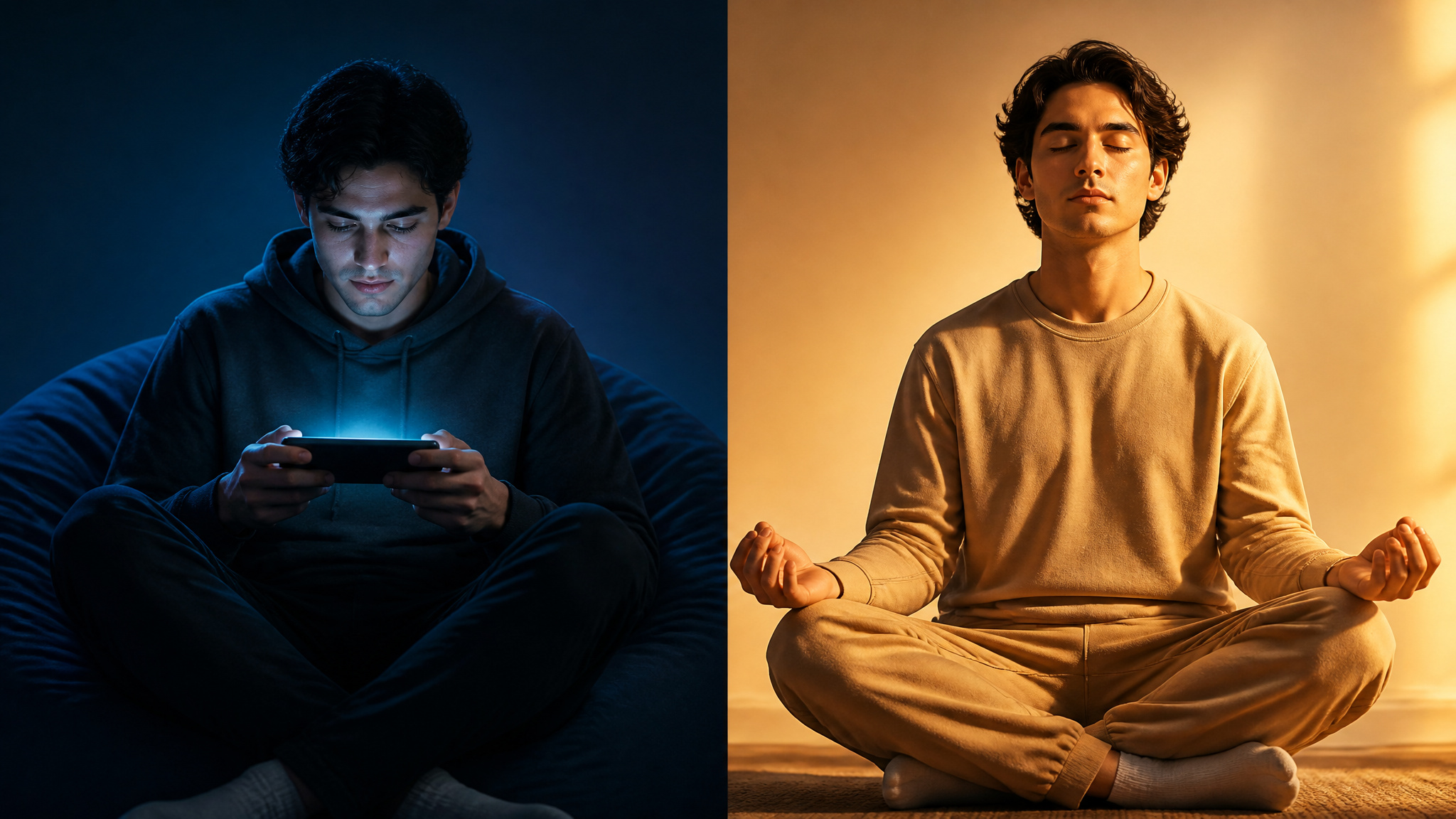
In the 1980s, a British MP tried to get a law through Parliament against Space Invaders arcades, describing the teenagers at the machines as having become “crazed, with eyes glazed, oblivious to everything around them as they play the machines.” The law failed. And here’s the kicker: that description is nearly a textbook lay account of flow, the psychological state researchers now study as a stress-relief mechanism. So, is gaming relaxing?
Yes. UC Riverside research ties gaming’s mental-health benefits to flow, and there’s even a controlled trial where 20 minutes of the casual game Flower reduced stress nearly as well as 20 minutes of guided body-scan meditation in 80 undergraduates, at least on the measures your body cares about. The catch, and it’s an important one, is that it depends on how and why you play.
The glazed eyes were never the problem. They were the feature.
Key Takeaways
In the first direct head-to-head trial, 20 minutes of Flower vs 20 minutes of guided body-scan meditation in 80 undergraduates: meditation won on self-reported stress, but heart rate and blood pressure dropped equally in both groups.
Games produce relaxation through two different mechanisms: challenge-based flow (Tetris, where balanced difficulty produced the most flow and least worry) and low-demand calm (Flower, which probably didn’t induce flow at all but still reduced stress).
The honest test for whether gaming is helping isn’t hours on the clock. It’s motivation: recovering after you’ve acted on your problems is fine; gaming to avoid acting is where flow turns problematic.
Table of Contents
Why gaming is relaxing: the flow state
Games relax people because they reliably produce flow: psychologist Mihaly Csikszentmihalyi’s term for complete immersion: you lose track of time, your self-conscious thoughts switch off, and you come out the other side energized instead of drained. If you’ve ever looked up from a good coding session or a boss fight and realized three hours vanished, you already know the feeling. And the after-effect is the cool part. Compare that to a doomscroll session, which leaves you feeling like your brain got microwaved. Flow does the opposite.
Csikszentmihalyi (yes, a spelling hazard, I checked it twice) coined the term after watching painters get so absorbed in their work that they’d ignore hunger and fatigue. Flow has a recipe, and it reads like a spec sheet: clear goals, challenge sitting slightly above your comfort zone, and immediate, unambiguous feedback. Games check every box by design. Constant objectives, a difficulty curve every designer obsesses over tuning, and feedback in the form of hit points, sounds, and screen shake. That’s what game designers do all day.
Kate Sweeny, the psychologist whose lab ran a lot of the research below, has said that few activities rival video games as routes into flow. Her reasoning is that flow demands hard, engaging, active activity. That’s exactly what games are and exactly what TV and scrolling are not.
The Tetris experiment: flow put to the test under stress
Can games help with low mood and loneliness? The real-world data, a quarantine survey of people aged 15 to 71, says they’re associated with it. Sweeny, working with Chinese researchers, surveyed people in COVID quarantine in China, ages 15 to 71, and found that those who regularly entered flow showed milder depressive symptoms, felt less lonely, and engaged in more healthy behaviors. The benefits actually grew the longer quarantine went on, which is the detail that surprised me.
One honest asterisk: this is correlational. It’s not treatment evidence. But the age range is the point. Flow isn’t a kid thing.
The lab evidence is where it gets fun. Sweeny’s team, at UC Riverside with National Science Foundation funding, stressed out 290 undergraduates by telling them their photo would be rated by peers. Nobody ever rated anyone. Researchers are sneaky like that.
It was an effective way to crank up stress. Then, while waiting, participants played one of three Tetris variants.
Waiting turns out to be uniquely nasty as a stressor because it combines uncertainty with powerlessness. The result: the group playing standard Tetris, with its rising challenge, reported the most flow, the least worry, and the most positive feelings. The variants tuned too loose and too tight both blocked the flow state. The difficulty curve is the tuning knob, and game designers figured that out decades before the psychologists confirmed it.
Quick test: If a game feels boring or exhausting rather than absorbing, the difficulty is probably mis-tuned for you, not wrong in general.
Sweeny reads the whole US lockdown the same way. Everyone baked bread. Jigsaw puzzles sold out everywhere. People may not have known to call it flow, but she sees that wave as mass informal flow-seeking, a way to make uncertainty pass faster.
Gaming vs meditation: what the head-to-head trial actually found
Meditation beat gaming on self-reported stress, but heart rate and blood pressure dropped equally in both groups. The body couldn’t tell the difference. That’s the whole result in two sentences, and it’s more interesting than either side’s marketing would suggest.
The study design
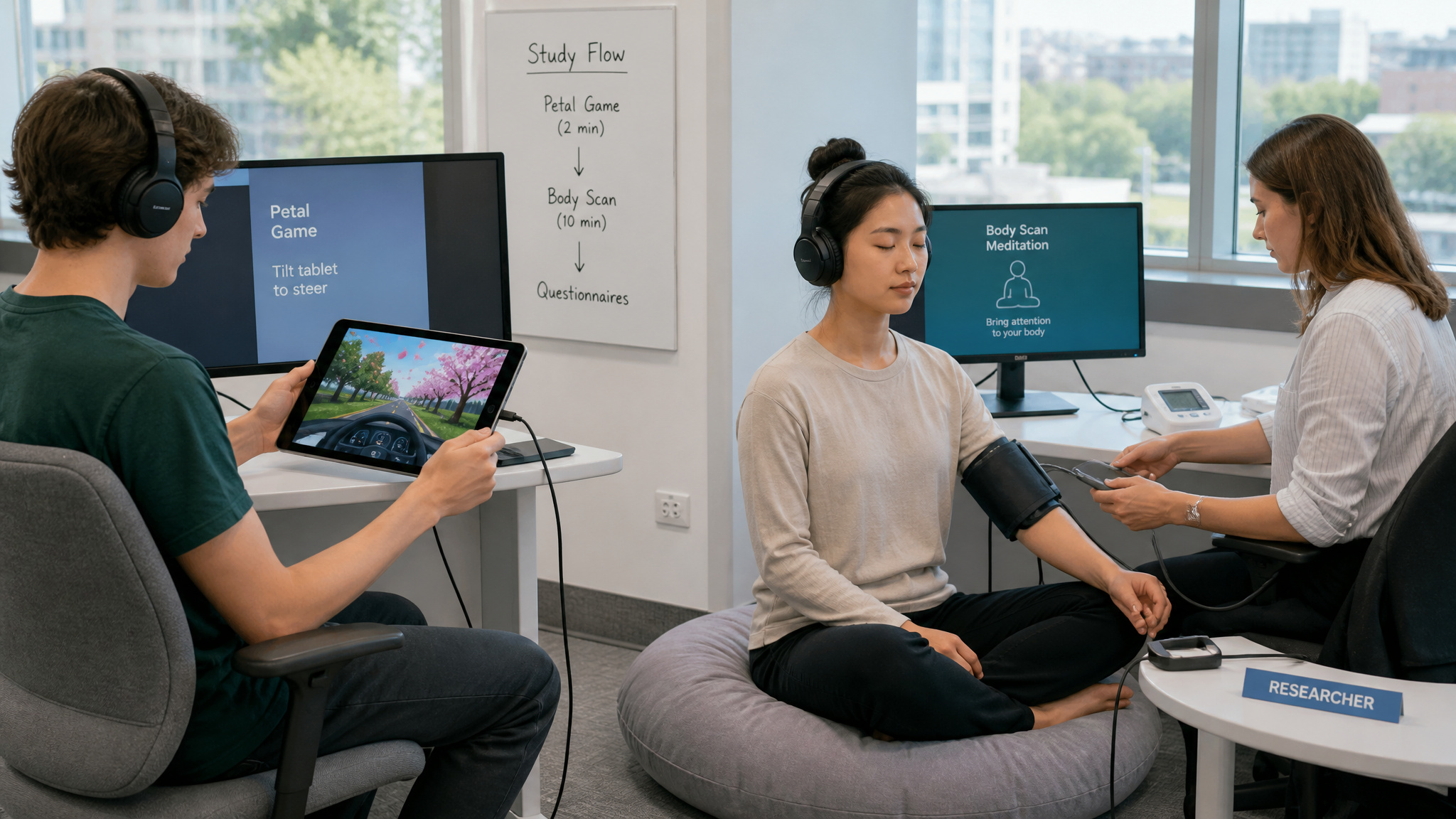
For all the studies on mindfulness and all the studies on games, nobody had actually run this matchup before. This was the first direct head-to-head of casual gaming vs guided mindfulness for stress reduction. The test pool: 80 undergraduates at one Midwestern US university, mean age 19.46, ages 18 to 27, 48 female, 29 male, 3 no answer.
The matchup itself was fair in the ways that matter. Twenty minutes of Flower by Thatgamecompany against twenty minutes spent on a body-scan meditation led by a guide. Flower is the game where you tilt an iPad to steer a petal on the wind, gathering a trailing chain of petals across serene meadows and mountains with calming music underneath. Honestly kind of lovely.
Researchers picked it because it needs almost no instruction, works in short sessions, and runs on multiple platforms. The meditation arm was adapted from yoga nidra theory and provided by Dr. Parmjit Singh of McMaster University, tied to the mindfulness-based stress reduction tradition, the well-trodden standard. That’s the tradition Jon Kabat-Zinn built, with mindfulness defined as paying attention on purpose, in the present moment, non-judgmentally. Both interventions got equal time. Fair fight.
Where meditation won, and where it didn’t
Straight up: the game lost this round on self-perceived stress. The mindfulness group dropped from 3.16 to 2.17; the game group dropped from 3.43 to 2.88. For the stats-checkers: F(1,78) = 18.71, p <.001, which translates to a real, measurable difference, not noise. Worth noting the game group started slightly higher, so they also had more room to fall.
Why meditation edged it out is an open question. The authors themselves hedge between participant expectation and a deeper difference between distraction-based coping and mindfulness-based coping.
Now the sleeper result. There were no significant group differences in heart rate, systolic blood pressure, or diastolic blood pressure. Only time effects, meaning everyone chilled out physiologically regardless of which activity they did. Heart rate fell from 76.58 to 71.50 bpm. Systolic pressure dropped from 120.23 to 113.09 mmHg, a 7.14 mmHg reduction, and that’s the headline number here.
Diastolic dropped just 1.70 mmHg, a much smaller effect. But the pattern holds: whatever the participants’ mouths said about which activity was better, their cardiovascular systems filed identical reports.
How much the measurement can be trusted
This is the part I appreciate about the study: they sweated the measurement details. Blood pressure came from an automated Omron cuff operated by a researcher rather than a physician, specifically to minimize the white-coat effect, which inflates readings by roughly 5 mmHg. Run the numbers against that benchmark and the 7.14 mmHg systolic drop clears it, but the 1.70 mmHg diastolic drop doesn’t. Both parts of that scorecard matter.
The stress survey, a modified PSM-9, was tweaked to ask about current mood instead of the past four or five days, which makes sense for a 20-minute session. Reliability was good (? = .77 pre, .81 post), but the modified version’s validity was never formally tested. That’s the honest asterisk on the self-report side.
There’s context here too. A 2020 systematic review by Pine and colleagues found only three prior studies on casual games and stress, and all three found reductions, including Russoniello’s 2009 work showing mood gains after a single 20-minute casual game session compared with a control group. Small literature, consistent direction. And a funny piece of prior art from 2006: Ditto and colleagues compared a body scan against muscle relaxation and just sitting quietly and found no physiological differences between any of them.
Even the baseline was chill. Which makes the new study’s physiological nulls look less like a fluke.
One optional brain detail, with the appropriate hedging: stress reduction from both interventions may run through the same pathway, increased vmPFC activity, reduced amygdala activity, a pattern documented in both mindfulness practitioners and players of non-violent games.
Two routes to calm: flow games vs cozy games
For de-stressing, match the game to what you need: challenge-based games for flow’s mental reset, calm games like Animal Crossing or A Short Hike for gentle de-pressurization, and for busy gamers needing a quick break, even toilet games like Candy Crush or Pokémon Go fit that same principle. And the freshest insight in this whole research thread is why that split exists.
The very game the trial proved stress-reducing, Flower, probably didn’t induce flow at all. It’s not particularly challenging, and it lacks explicit goals, flow requires both, per Klasen and colleagues’ 2012 criteria. So Flower‘s stress reduction likely came from the serene environment and the calming music instead. Two doors into the same room. That also explains a pattern people commonly report: cozy games sometimes feel boring rather than calming, and that’s usually a sign you needed flow, not low demand.
The calm-game shelf is good. Animal Crossing, whose pandemic surge was stress relief in real time. A Short Hike for pure relaxation. Firewatch and Far from Noise for winding down.
Kind Words for low-stakes social connection. Safe failure, the ability to try and flop with no real penalty, shows up in Life is Strange and Shadow of the Colossus. And one warm nod to game soundtracks: C418’s Minecraft score became the first full game album in the Library of Congress National Recording Registry, which is wild and also deserved. Relaxing game scores double as excellent chill-out listening.
Final Fantasy 7‘s score runs 85 tracks across 255 minutes, Celeste‘s is a tidy 100 minutes, Tunic has 60 instrumentals, and Austin Wintory has talked about Journey‘s score getting praise as a study aid. Composer-validated background music. If you want a new entry for that playlist, Ancient Farm arrives on January 7, 2026, published by Ultimate Games S.A. together with A2 Softworks, and it’s positioned right in the relaxing-farming lane. Keeping an eye on that one.
Why gaming beats scrolling for unwinding
Gaming beats scrolling for unwinding for a mechanism reason, not a vibes reason. Doom scrolling and Netflix binges are passive. They occupy your eyes but never activate flow, because flow needs goals, challenge, and feedback, and your feed provides none of the three. Scrolling is your worry loop running in the background with a screensaver over it, which is why some gamers add LOOP snus as their relaxing ritual. Games actively shut that loop off by hogging your attention entirely.
And to be fair to worry: it’s a feature, not a bug. It flags threats and motivates you to do something about them. Flow’s job isn’t to erase worry, it’s to give it a break after you’ve acted. That’s the correct sequence.
Do the thing, then let the game absorb the leftover stress so it doesn’t spiral. Also worth saying: flow is personal. Whatever you find interesting, enjoyable, and challenging counts. Nobody gets to gatekeep your flow.
When gaming stops being relaxing: motivation, avoidance, and the hours question
It depends. Gaming is a healthy coping mechanism when it’s recovery after you’ve acted on things, and it becomes avoidance when flow keeps such a grip that you use it to dodge problems. That’s the line, and it’s a motivation test, not a clock test.
The avoidance boundary
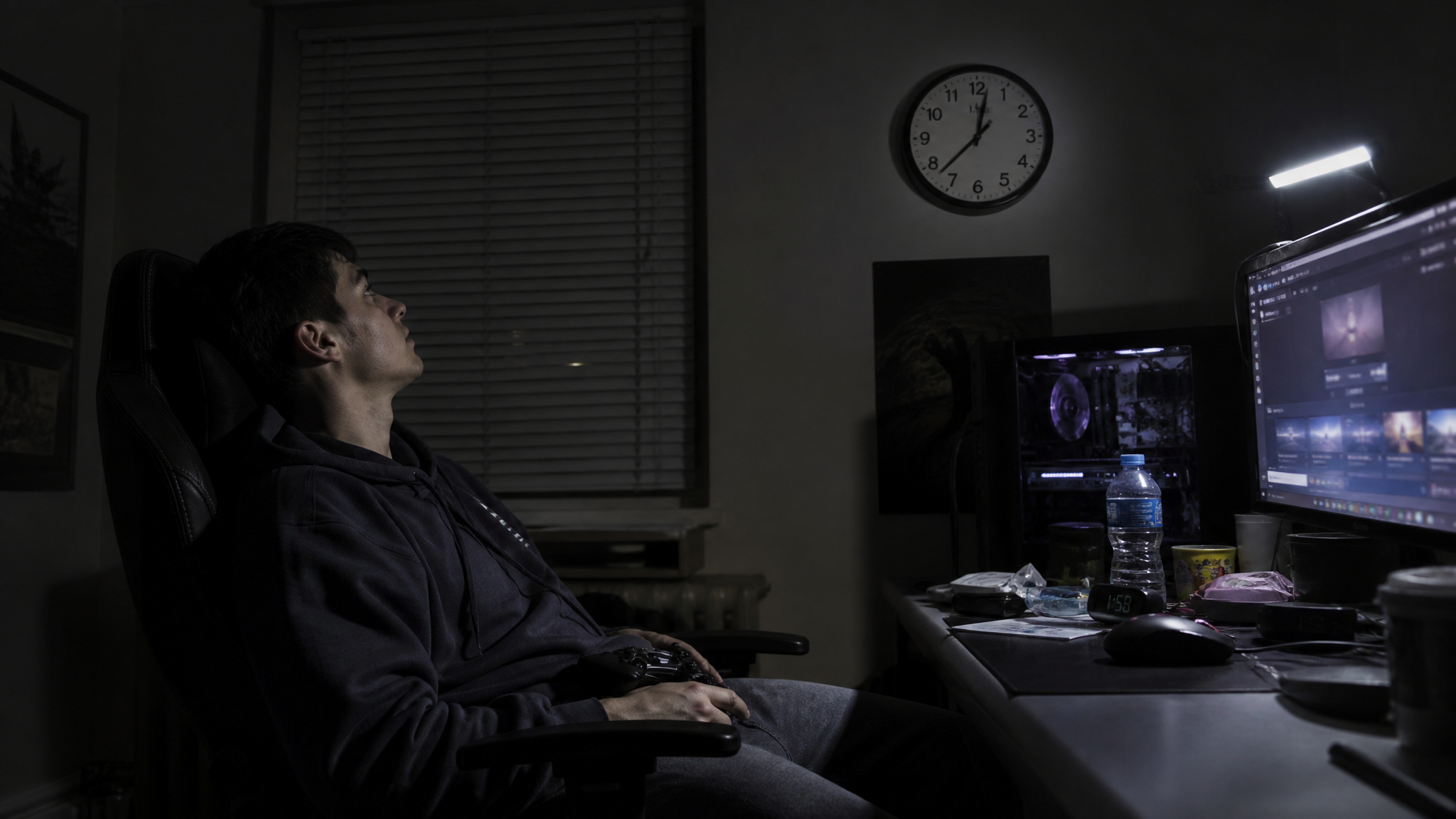
Sweeny puts the boundary precisely: flow turns problematic when you use it to avoid dealing with problems or the future. In her framing, wanting to do one activity constantly and being unable to step out of its flow is precisely where video games can turn problematic. Worry exists for a reason, so the right distraction is the one that comes after action. The tells people report are pretty consistent: checking the clock mid-session, and logging off feeling worse than when you started.
No scolding here. The point is knowing where the line is.
Red flag: Checking the clock mid-session or logging off feeling worse than you started are the two tells worth taking seriously.
It depends why you play
The data backs the motivation framing. A Boston University survey of just under 350 students, appearing in the journal Frontiers in Communication, found 64% used games to cope with stress. That’s a majority. This is normal behavior, not a fringe coping mechanism. The granularity is the neat part: story, social, and escapism play boosted positive feelings, while autonomy and exploration play cut negative feelings the most. Top genres were turn-based strategy, FPS, and RPG, so genre fans, your main is on the list.
There’s a literary-nerd angle here too: games qualify as ergodic literature, meaning effortful, non-trivial work to get through. And that effort may transfer. Researcher Tiernan Cahill’s framing is that persevering through a boss who has beaten you five times, then winning on the sixth, is a decent model for resilience after failed interviews. Games also map reasonably onto Seligman’s PERMA theory of wellbeing, though I’ll spare you the framework tour. The stronger reframe comes from Oxford’s Dr. Andy Przybylski, whose research found players generally game to run toward their ideals, not away from their problems. That flips the escapism stereotype on its head without pretending problematic gaming doesn’t exist.
As for the dosage question everyone searches: is two hours a day bad? No study establishes any hours threshold. Anywhere. The real criterion is motivation, not the clock.
Are you gaming to recover, or gaming to never act? That’s the question worth asking.
Gaming for stress relief: the evidence, the accessibility case, and what it can’t yet say
Gaming is a reasonable way for adults to unwind, and plenty of adults already do it. But here’s the spec-sheet fine print: the controlled evidence comes from undergraduates aged 18 to 27, so adult benefits are a reasonable inference rather than a proven finding. Flagging that honestly, because this audience deserves the real spec sheet.
Who benefits, and how accessible it is
The stakes are real: in a 2019 American College Health Association survey, nearly 60% of US students reported above-average stress in the past year, and about 35% said stress had damaged their academic performance. Both figures, no crisis rhetoric needed.
The adoption argument writes itself. Pew found back in 2008 that 57% of people who had completed at least some higher education play games, rising to 76% among current students, and more than 190 million Americans play yearly. Since casual games beat meditation on accessibility, ease of use, and popularity among students, the study’s authors suggest something refreshingly practical: game stations in student spaces. Not a wellness app nobody opens. A couch, a console, and meeting people where they actually are.
How solid is the evidence really
Candidly? Three prior studies plus one head-to-head trial. Eighty undergraduates, two 20-minute arms, a single game, a single meditation form. That’s the whole controlled base. The open rabbit holes for researchers are good ones: other genres, other meditation forms, cortisol as a more accurate measure, formally validating that modified PSM-9, long-term benefits, and whether casual games can induce flow at all.
But close the historical arc for a second. The behavior that MP tried to outlaw in the 1980s is the same state researchers now suggest institutions deploy deliberately, in student unions, as a mental-health support. The threat and the therapy were the same phenomenon all along. The measurement just got better.
Gaming is relaxing when the game matches the need: a challenge-based flow game for a mental reset, a calm game for de-pressurizing. And it works when your motivation is recovery after acting, not avoidance of acting. Everything else is tuning. The glazed eyes were never the problem. They were the whole point.
Frequently Asked Questions
Is gaming healthy for your brain?
Gaming reliably produces flow, the psychological state of complete immersion where self-conscious thoughts switch off and you come out energized. Research ties gaming’s mental-health benefits to flow, and one proposed pathway is increased vmPFC activity with reduced amygdala activity, a pattern documented in both mindfulness practitioners and players of non-violent games. That brain detail comes with hedging, but the stress-reduction evidence is real.
Is gaming good for mental health?
It can be, depending on how and why you play. In a COVID quarantine survey of people aged 15 to 71, those who regularly entered flow showed milder depressive symptoms, felt less lonely, and engaged in more healthy behaviors, with benefits growing the longer quarantine went on. That’s correlational rather than treatment evidence, but a Boston University survey also found 64% of students used games to cope with stress.
Can video games reduce stress as well as meditation?
In the first direct head-to-head trial, 20 minutes of the casual game Flower versus 20 minutes of guided body-scan meditation in 80 undergraduates produced identical physiological results: heart rate and blood pressure dropped equally in both groups. Meditation won on self-reported stress, though the game group also started slightly higher. So your body couldn’t tell the difference, even if your mouth said meditation felt better.