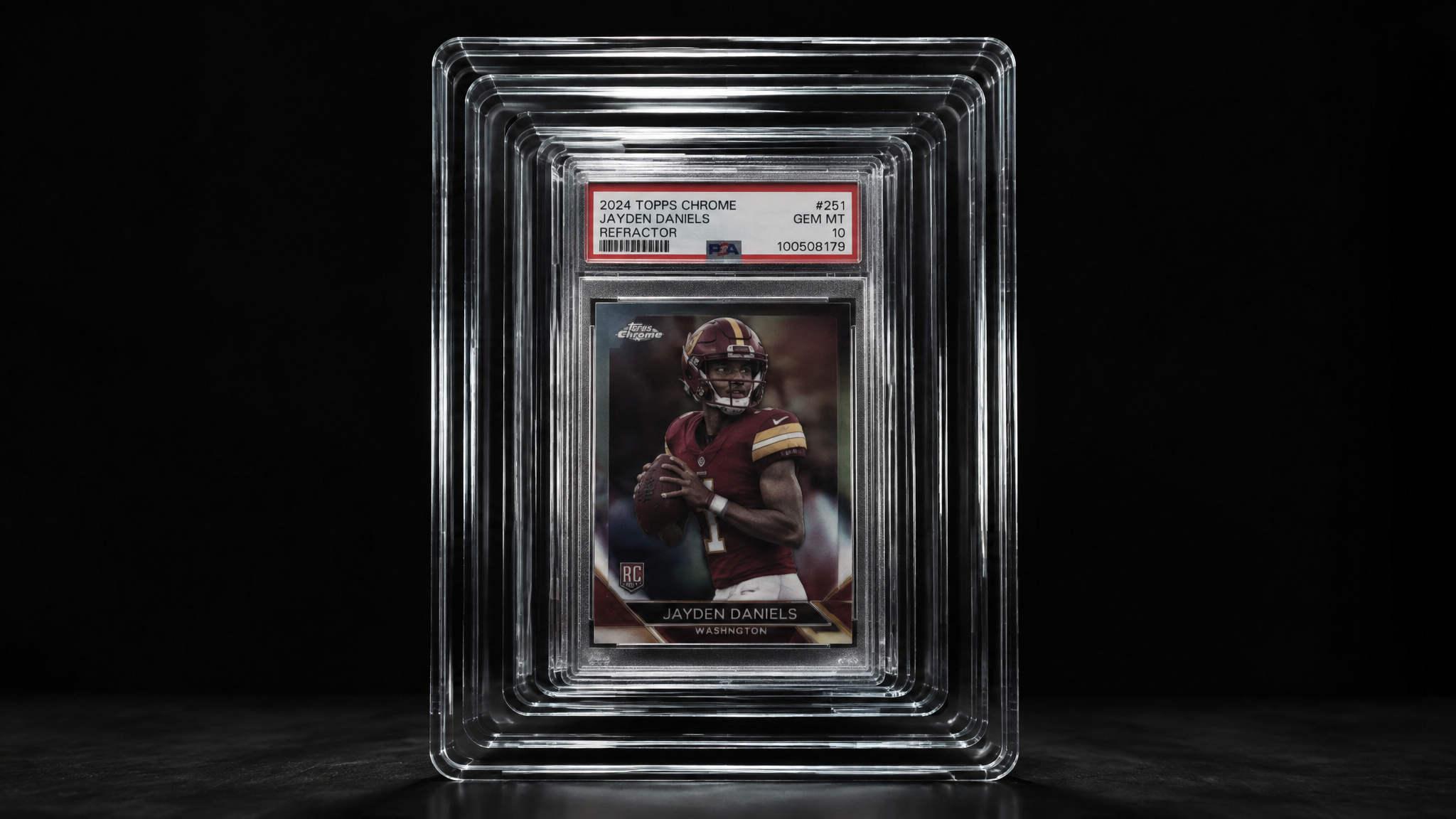
Here’s the thing about shipping collectibles: “it arrived” and “it arrived worth what it was” are two different outcomes. A comic shows up with one bent corner, a baseball card comes out of the mailer scuffed, a coin has a fresh scratch across the obverse. The object technically survived. The value didn’t.
If you’ve ever looked up how to ship collectibles, you’ve probably found a hundred “use bubble wrap” lists, and that’s not enough for stuff where condition IS the product, and it’s even trickier when the box is crossing borders, like when you rely on parcel forwarding from the US to UK and every extra transit leg is another chance for damage. What I found instead was closer to a packing architecture: a four-layer system with actual materials chemistry behind it, category-specific recipes with named products, and a claims process that’s decided before the box ever seals. So this is the whole sequence, end to end: assess the item, pick materials, pack by type, choose a carrier tier, set declared value, ship, track, and know the claims drill before you tape anything shut.
Key Takeaways
The four-layer packing system is sleeve or holder, rigid support, cushioning, outer box, and most shipping damage happens at corners, which is the rigid layer’s job.
Insurance and claims are won at packing time: declared value must be the selling price or fair market/replacement value, the sender files the claim, and the recipient must keep all packaging.
For furniture-scale collectibles like antique mirrors or lamps, The UPS Store offers blanket wrap, custom cartons, crating, shrink-wrapping, and palletizing, but call first since services vary by location.
Table of Contents
Assess your collectible before you pack
Before touching a box, you make three decisions that shape everything downstream: archival-safe or standard materials, DIY or professional packing, and domestic or international. The material call matters most because it’s irreversible. A non-archival plastic or adhesive pressed against a comic cover causes chemical damage that no insurance claim can undo. And note the value now, because the number you settle on here drives your insurance and, later, your customs paperwork.
Choose materials: the four-layer system and archival-safe plastics
The packaging that protects collectibles in transit is four layers: sleeve, rigid support, cushioning, outer box. That’s it. Everything else builds on this skeleton, which comes courtesy of Kira at ClearBags, whose packaging guide (last updated August 19, 2026) is a good bookmark.
The four-layer system
Layer 1 is the individual sleeve or holder, the thing touching the item. Layer 2 is rigid support, stiff material that keeps the item from bending. Layer 3 is cushioning. Layer 4 is the outer box or mailer.
Two pieces of physics make this click. First: anything that can move inside the box will find a way to break, so add padding until the shake test comes up silent. Zero play is the goal. Second: most shipping damage happens at corners, and that’s exactly what the rigid layer exists to absorb.
More bubble wrap isn’t the answer. Structure is.
Archival-safe materials
Not all plastics are equal over time. Polypropylene, BOPP, PET, and glassine protect against chemical deterioration, discoloration, and moisture. Generic PVC and acidic cardboard can chemically attack a collectible during a long transit, slowly, invisibly. Your packaging shouldn’t be poisoning your grail. And it’s worth knowing where that damage actually starts: most shipping damage happens at the corners, which is exactly what rigid support and a proper outer mailer are for. That’s the whole archival point, and it connects straight to money: minor damage is exactly what kills resale value.
Pack by collectible type
The four layers are the framework; here’s how each category fills them in.
Packing trading cards
Packing trading cards safely means starting with the card inside a penny sleeve, a cheap clear plastic sleeve that’s the universal first layer, and then sliding that into a toploader, the rigid plastic brick that stops bending, a semi-rigid holder works too if that’s what’s on hand. That’s the consensus stack, and both DHL’s collectibles guide and ClearBags agree on it. From there it splits by shipment size. Bigger lots: wrap the sleeved stack in bubble wrap and box it in something small and sturdy.
A single valuable card: sandwich it between two rigid pieces of cardboard, put it in a padded envelope, and label it Do Not Bend. The classic first-timer mistake is stopping at the toploader and dropping it alone into a padded mailer. The loader itself cracks in transit, and the tell is corner damage even though the card never touched the outer box.
Packing coins
Coins fail differently: scratches and oxidation, not bends. That’s why they go in coin flips (those cardboard pockets with clear windows) or rigid capsules, which stop both surface contact and air exposure. One coin per pocket, then bubble wrap and a sturdy box with zero rattle. One wonderfully specific detail: label temperature-sensitive finishes “Temperature Sensitive: 65-75º.” And if you’re sending precious-metal coins abroad, check the destination country’s import rules before you’re standing at the counter.
Packing comic books
Paper is unforgiving and bends are forever. Comics go in acid-free bags with backing boards, the rigid card that keeps them flat, because ordinary plastic can chemically hurt paper over time. Then it’s either a Gemini mailer (the cardboard sandwich envelope comic shippers swear by) or the DIY version: cardboard on both sides with bubble wrap, into a rigid envelope or box. Slap on Fragile and Do Not Bend labels.
And here’s the headline gotcha, said with full horror: adhesive must never touch the cover. Tape on a cover is instant, permanent value death, which is why storing collectibles without ruining them demands strict archival methods from bag to box.
Red flag: Any tape or adhesive touching a comic’s cover is permanent value loss — pack rigid supports so nothing sticky ever contacts the artwork.
Packing vinyl records
The enemy here is warping, and it’s preventable in three moves. Use a correctly sized LP mailer so the record fits snug, because sizing matters more than people think. The counterintuitive pro move: slide the record out of the jacket into an inner paper sleeve, then bag record and jacket together. That’s what prevents seam splits, where the jacket tears itself open on the disc.
Keep the whole thing flat and supported; heat plus pressure plus lean equals warp. For the paranoid tier, bubble-wrap the mailer inside a bigger box.
Packing action figures
Boxed versus loose are two different problems. For a boxed or mint-in-box figure, the box IS the collectible, so protect it like one: corner protectors, bubble wrap, snug outer box. Loose figures get individually wrapped with dividers so nothing touches anything else, plus a Fragile label. Figure-on-figure contact is the failure mode you’re eliminating.
And for a worked example of what “snug” actually means, check out SMR Collectibles on YouTube, whose How to Series (Series 03) demos shipping a baseball: wrapped, in a 4x4x4 inch box, business card included, label applied on the side. The exact dimensions are the lesson. That’s how little air a proper pack leaves.
Large, odd-shaped, and fragile items: mirrors, lamps, and antique furniture
Shipping antique furniture across the country calls for a different toolset entirely, and the honest answer is: the four-layer logic still applies, but the materials scale up. A mirror needs rigid faces on both sides, edge protection, and zero internal movement, exactly like a graded card needs its toploader. A lamp is a rigid-structure problem plus a shade that can’t take pressure. Antique furniture adds weight, weird shapes, and finish that can’t touch anything. The catch worth being upfront about: the sources behind this article give the framework extension but no mirror- or lamp-specific recipe, so treat this as architecture, not a parts list.

What the sources do give you is the professional tier, and it’s the fun overengineered list. The UPS Store, which is a franchise network rather than UPS corporate, offers five options for large and odd-shaped items:
- Blanket wrap
- Custom cartons
- Crating
- Shrink-wrapping
- Palletizing
Crating and palletizing in the same breath as “ship a statue” is exactly the kind of heavy-duty kit this topic deserves.
So when is crating worth it versus DIY double-boxing? The honest criteria, not fixed thresholds: how much the item is worth, how fragile it is, and how big and awkward it is. A sturdy dresser travels fine double-boxed or blanket-wrapped. A large antique mirror with original glass, or anything where a single cracked panel destroys the piece, is crating territory. The pattern is that the more the item’s value concentrates in one fragile component, the more you want a professional structure around it rather than padding.
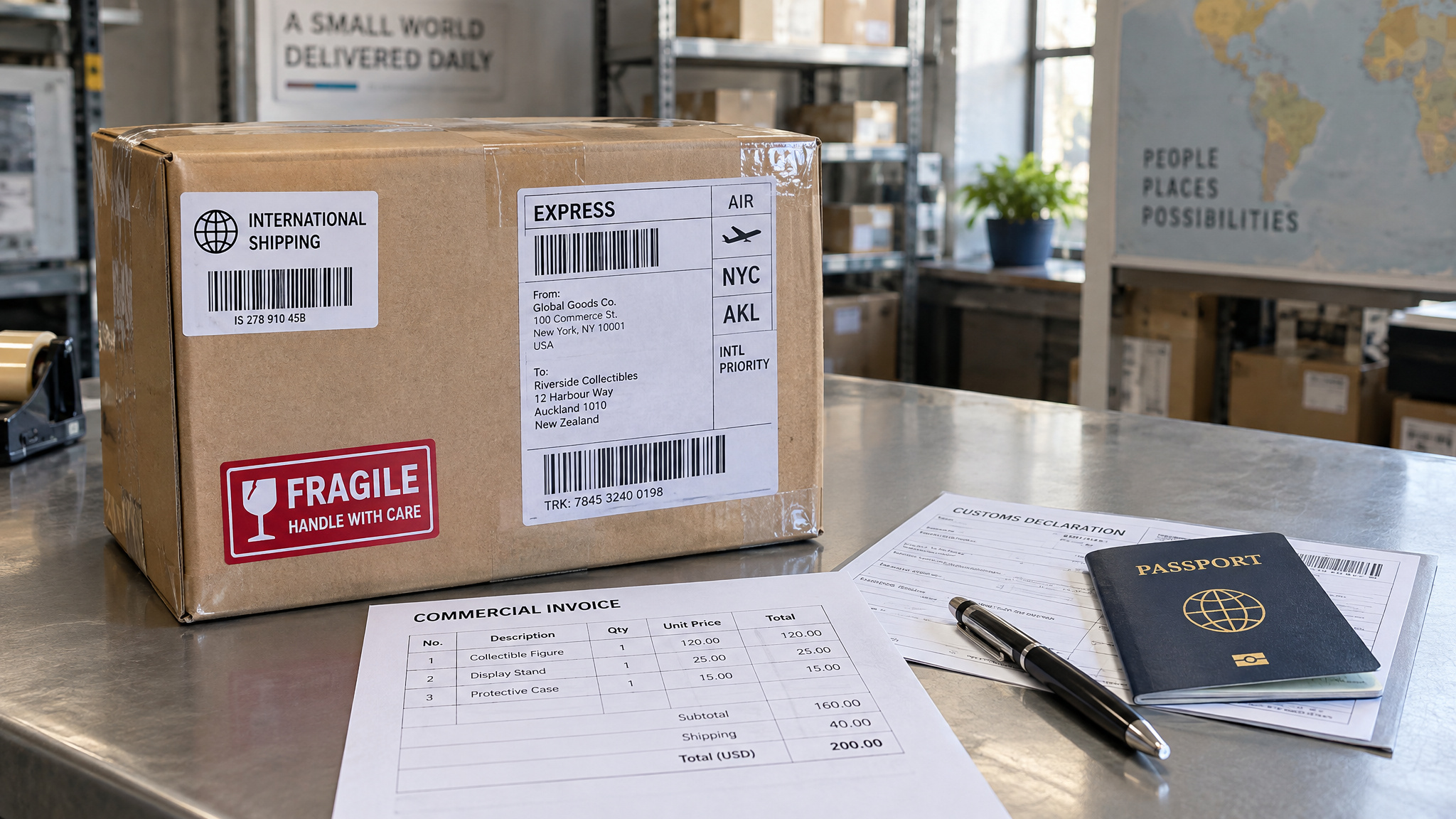
On cost, there are no fixed figures, and that’s not a dodge: each location is independently owned and prices individually. The actual cost drivers are size, weight, declared value, and service tier, so those are what move your quote. One more caveat: many, but not all, locations handle furniture-scale items. Call your local store first and ask. Two minutes on the phone beats finding out at drop-off.
Quick test: The more an item’s value sits in one fragile component — original mirror glass, a shade — the more you need professional crating over padding.
Should you pack it yourself or use a professional packing service?
Pack high-value or fragile collectibles professionally when the item’s value, fragility, or awkward size makes a packing failure more expensive than the service. It’s a three-option fork, not a binary. Option one is DIY with the four-layer system above, which works great for most cards, comics, and records, use the right supplies, wrap each item carefully, and label boxes clearly, much like a standard guide to safely moving collectibles would walk you through. Option two is professional packing: The UPS Store locations are staffed with packing professionals who secure items for shipment, and the real draw is less “enterprise service” than the maker friend who already owns the right foam.
Option three is the middle path most guides miss: bring your pre-packed box and have the packing experts assess whether a customer-packed package can withstand shipping stresses. A free sanity check, basically a code review for your box.
Gotchas, plainly: stores sell envelopes, boxes, bubble cushioning, and tape, but not carrier-branded supplies. Order those direct from the carrier so nobody shows up expecting free UPS boxes, and if you ship fragile or hazardous items, extra shipping tips for small businesses can help you confirm your carrier handles them safely and legally. And since every store is independently owned, prices and services vary, so call your local one. Subtle bonus: a professionally packed shipment slots neatly into the claims story, because “packed by the store” is documented the moment it happens.
Choose a carrier service level and get the package into the network
Delivery time depends entirely on the service you buy: UPS Next Day Air, 2nd Day Air, 3 Day Select, Ground, and others. The reframe worth making: speed is a risk decision, not a price dial. Fewer transit days means fewer handling events for a fragile box, and every handling event is a corner-damage opportunity. So Next Day Air is “I need it there tomorrow” and also this box should be touched as little as possible; Ground is the sensible default for less fragile hauls. One honest note on the “UPS or FedEx for art?” question: this article’s sources cover UPS and DHL mechanics, so I’ll leave you with reputation shorthand at most rather than a benchmark I can’t back.
Holiday shipping days vary by location, and UPS publishes a holiday schedule worth checking before the December panic sets in.
Drop-off, pick-up, and pre-manifested packages
Getting the box into the network is easy: UPS Stores are approved UPS drop-off locations, and pre-manifested packages (label already printed) just get scanned and go. The store itself doesn’t do scheduled pick-ups, and here’s the weird edge case: some locations offer residence or business pick-up and pack-and-ship, but can’t pick up pre-manifested packages. Sure. Why not. Mailbox holders can have shipments held for pick-up, with storage fees possibly applying.
Insure, declare value, and document before the box seals
Insuring a valuable collectible shipment starts with accurate declared value, and the core idea is simple: the claim is won before the box ships. Most guides treat insurance as a checkout add-on. Treat it as a packing-time decision instead, because three things happen while you’re still holding the tape.
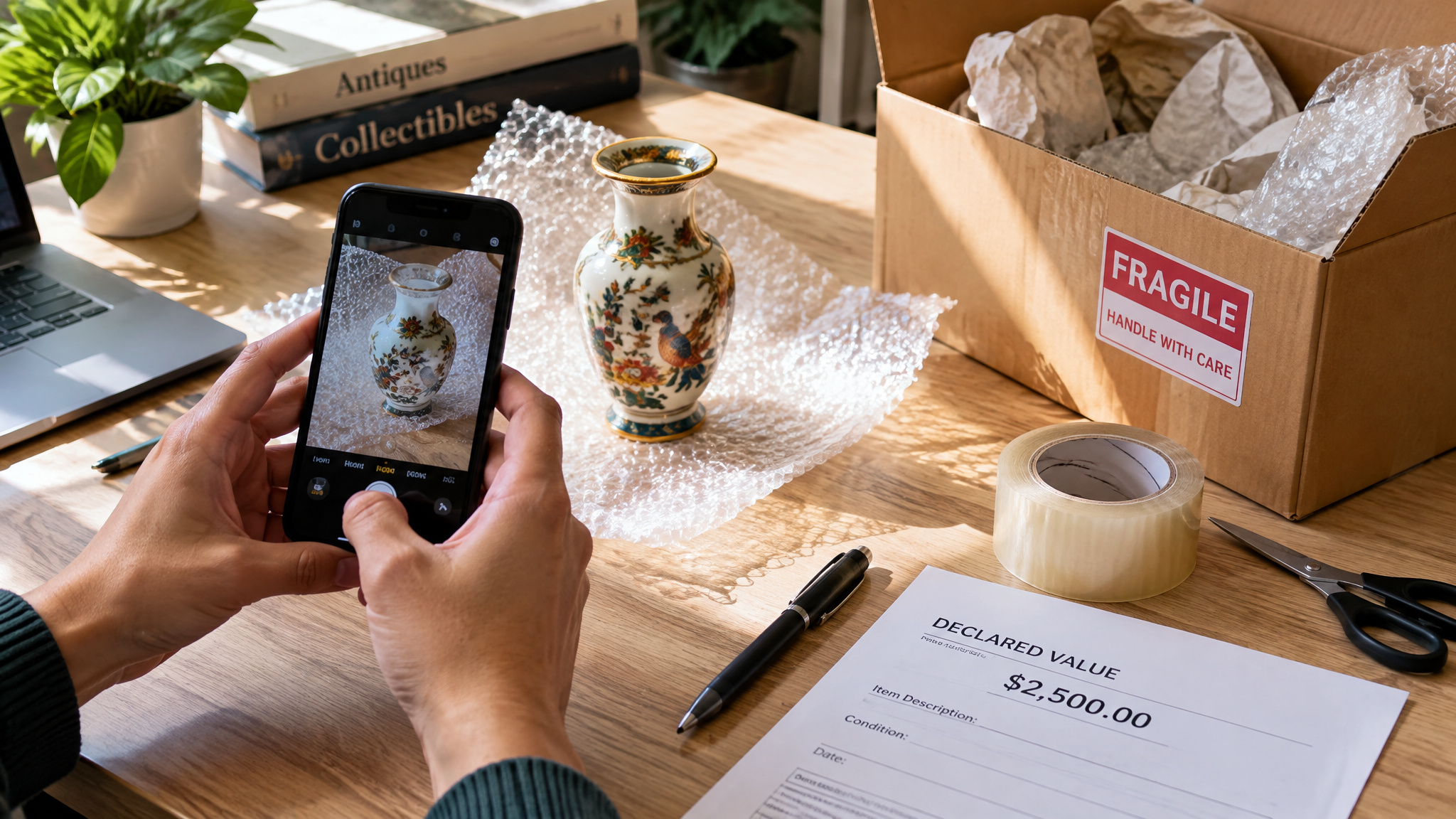
First, declared value. Every carrier has a declared value program, and prices vary by location. The rule to keep exact: the declared value must be the selling price, or the fair market or replacement value if the item wasn’t sold. Not a guess, not a lowball to save on fees.
For high-value collectibles, DHL Express offers optional insurance. One honest number solves two problems at once: liability coverage and customs compliance.
Second, know the claims process before anything goes wrong. The sender, not the recipient, initiates a damage or loss claim, immediately, through the shipping location. And the recipient must retain all packaging material for the carrier’s investigation. Yes, the hoarder instinct is correct here; this is its moment.
The carrier investigates and may or may not approve, no promises. The recurring failure pattern is painful and predictable: the recipient finds damage, contacts the carrier directly, learns the sender has to file, and by then the packaging is in the dumpster. Claim stalled. The sender is the store’s customer, which is why recipients get routed back through them.
Third, document. Photo or video the item and the packing process as you go. This one comes from the broader shipping community rather than official carrier guidance, but the logic is sound: it’s claim evidence captured at the exact moment condition is provable. Photos of the item, proof of value, the tracking number, notes on the packing. Boring to make, priceless later.
One more mechanism worth knowing: the UPS Guaranteed Service Refund. For eligible late shipments, the shipping location can submit a refund request, and refunds go to the sender up to UPS retail rate for shipping charges (retail accessorial rate for refundable options). The check can be mailed to the sender’s address or the store’s. The fine print that bites in December: service guarantees may be suspended during holidays. Never bank on the refund until it’s paid.
Track your shipment and control it in transit
If tracking stalls or the package seems lost, contact the shipping location (for store shipments) or the carrier directly. Store headquarters can’t see your shipment details, because each location is independently owned, which is exactly why the store, not the 1-800 number, is your escalation path. The boring habit that saves you: record the tracking number for every shipment. Collectibles are hard to replace, and that number is your only thread if things go sideways.
Once it’s moving, UPS online tracking needs the tracking number, and delivery notifications support up to three email addresses plus one optional short message, which is a oddly delightful level of specificity. DHL’s MyDHL+ gives real-time tracking to both shipper and customer, so you and your buyer can watch the grail cross the country together. Half the fun.
And for sold-to-wrong-buyer moments: UPS Delivery Intercept is a fee-based feature that lets the shipper redirect a package before delivery, with four actions: send it back to the sender, route it to a different address, reschedule the delivery, or hold it for will call. Address changes and re-routing go through the shipping location or the carrier, not a self-serve button.
Ship collectibles internationally
A compliant international shipment starts with a detailed Commercial Invoice (or a Proforma Invoice for non-sale shipments) with accurate descriptions, and that’s where the paperwork surprises people. The nuance that trips everyone: sample lines like “Collectible trading card, no commercial value” or “Used comic book for personal collection” can seek preferential duty treatment, but the declared value must still be the selling price or fair market/replacement value. Those lines are copy-paste help, not a loophole.
The recurring cross-border mistake, as a pattern: writing “gift, no commercial value” on a valuable collectible to spare the buyer duties. That conflicts with declared-value requirements and can undermine both your insurance and the customs clearance. Vague descriptions get packages stuck in customs, which is where cross-border collectible shipments go to die.
Also worth knowing before you ship: some countries restrict precious-metal coins (legal tender and antiques both come up), and certain comics or trading cards get flagged for cultural, political, or content reasons. Import duties are assessed on declared value, and who eats the cost depends on the shipping terms. Five minutes reading the destination country’s shipping guidelines beats a seized package, and duty/tax calculator tools exist if you want a cross-border estimate before you commit.
The whole system is the sequence: assess, four layers, category recipe, carrier tier, declared value, tracking number saved. Every decisive act happens before the box seals, not somewhere in transit. Pack like the shake test has to come up silent, document while you can still prove condition, and the worst thing that happens is a late delivery.
One last flavor note, because collecting culture is gloriously weird: Disney Cruise Line sells blind-boxed mini funnel pieces, one of eight. People are shipping those with the same care as a $4,000 statue, and honestly, respect.
Frequently Asked Questions
Is shipping yourself in a box legal?
That’s outside what standard collectible shipping guidance covers — carriers have rules against shipping people, and it’s not a legitimate option. For anything valuable, the real question is how to pack it so condition survives transit, which is what the four-layer packing system is for.
What is the cheapest way to ship a lot of stuff?
For bulk lots of collectibles like trading cards, wrap the sleeved stack in bubble wrap and box it in something small and sturdy — less air means less internal movement and lower dimensional weight. UPS Ground is the sensible default for less fragile hauls because it’s slower but cheaper. Just remember speed is a risk decision: fewer transit days means fewer handling events, so don’t cheap out on genuinely fragile items.
Is UPS or FedEx better for shipping art?
A fair comparison needs benchmarks the available guidance doesn’t back, so reputation shorthand is as far as it goes. What is solid: The UPS Store (a franchise network, not UPS corporate) offers blanket wrap, custom cartons, crating, shrink-wrapping, and palletizing for large and fragile pieces like mirrors and lamps. Since each location is independently owned, prices and services vary, so call ahead.
What is the safest way to ship comic books and vinyl records?
Comics go in acid-free bags with backing boards, then into a Gemini mailer or a DIY cardboard sandwich with bubble wrap, labeled Fragile and Do Not Bend — and adhesive must never touch the cover, because tape on a cover is instant, permanent value loss. Records need a correctly sized LP mailer, with the record slid out of the jacket into an inner paper sleeve to prevent seam splits. Keep records flat and supported, since heat plus pressure plus lean equals warp.