
There’s a moment in every crypto conversion where the screen asks you to trust a number. You’ve typed in your ETH, the quote comes back, and somewhere near the confirm button it says 0% fee. Free money plumbing! Except the fee didn’t disappear.
It moved inside the exchange rate, where nobody grades it. Or take the other classic: you set out to buy Bitcoin, swap Ethereum for it in your own wallet, enjoy a brief glow of self-custody satisfaction, and later notice the balance reads WBTC. You don’t hold Bitcoin. You hold a Bitcoin-shaped token living on Ethereum.
This guide covers how to convert ETH to BTC three ways: a one-click convert on a centralized exchange, a two-hop spot trade through a stablecoin, and a self-custody wallet swap. Two traps run through all of them: spreads hiding inside zero-fee quotes, and wallet swaps that hand you Wrapped Bitcoin when you expected the real thing.
Key Takeaways
Bybit Convert charges zero fees, quotes the final rate, and locks it for 15 seconds after you confirm, but the spread sits inside that rate and no converter page publishes the number.
The Trust Wallet swap runs on the Ethereum network, so the output is Wrapped Bitcoin (WBTC), not native BTC; unwrapping to real Bitcoin is a separate later step.
At capture, 1 BTC ? 30.845 ETH and 1 ETH ? 0.0324 BTC, so 3 ETH was worth about 0.097 BTC; verify a quote’s rate direction before confirming, because live converter pages have shipped mislabeled reciprocals.
Table of Contents
Three ways to convert ETH to BTC
The decisive difference between the three routes isn’t fees. It’s custody. Custodial means the platform holds your keys; non-custodial means you hold your own private keys, with all the control and responsibility that implies.
Exchange convert is one click and fully custodial: the platform holds your assets before and after the trade. Bybit’s Convert is the example here, advertised with zero fees, no slippage, and a single quoted rate covering everything. Spot trading, ETH to USDT then USDT to BTC, is also custodial but with transparent maker fees from 0.1% per hop. The wallet swap keeps you in control the whole time, and here’s the caveat most tutorials bury: because the swap executes on the Ethereum network, the output is Wrapped Bitcoin, not native BTC.
So: convenience plus custody, transparency plus custody, or control plus a wrapped asset. Pick deliberately.
Method 1: Convert ETH to BTC on Bybit Convert
Yes, converting on Bybit is free as advertised: zero fees, no slippage, and one quoted rate with nothing added afterward. If you want one-click simplicity and you’re okay with the platform holding your keys, this is the route.
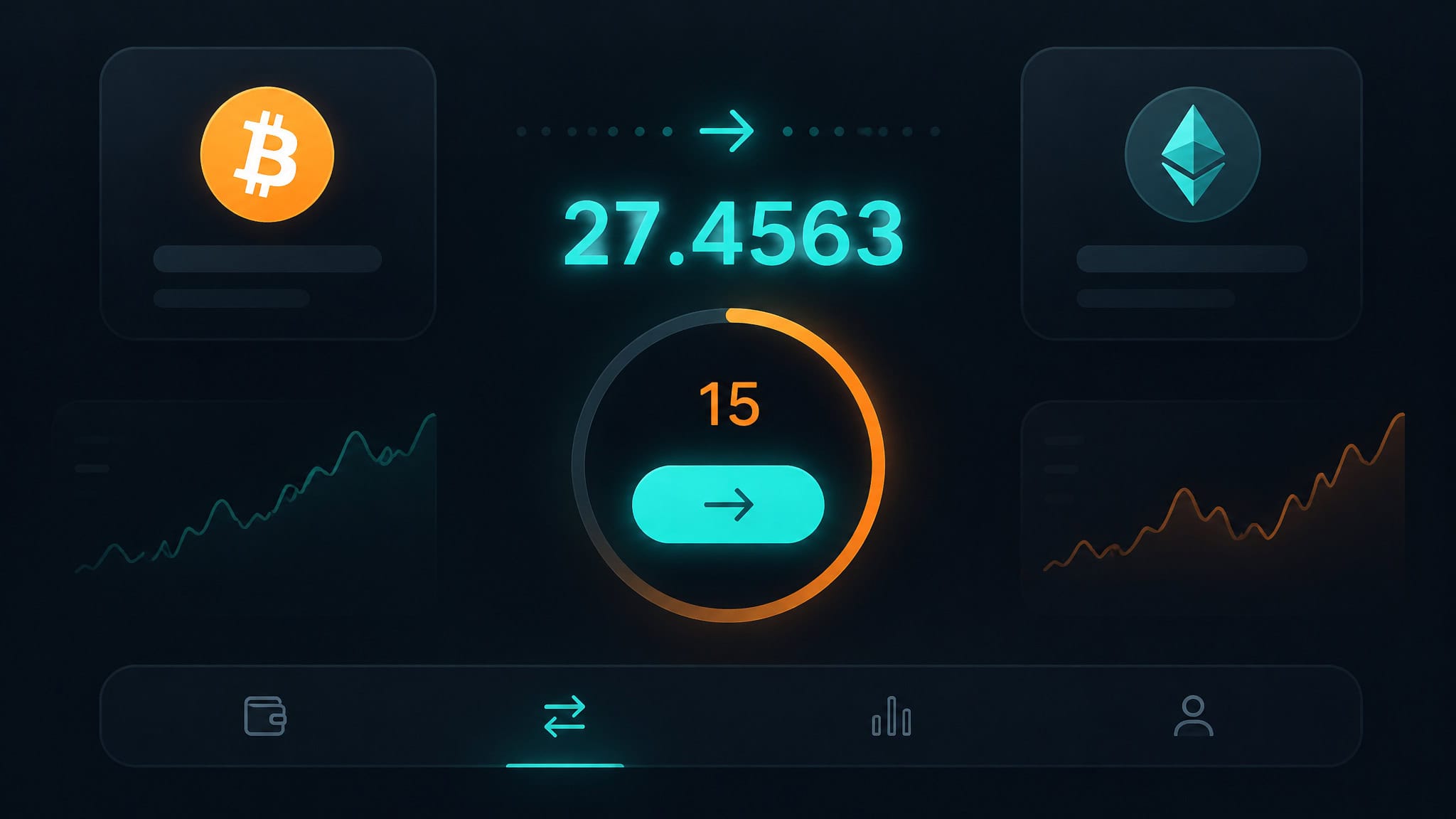
The mechanics are short. Deposit ETH, open Convert, select ETH to BTC, enter the amount. When you confirm, the platform locks your rate for 15 seconds, which is a satisfying piece of engineering: the number you agreed to is the number you get, even while the market keeps moving underneath it. Quotes come from aggregated market-maker pricing in real time, so the rate reflects live order books rather than a stale calculation. Coverage is broad: 350+ cryptocurrencies and 40+ fiat currencies.
The honest caveat: the spread sits inside the quoted rate. The real cost is the gap between the quote and the live market, and no converter page publishes that number. At capture, 1 ETH quoted around 0.0324 BTC. Sanity-check the rate direction before you confirm; we’ll come back to why that matters.
- ## Method 2: Spot trading route, ETH
- USDT
- BTC
This is the transparent-fee option: sell ETH for USDT, then buy BTC with the USDT. Two hops, maker fees from 0.1% each, deep liquidity on the BTC/USDT pair. Where Convert is an automatic transmission, spot is manual gears: more clicks, more control, and a fee schedule you can read.
The quantified tradeoff: convert wins on simplicity, spot can win on price when the embedded convert spread exceeds roughly 0.2% in total trading fees. Here’s the catch, stated plainly: no source discloses the convert spread percentage, so nobody can print the exact crossover point. The practical test is comparing outputs. If the convert quote’s BTC output looks worse than what the spot math implies, route through spot. Two hops at 0.1% each is 0.2% total in known fees; anything the convert quote delivers below that benchmark is costing you more than it admits.
Quick test: Compare the BTC output from the convert quote against the spot math; if convert delivers less than the 0.2% known-fee benchmark, route through spot.
| Route | Fees | Custody | What you receive |
|---|---|---|---|
| Exchange convert | Zero stated (spread inside the rate) | Custodial (platform holds keys) | Native BTC |
| Spot, ETH ? USDT ? BTC | From 0.1% maker per hop | Custodial (platform holds keys) | Native BTC |
| Wallet swap | Ethereum network gas | Non-custodial (you hold keys) | Wrapped Bitcoin (WBTC) |
If you’re starting from Binance or another major exchange instead, the playbook is the same: find the convert tool or route through the stablecoin pair. Only the menu labels change.
One side door worth a line: if you need to fund the exchange first, Bybit supports BTC purchases via bank card, bank transfer, or P2P trading in 60+ currencies, with P2P advertised at zero fees, plus One-Click Buy and Crypto Deposit for funding with crypto you already hold. Those fee claims are the platform’s own advertising, not independently verified. And a fun aside from the spot menu: it runs from BTC/USDT to a TSLAUSDT tokenized-stock-style pair. Huh, neat.
Method 3: Swap ETH to BTC in Trust Wallet (you get Wrapped Bitcoin)
Yes, you can swap ETH to BTC in Trust Wallet. The prerequisite to understand before you tap anything: the output is Wrapped Bitcoin, because the swap executes on the Ethereum network. Ethereum can’t mint native Bitcoin; the only BTC-flavored thing it can hand you is a wrapped token. The good news: wrapped tokens can be unwrapped at any time and swapped for native Bitcoin, so you’re not locked into WBTC forever.

The click path, in order. Swap lives right on the home screen, no digging through menus. Tap it and the screen opens on “Swap and Exchange”, which is apparently the default even though you want plain “Swap”, so toggle over; a small UI quirk that feels like every settings page that opens on the tab you didn’t need. Select Ethereum as the input token.
Then type BTC and pick Wrapped Bitcoin as the output. This is the step that trips people up, so slow down here: grab the wrong output and you’ll end up holding something other than what you intended, and the wallet won’t stop you. Enter the amount, hit Swap. That’s the whole flow.
If your wallet holds enough ETH, the swap completes and you’re holding WBTC. So what is that, exactly? Wrapped Bitcoin is Bitcoin that lives on Ethereum. Think of it as the Bitcoin asset wearing an Ethereum-compatible interface: it tracks the underlying thing, but it’s on a different network with a different redemption path. The good news is you’re not locked in, wrapped tokens can be unwrapped at any time and swapped back for native Bitcoin, so the wrap is a detour, not a dead end.
Wrapped tokens can be unwrapped at any time and swapped for native Bitcoin, so the wrap is a detour, not a dead end. Unwrapping is a separate later step with its own custody implications, so treat it as its own task rather than a footnote.
What WBTC is not: identical to native BTC, and not interchangeable everywhere. They’re different assets with different redemption paths. It’s also not a scam; it’s a deliberate design consequence of running the swap on Ethereum. Know which one you’re holding and you’re fine.
Why your swap might fail: the insufficient balance error
Swaps fail at confirmation when your ETH doesn’t cover the swap amount plus the network cost. That’s the whole failure mode, and it’s the one Trust Wallet’s own tutorial presenter hit on camera, so it’s a documented pattern rather than a bug. For timing contrast: exchange converts lock your rate for 15 seconds once you confirm, so the failure window there is basically nil.
The documented case study is refreshingly honest: in Trust Wallet’s own tutorial video, the presenter ran the ETH to BTC swap on their own wallet and got an “insufficient Ethereum balance” error, on camera. Not a hypothetical, an actual failed demo in the official walkthrough. The fix is exactly what the error says: hold enough ETH to cover the swap amount plus gas. We won’t invent specific gas numbers since they move with network conditions, but the precondition is simple. Your money moves when your balance actually covers it.
What “zero fees” actually costs: the $1000 platform comparison
Fee labels don’t tell you what you’ll pay. The BTC received for a fixed input does. So here’s the bench test: $1000 into BTC, seven platforms, same input, different outputs. All figures are capture-time snapshots with unstated page dates.
| Platform | BTC for $1000 | Stated fee |
|---|---|---|
| Bleap | 0.011839 | none (“Best value”) |
| Tokenbase | 0.011698 | 2.00 ETH |
| Slope | 0.011606 | none |
| SaturnPay | 0.011583 | 2.00 ETH |
| Bonanza | 0.011547 | 5.00 ETH |
| Crypto.xyz | 0.011547 | 5.00 ETH |
| Next | 0.011547 | 5.00 ETH |
Read the spread: stated fees of 2.00 or 5.00 ETH swing the output by roughly 0.0003 BTC on the same $1000, and Slope charges nothing yet still returns less than Bleap, which is the entire argument against trusting a fee label. Two honest caveats. First, this is one snapshot at one rate and one amount, not a universal ranking. Second, a source-hygiene note we can’t resist flagging: this Crypto.com/Bleap comparison content appeared on a Bybit URL, and one table row labeled “1 BTC = 0.032051 ETH” is actually the reciprocal, about 0.032 BTC per ETH. The numbers still speak for themselves; the labeling just needs a careful eye.
How to read the ETH to BTC rate (and catch a mislabeled quote)
Using an ETH to BTC converter is two steps: enter the amount, read the equivalent at the live rate. Here’s the part worth slowing down for: check which direction the rate runs before you trust it.
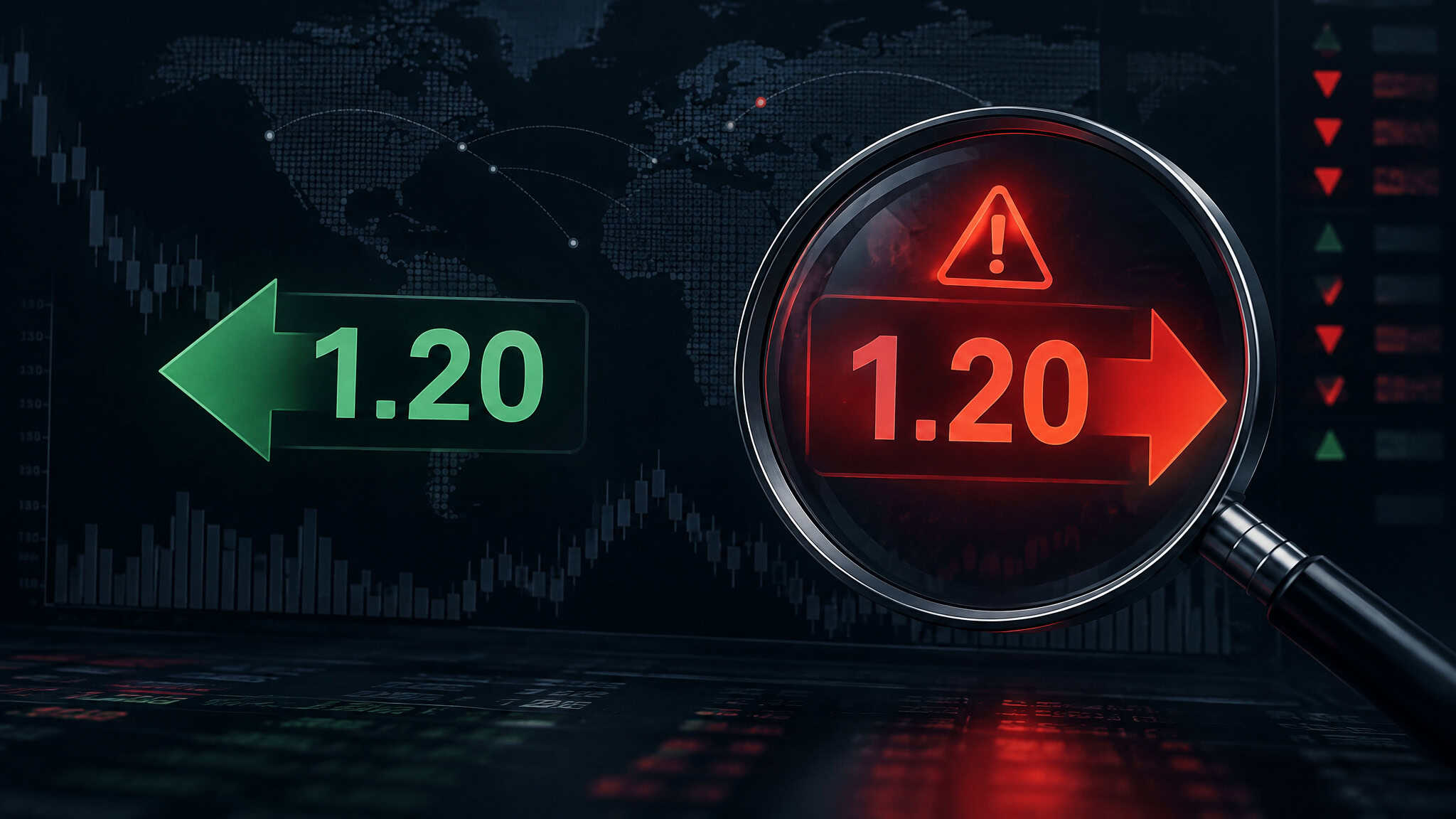
At capture, 1 BTC ? 30.845 ETH and 1 ETH ? 0.0324 BTC. Those are reciprocals, and live pages have mixed them up. Documented examples: a comparison table listing “1 BTC = 0.032051 ETH”, which is the ETH-per-BTC figure wearing the wrong label (the true rate is about 30.845 ETH per BTC), and page copy presenting “1 BTC = $30.84 USD” when BTC actually traded at $84,398. A quote accepted in the wrong direction can be orders of magnitude off market, so check it against a known BTC price before confirming. We’re describing a pattern observed on live converter pages, not one platform’s permanent habit.
Red flag: If a quote’s rate direction looks off by orders of magnitude, check it against a known BTC price before confirming.
Quick reference ladder, at the same capture rate:
| ETH | BTC |
|---|---|
| 0.001 | 0.00003242 |
| 0.01 | 0.00032421 |
| 0.1 | 0.00324207 |
| 1 | 0.0324 |
| 5 | 0.1621 |
| 10 | 0.3242 |
| 100 | 3.24 |
Worked example: 3 ETH ? 0.097 BTC at that rate. Every figure here is a snapshot that ages instantly; rates update in real time from aggregated market-maker quotes, so treat the ladder as mental math, not a quote.
Choosing a platform: licensing, reserves, and custody
Judge a platform by three verifiable criteria, not reputation vibes: the named legal entity and its regulator, what the license actually covers, and how reserves are verified.
Concrete anchors. Foris DAX MT Limited, trading as Crypto.com, is authorized by the Malta Financial Services Authority as a Crypto-Asset Service Provider under MiCA (Regulation 2023/1114), with six authorized services including crypto-to-crypto exchange and custody. That tells you what’s actually regulated, which beats a trust badge. Bybit states that user reserves are held 1:1 and verified monthly via on-chain Merkle proofs; a Merkle proof is on-chain math that lets anyone independently check the reserve claim against the blockchain, which is the kind of trust signal you can verify rather than vibe-check. On the custody side, Bleap pairs a non-custodial MPC wallet, where you keep control of your funds, with a connected Mastercard for spending.
One honesty beat, because fine print is the house beat: other products advertised on these pages come from other group companies and fall outside those regulated services. The license covers what it covers.
Safety checklist: addresses, networks, and taxes
ETH cannot be sent to a native BTC address; incompatible networks mean permanent loss, and wrapped routes like WBTC exist precisely because of that wall. Swaps fail at confirmation when your balance doesn’t cover the amount plus the network cost, as covered above. Converting ETH to BTC can count as a taxable disposal depending on your jurisdiction, so check local rules; no jurisdiction-specific guidance here. And the plain-voice version of the disclaimer: crypto is risky and not for everyone, and last year’s chart promises nothing about tomorrow.
What you’ll hold: Bitcoin in context
Whether to convert now is a risk-tolerance call, and we’re not making it for you.
Bitcoin (BTC) was the first decentralized cryptocurrency, created in 2009 by the pseudonymous Satoshi Nakamoto, and pitched in its original writeup as peer-to-peer electronic cash that works without banks. Supply is tight: circulating and total supply both sit at 20,090,790 BTC, close to the 21 million cap. Price context, all snapshot figures with unstated capture dates, so your mileage may vary: $84,398, up 1.27% over 24 hours, down 1.86% for the week, up 7.19% over 30 days.
The all-time high was set on October 6, 2025 at $126,080; the all-time low was $67.81 on July 5, 2013. From $67.81 to $126,080 is a real range, and it cuts both ways: the same asset that lost 99.9% once also ran to six figures.
If you do convert and hold, Bybit offers Earn products for holding BTC and TradeGPT, a feature that surfaces market insights and live BTC/USD analysis. They’re options, not recommendations.
Which route should you use
Two things decide it: where your keys should sit, and whether the quoted output beats the spot alternative. Exchange convert for speed if platform custody is acceptable. Spot when the convert spread looks worse than about 0.2% in total fees. Wallet swap when self-custody matters, accepting WBTC and a possible unwrap later. And compare the BTC you’d actually receive, never the fee label.
Frequently Asked Questions
How to switch from ETH to BTC on Coinbase?
The playbook is the same across major exchanges: find the convert tool and select ETH to BTC, or route through the stablecoin pair by selling ETH for USDT (or USDC) and buying BTC with it. Only the menu labels change between platforms. Compare the BTC output you’d actually receive rather than trusting a zero-fee label, since the spread can hide inside the quoted rate.
Is it safer to swap ETH to BTC on a centralized exchange or in a self-custody wallet?
It depends on where you want your keys to sit. Exchange converts and spot trades are custodial — the platform holds your assets before and after — while a wallet swap keeps you in control the whole time. The wallet swap trade-off is that you receive Wrapped Bitcoin, not native BTC, and unwrapping is a separate later step with its own custody implications.