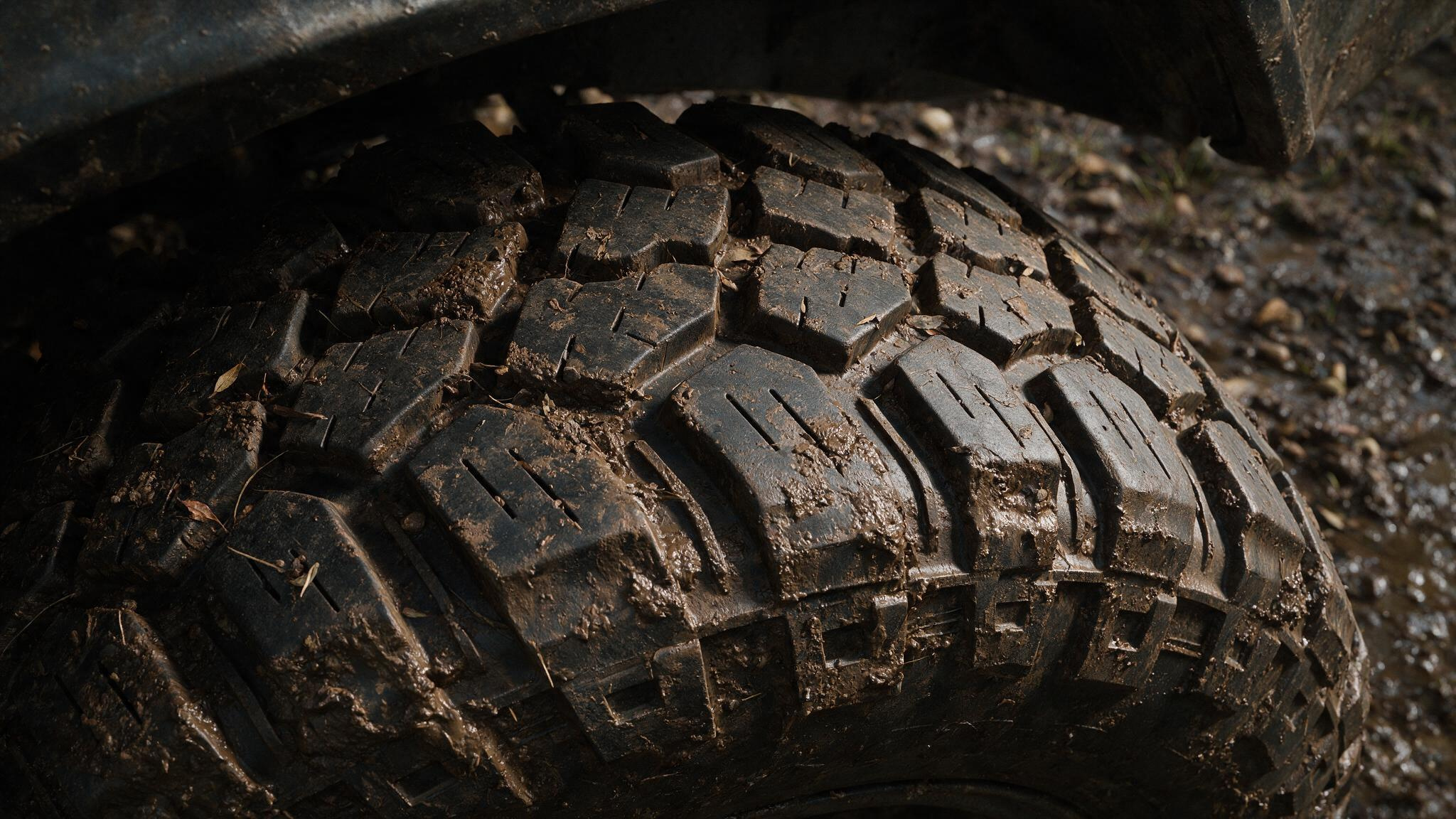
You’re staring down a gravel access road that turns into a dirt track, and you know the campsite is another two miles of loose rock and rutted clay. Your daily driver is a crossover with highway tires. That’s a problem. An all-terrain tire is the thing designed to make that problem disappear—but the engineering behind it is a fascinating stack of compromises.
One tire has to grip smooth pavement at 70 mph, crawl over wet rocks, shove through mud, and still let you stop in light snow. It can’t be best at any single job. It has to be good enough at all of them. The solution started in 1976 with the BFGoodrich Radial All-Terrain T/A—the first tire that deliberately sat between the highway-touring world and the knobby, noisier world of mud-terrains.
Key Takeaways
All-terrain tires use blocky tread patterns, sipes, and coupling joints to generate biting edges on loose surfaces while keeping enough rubber contact for paved roads—but that same geometry creates highway hum and packs mud in heavy clay. mud in heavy clay.
Rubber compounds in most AT tires stiffen below 44-50°F: at 40 mph on snow, AT tires need about 56 meters to stop, versus 39 meters for a dedicated winter tire—a 44% gap that the 3PMSF rating alone doesn’t reveal because the test only measures acceleration.
Sidewall construction (ply rating, reinforced shoulders, features like Sidebiters) determines how low you can air down off-road: tires like the BFGoodrich KO2 are designed for 10-15 psi operation, while a high-ply Voyager A/T can carry over 4,000 pounds on a light truck but rides stiffer on the daily commute.
Table of Contents
The Mechanical Heart of AT Tires: Tread Design
An all-terrain tire’s surface looks like a cross between a street tire and a monster truck mudder—chunky blocks separated by deep grooves.
Tread block shape and spacing: how biting edges work
Those big interlocking blocks create edges that dig into rocks, gravel, and dirt when the tire rotates. On pavement, the same blocks flatten out enough to maintain a reasonable contact patch—they’re not as smooth as a highway tire, but they don’t vibrate like a mud-terrain either. The spacing between blocks is the dial. Tighter gaps give you more biting edges but trap mud, turning the tire into a slick the second the goo packs solid.
Wider gaps self-clean better but increase noise and reduce pavement grip.
In wet clay, the tread packs tight, the tire stops flinging mud, and the truck stops moving forward. That’s the packing limit—the open space between blocks is gone, and you’re riding on a layer of grease.
Sipes and their role in snow and wet grip
Sipes are tiny slits cut into the tread blocks. When a block hits a slippery surface, the sipes let the rubber flex independently, creating more surface area that can bite into ice or wet pavement. The General Grabber A/TX uses multiple sipes to keep tread blocks connected to the ground on uneven terrain. Mud-terrain tires typically skip sipes because they rely on wide-open, self-cleaning tread patterns instead—their design priority is purging muck, not hugging ice.
Coupling joints and noise reduction tradeoffs
Some AT tires add small rubber bridges between the outermost tread blocks and the center blocks. Nitto calls them coupling joints on the Terra Grappler G2. Those joints stiffen the tread, reducing the flapping that creates low-frequency rumble. The tradeoff?
You lose a little bit of independent block movement, which can reduce grip in extreme rock crawling.
Even with coupling joints, AT tires are louder than touring tires. Their block patterns create symmetrical grooves that produce air turbulence noise—a constant hum that gets louder at highway speed. Variable-pitch tread patterns (common on high-end road tires) break up that sound by using different-sized blocks so air waves cancel each other. AT tires mostly don’t do that because the block size is driven by traction needs, not acoustic engineering.
Rubber Compounds: The Temperature-Responsive Grip Element
All-terrain compounds have a hard threshold: 44-50°F. Above that, the rubber stays pliable—good grip on pavement and dirt. Below it, the compound stiffens up, and you lose traction.
A dedicated winter tire uses a softer compound that stays flexible down to well below 32°F. The difference in braking distance is 17 meters. At 40 mph on snow, an AT tire needs about 56 meters to stop. A winter tire stops in 39 meters.
That’s a 17-meter gap—four car lengths. And the 3PMSF (Three-Peak Mountain Snowflake) rating you see on many AT tires? It only tests acceleration in medium-packed snow. It doesn’t measure braking or cornering. So that little mountain-snowflake icon means “this tire passed a snow-acceleration test,” not “you can stop like a winter tire.”
Winter-rated AT tires (like the KO2, Toyo Open Country A/T III, or Falken Wildpeak A/T Trail) modify the compound to stay a bit more flexible in cold weather. They are a step up from an M+S rated tire, but they are still a compromise. If you live where temps drop below freezing and the roads stay snowy, dedicated winter tires are the safer choice. If you’re in a temperate climate with occasional cold snaps, a 3PMSF-rated AT is fine.
Sidewall Construction: Load Capacity and Air-Down Capability
Drop from street pressure (around 35 psi) to 10-15 psi for sand or rocky trails, and the tire’s contact patch gets longer, spreading the vehicle’s weight over more surface. That prevents sinking into soft sand and gives the tread more edges to grab onto rocks. But at low pressure, the sidewall takes the brunt of the load. If it’s not stiff enough, the bead can separate from the rim.
This is where ply rating matters. Higher ply numbers (like 10-ply on the Groundspeed Voyager A/T) mean more layers of cord reinforcement. That increases load capacity—light trucks can carry up to about 4,000 pounds on AT tires; pickup trucks can go up to about 6,000. It also adds puncture resistance when you are scraping against rocks or running over sharp gravel. The downside: stiffer sidewalls transmit more road imperfections, so the ride on pavement gets harsher.
Manufacturers build specific features into sidewalls to handle low-pressure abuse. BFGoodrich puts Sidebiters (reinforced shoulder rubber) on the KO2. Mickey Thompson’s Baja Boss A/T uses deeper Sidebiters and tougher cords. The Yokohama Geolandar G015 uses Endurocore construction for heavy loads.
An off-road setup involves airing down to 10-15 psi—not all AT tires have sidewalls capable of supporting the vehicle at those pressures without risking bead separation. Tires with higher ply ratings and dedicated reinforcement handle it better.
Snow Performance: What the Ratings Actually Mean
Here is what the common ratings tell you.
- M+S (Mud + Snow): This is a self-certification. The manufacturer claims the tire has tread pattern and compound suitable for light snow and mud. No government test. It’s the minimum bar.
- 3PMSF (Three-Peak Mountain Snowflake): The tire passed an acceleration test on medium-packed snow. It’s a standard, but it doesn’t test braking, cornering, or ice. It means the tire can get you moving in snow—not “the tire can stop you in snow.”
- Winter tire: Designed with a compound that stays soft below 32°F, deeper sipes, and often a tread pattern optimized for snow and ice. Stops in 39 meters at 40 mph on snow.
The AT braking gap—56 meters versus 39 meters—is not small. If you drive in areas with winter, a 3PMSF-rated AT tire is a compromise that works for light snow and plowed roads. For severe conditions, you want winter tires.
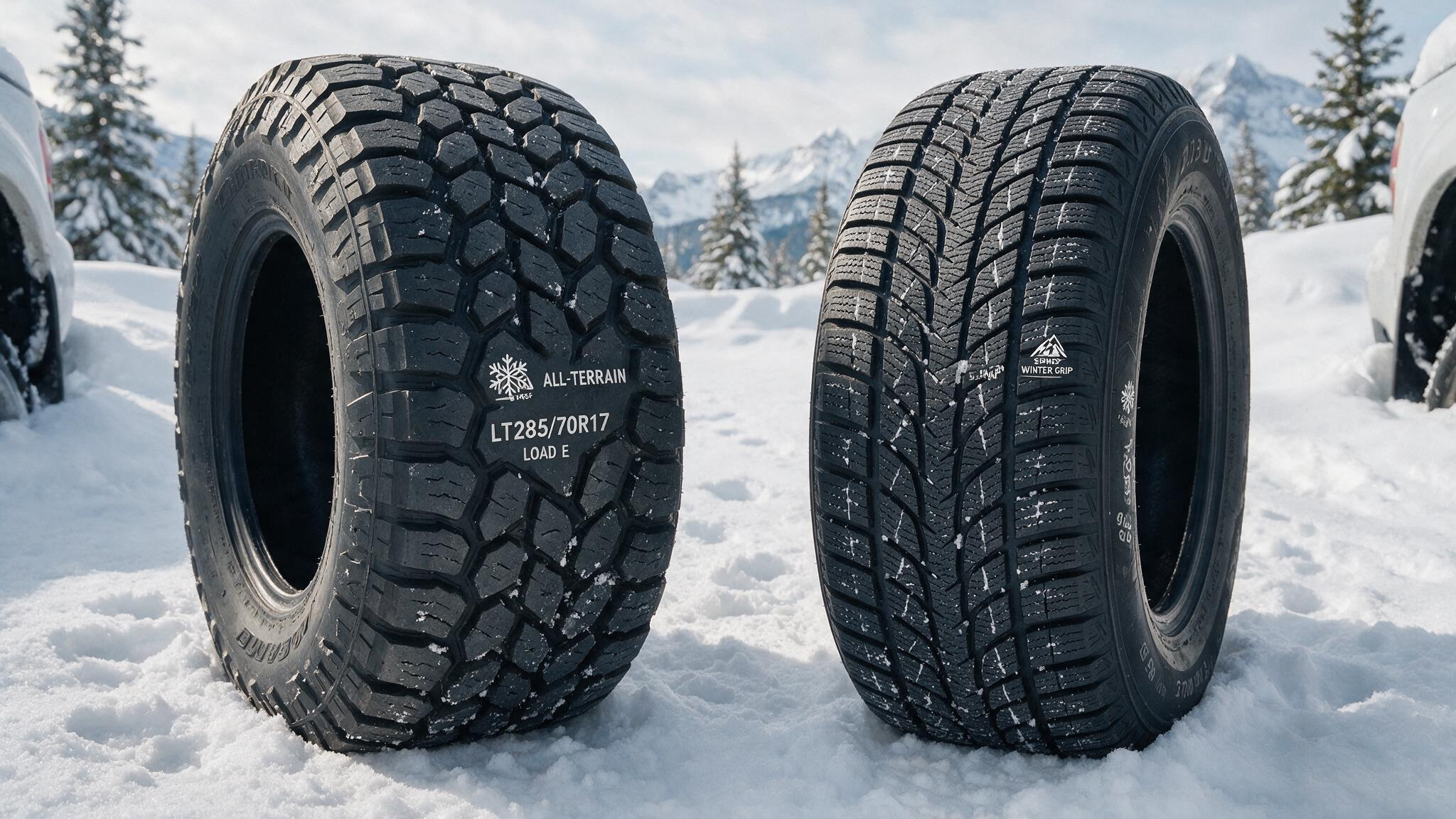
And note: some regions legally require studded tires or chains regardless of tire rating. Check local laws before trusting a 3PMSF badge.
On-Road Tradeoffs: Noise, Fuel Economy, and Tread Wear
The same features that give AT tires off-road bite make them worse on pavement.

Why AT tires are noisier
Block tread patterns create more air turbulence than the continuous ribs on a highway tire. The air gets trapped between blocks and escapes with a characteristic hum. Symmetrical groove patterns (common on ATs) don’t cancel sound well.
The Goodyear Wrangler DuraTrac is an example: users report a loud howl at highway speeds, especially if rotations are skipped.
Fuel economy: rolling resistance and the 0.5 mpg benchmark
Heavier tread and stiffer sidewalls increase rolling resistance. One Reddit user reported dropping about 0.5 mpg when switching from street tires to BFGoodrich KO2s. That’s 0.5 mpg, but it adds up over a year of commuting.
According to PriorityTire, all-terrain tires sit in the middle of the efficiency spectrum: highway tires are best, then ATs, then mud-terrains (which can drop 2-3 mpg).
Tread wear on pavement
Softer rubber compounds that provide grip also wear faster on hot asphalt. If your driving is 90% highway, you will burn through the tread quicker than a touring tire. Mileage warranties give a useful benchmark for expected life, but you might also wonder how to make RC cars faster by choosing race tires that match the surface, like slicks or mini pins, since tires link all your power to the ground.
- BFGoodrich KO2: 50,000 miles
- Toyo Open Country A/T III: 65,000 miles
- Falken Wildpeak A/T Trail: 65,000 miles
- Mickey Thompson Baja Boss A/T: 50k (light truck) / 60k (SUV)
- Yokohama Geolandar G015: 60,000 miles
- General Grabber A/TX: 60,000 miles
Those numbers assume a mix of driving—if you hammer them on hot pavement every day, you will get less.
Historical Evolution: From Rut-proof to Multi-Compound AT
- 1921 – Goodyear Rut-proof: The first off-road tire, period. Bias-ply construction, primitive tread. It was a solution to the problem of getting farm trucks and early off-roaders unstuck.
- 1976 – BFGoodrich Radial All-Terrain T/A: The category’s true origin. BFGoodrich moved from bias-ply to radial construction, improving ride comfort on pavement while keeping an open tread for dirt. This was the first tire that said “we’re intentionally splitting the difference.”
- 1980s-1990s: AT tires became a mainstream option as SUVs and light trucks grew in popularity. Brands like Goodyear (Wrangler AT) and Cooper (Discoverer) entered the space. Tread patterns got more sophisticated—still blocky, but better at shedding water.
- 2000s-present: Computer-aided design allowed variable block positioning, optimized sipe geometry, and multi-compound rubber. Modern AT tires like the KO2 use a rubber compound that balances tread life and grip across a wider temperature range. Coupling joints, reinforced sidewalls with features like Sidebiters, and 3PMSF ratings are all recent innovations.
The 1976 BFGoodrich Radial All-Terrain T/A solved the “ride like a brick on pavement” problem. Modern sipes solved the “no snow grip” problem. Multi-compound rubber solved the “summer compound freezes in winter” problem.
Product Examples: How Different AT Tires Implement Design Choices
Each of these tires makes different tradeoffs.
BFGoodrich All-Terrain T/A KO2 – The benchmark. Designed with tough sidewalls that resist splitting in rocky terrain, and engineered for low-PSI operation (10-15 psi in sand and rocks). The tradeoff is weight and a reported ~0.5 mpg drop versus street tires. 50k-mile warranty, 3PMSF rated. If you’re overlanding, this is the tire everyone compares to.
Toyo Open Country A/T III – Focuses on wet performance and long tread life (65k-mile warranty). Users say it is quieter than the KO2 and handles towing through 6+ inches of Colorado snow. The downside: deep mud and snow can pack into the lugs, and road noise is still noticeable. Reddit forums report it as an all-rounder with good highway manners.
Falken Wildpeak A/T Trail – Comfort-oriented. The tread is designed to balance on-road smoothness with off-road capability, and the tough upper sidewall handles rocky trails. Another 65k-mile warranty, 3PMSF. A choice for CUVs and SUVs that see moderate dirt.
Mickey Thompson Baja Boss A/T – A more aggressive AT that blurs the line toward mud-terrains. Deeper Sidebiters for traction on rough surfaces, tougher cords for puncture resistance. Warranty is 50k-60k miles depending on vehicle. It’s still smoother on the highway than a full M/T—but not as smooth as a KO2.
Dick Cepek Baja Legend EXP – An extreme off-road AT designed for serious trail use. Features a rugged tread pattern with deep sipes and reinforced sidewalls for rock crawling and mud. Acquired by Mickey Thompson in 2022, the Baja Legend EXP continues the legacy of Dick Cepek’s off-road expertise.
Yokohama Geolandar G015 – Built for heavy loads. Uses Enduro compound for flexibility and Endurocore construction for load capacity. 60k-mile warranty, 3PMSF. If you’re hauling gear in a truck or overlanding with a heavy setup, this tire’s sidewall construction is a differentiator.
Nitto Terra Grappler G2 – Leans toward on-road comfort. The coupling joints reduce noise, and Motor Trend tested it at 10-12 psi on loose sand and silt with good results. But it is not for rock crawling, and snow performance is mediocre. Great for wet roads and towing on dirt.
Goodyear Wrangler DuraTrac – Aggressive—some say it is a mud-terrain in AT clothing. Self-cleaning tread, rim protection, 3PMSF rated. The reputation: stable on dry roads, handles mud and deep snow, but loud. Users report a constant howl at highway speeds and about 50k miles per set.
General Grabber A/TX – Versatile all-rounder with an aggressive look. Multiple sipes for snow traction, 60k-mile warranty, 3PMSF. Motor Trend tested it on rocks and snow and found it performed well across terrain types. Comes in many sizes—good fitment coverage.
Goodyear Wrangler Outbound AT (2025) – New model targeting adventure seekers, EV drivers, and working professionals. Full-size SUVs, light trucks, vans, off-road rigs. Backed by Goodyear’s 60-Day Satisfaction Guarantee.
Goodyear Wrangler Workhorse AT 2 (2025) – Heavy-duty version of the same family.
Goodyear Wrangler ElectricDrive AT (2025) – Designed specifically for electric vehicles—likely optimized for lower rolling resistance and quieter operation.
Groundspeed Voyager A/T – A newer brand that combines all-season and mud-terrain features. 10-ply construction, Zig-Zag tread pattern, Pattern Block Design with fine/dense sipes for noise reduction and wet traction. Stabilized shoulder for high-speed turn stability. 50k-mile warranty, 3PMSF.
Vehicle Fitment: Why Not All Vehicles Can Use AT Tires
AT tires are taller and heavier than standard highway tires. For a standard sedan or small hatchback, you may need new wheels and suspension upgrades to keep the tire from rubbing against the wheel wells or throwing off speedometer calibration. Even standard 4-wheel drive cars can benefit from AT tires if they have adequate wheel arch clearance and upgraded suspension.
Vehicles that commonly accept AT tires without major modification: light trucks, pickup trucks, SUVs, campers, and 4WD cars that come from the factory with larger wheel arches. Even then, you need to check load capacity—the tire must support the vehicle’s weight within manufacturer specifications. CUVs and smaller SUVs typically have both all-weather and all-terrain options. Full-size pickups and larger SUVs sometimes lack all-weather options entirely, so a 3PMSF-rated AT tire often serves as the closest winter-ready substitute. But if you live somewhere with studded tire laws, even a 3PMSF AT may not be enough.
Comparison to Other Tire Types: Where AT Fits in the Spectrum
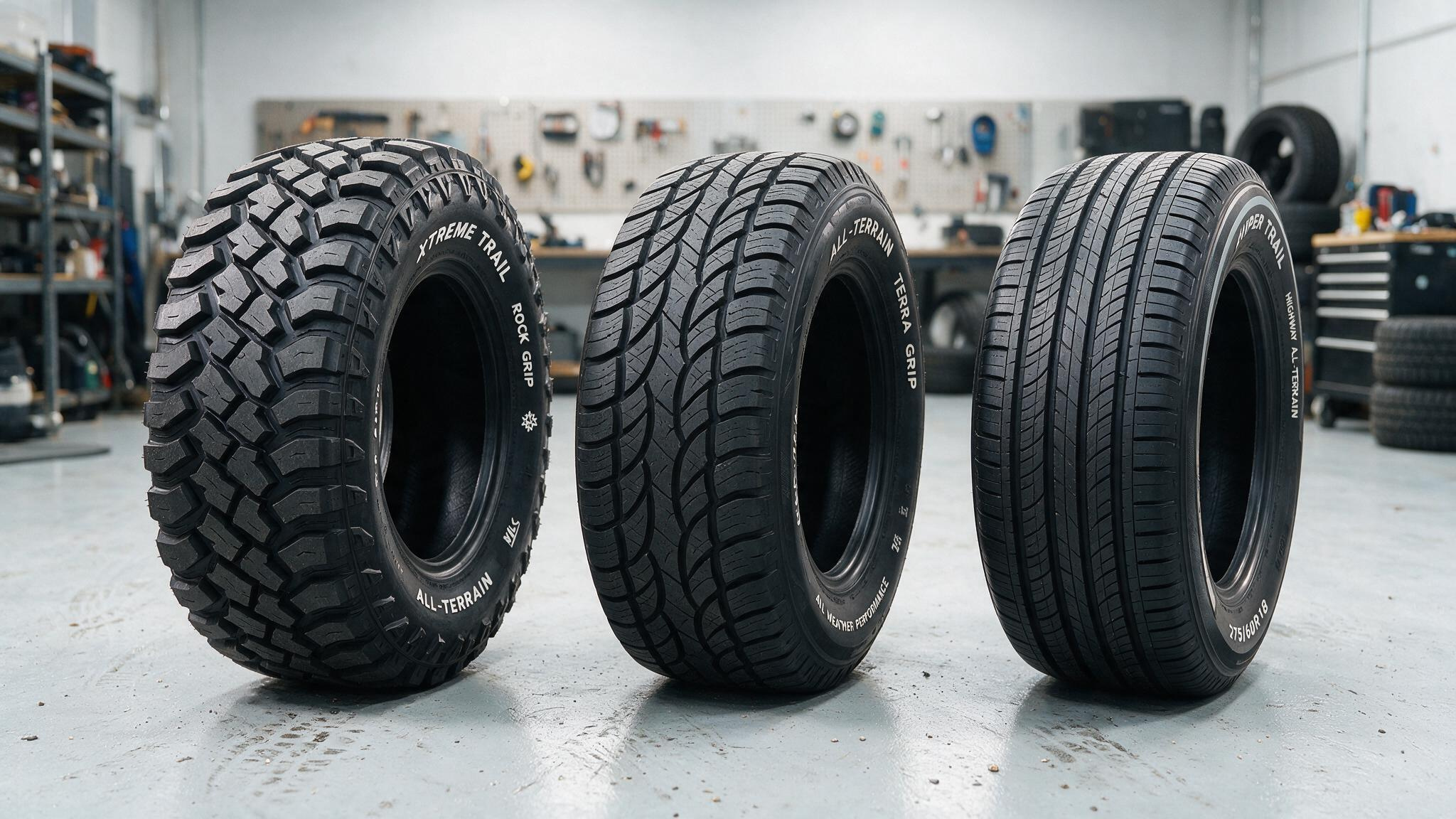
- AT vs. Highway (H/T): H/T tires are quieter, more fuel-efficient, and ride smoother. You lose off-road traction, puncture resistance, and snow capability. AT tires wear faster on pavement than H/Ts. If your driving is 80%+ highway, H/Ts are the better choice.
- AT vs. Winter: AT tires stop 17 meters longer on snow at 40 mph. AT compounds stiffen below 44-50°F; winter tires work below 32°F. Gain all-season convenience with ATs; lose safety margin in severe snow. Winter tires also wear quickly on warm pavement.
- AT vs. Mud-Terrain (M/T): M/Ts have self-cleaning tread that flings mud, better rock-crawling grip, and tougher puncture resistance at low PSI. But they are loud, vibrate on pavement, and kill fuel economy. ATs are quieter, more comfortable, and get better mpg. If you daily-drive to the trailhead, AT is livable; if you are rock-crawling every weekend, go M/T.
- AT vs. All-Weather: All-weather tires are 3PMSF rated with winter-capable compounds but no off-road aggression. They are designed for pavement in all seasons. AT tires handle off-road terrain that an all-weather tire cannot. The catch: all-weather may not be available for full-size trucks and SUVs.
Simple decision framework:
- Mostly pavement commute ? H/T or touring tires
- Mix of pavement + light off-road (gravel, dirt tracks, mild trails) ? AT tires
- Mostly extreme off-road (deep mud, rock crawling) ? M/T tires
- Temperate climate with occasional snow ? 3PMSF-rated AT tires
- Severe winter climate ? dedicated winter tires regardless of AT rating
Is an All-Terrain Tire Right for Your Driving?
AT tires give you the confidence to turn off the paved road without worrying immediately about a flat, and they still let you drive to work Monday morning. But that confidence comes at a cost: more noise at 70 mph, a hit to fuel economy, and a safety gap in deep snow.
If you split your driving roughly even between pavement and light off-road, AT tires are the best fit. If you spend 70%+ of your miles on smooth asphalt, save the money and stay with highway tires. And if you face frequent snow, buy dedicated winter tires.
Frequently Asked Questions
What are the disadvantages of all-terrain tires?
All-terrain tires are noisier than highway tires due to their blocky tread patterns creating air turbulence, and they reduce fuel economy by about 0.5 mpg because of higher rolling resistance. They also wear faster on pavement if most driving is on-road, and their rubber compounds stiffen below 44-50°F, resulting in significantly longer stopping distances on snow compared to dedicated winter tires.
Is it okay to drive with all-terrain tires on daily commute?
Yes, but you’ll trade off some comfort and efficiency. AT tires are louder on the highway, reduce fuel economy slightly, and wear faster on hot asphalt compared to highway tires. If your commute is mostly pavement, you’re paying for off-road capability you may not use, so highway or touring tires are often a better choice for daily driving.
Can all-terrain tires be used all year round?
Yes, all-terrain tires are designed for year-round use in temperate climates, and many carry a 3PMSF rating for light snow. However, their rubber compounds stiffen below 44-50°F, so in severe winter conditions they stop about 17 meters longer at 40 mph than dedicated winter tires. For frequent snow and ice, winter tires are safer.
How do all-terrain tires work on pavement?
On pavement, the blocky tread blocks flatten out to maintain a reasonable contact patch, providing adequate grip for daily driving. However, the same tread design creates more air turbulence and noise than highway tires, and the stiffer sidewalls increase rolling resistance, which slightly reduces fuel economy and ride comfort.
What does the 3PMSF rating on all-terrain tires actually mean?
The Three-Peak Mountain Snowflake rating means the tire passed an acceleration test on medium-packed snow, but it does not test braking, cornering, or ice performance. So a 3PMSF-rated AT tire can help you get moving in snow, but it won’t stop as well as a dedicated winter tire, which can cut stopping distance by about 17 meters at 40 mph.
How much does fuel economy drop with all-terrain tires?
Switching from highway tires to all-terrain tires typically reduces fuel economy by about 0.5 mpg, though the exact drop depends on driving habits and tire model. The heavier tread and stiffer sidewalls increase rolling resistance, wasting more energy as heat compared to smoother highway tires.
