Boredom is the biggest driver of excessive gaming. When your brain isn’t engaged, it reaches for the thing that reliably delivers. The reason nothing else sticks is that gaming is a triple-threat activity: it hits mental engagement, low-effort rest, and social connection all at once. No single hobby can replace three different jobs.
This article is built on two frameworks: the neuroscience from Dr. Alok Kanojia and the Healthy Gamer team, and Cam’s 70+ Hobby Ideas list from Game Quitters. Together, they explain why you feel what you feel and what to do about it.
Key Takeaways
Boredom is the biggest driver of excessive gaming—generic advice fails because it ignores the specific stimulation your brain has adapted to.
Gaming fulfills three distinct needs (mental engagement, low-effort rest, social connection), so you need a portfolio of hobbies—not just one—to replace it.
Your favorite game genre reveals the real-world activity that will scratch the same itch: FPS players need adrenaline, strategy players need complex systems, and MMO players need community.
Table of Contents
The Brain Science: Why Everything Else Feels So Dull
Dr. Alok Kanojia’s work at Healthy Gamer breaks down three mechanisms that make gaming engaging: dopamine exhaustion, amygdala shutdown, and the triumph circuit.
First, dopamine exhaustion. Prolonged gaming raises the threshold for enjoyment in other activities. Your brain gets used to the drip of reward. A novel can feel slow compared to a Fortnite firefight or a Hearthstone combo, and your brain notices. That’s not a personal failing—it’s physics.
Second, the amygdala shutdown. fMRI studies show that gaming can suppress activity in the amygdala—the brain region that processes negative emotions—a mechanism called amygdala shutdown. That temporary escape feels great, but it creates a gap where you never learn to deal with boredom, frustration, or sadness naturally.
Third, the triumph circuit. Games are engineered to provide artificial challenges and rewards via the triumph circuit. Every level-up, every loot drop, every “Victory” screen is a designed hook. The long-term risk from the triumph circuit? Alexithymia—losing the ability to identify your own emotions.
The Three Needs: Why One Hobby Isn’t Enough
Gaming is a triple-class build. It covers mental engagement (immersion, strategy, challenge), rest (low-energy, low-pressure downtime), and social connection (guilds, clans, co-op) all at once. Finding one replacement activity that does all three is like trying to multiclass Druid/Bard/Fighter in real life. It doesn’t work.
Reading covers the rest need, but it doesn’t give you the adrenaline of an FPS or the community of a guild. You need a portfolio. Pick at least one activity from each category.
Why Common Replacements Fail (And Why It’s Not Your Fault)
Reading: The classic “healthy alternative.” For a dopamine-tolerant brain, a novel can feel like a loading screen. The feedback loop is measured in chapters, not seconds. It makes you want to reach for the controller.
Board games: On paper, they’re a natural fit. In practice, the pacing can feel glacial compared to a real-time strategy game or an FPS. Forcing them can create negative associations.
Playing outside: “Go play outside” is too abstract for a brain wired for clear objectives. Some kids also use games to escape bullying—forcing outdoor time ignores the real problem.
Household chores: This keeps you in the same environment as your console. The controller is still right there. You’re just adding a task without changing the trigger.
Genre-Based Matching: Hobbies Based on What You Actually Play
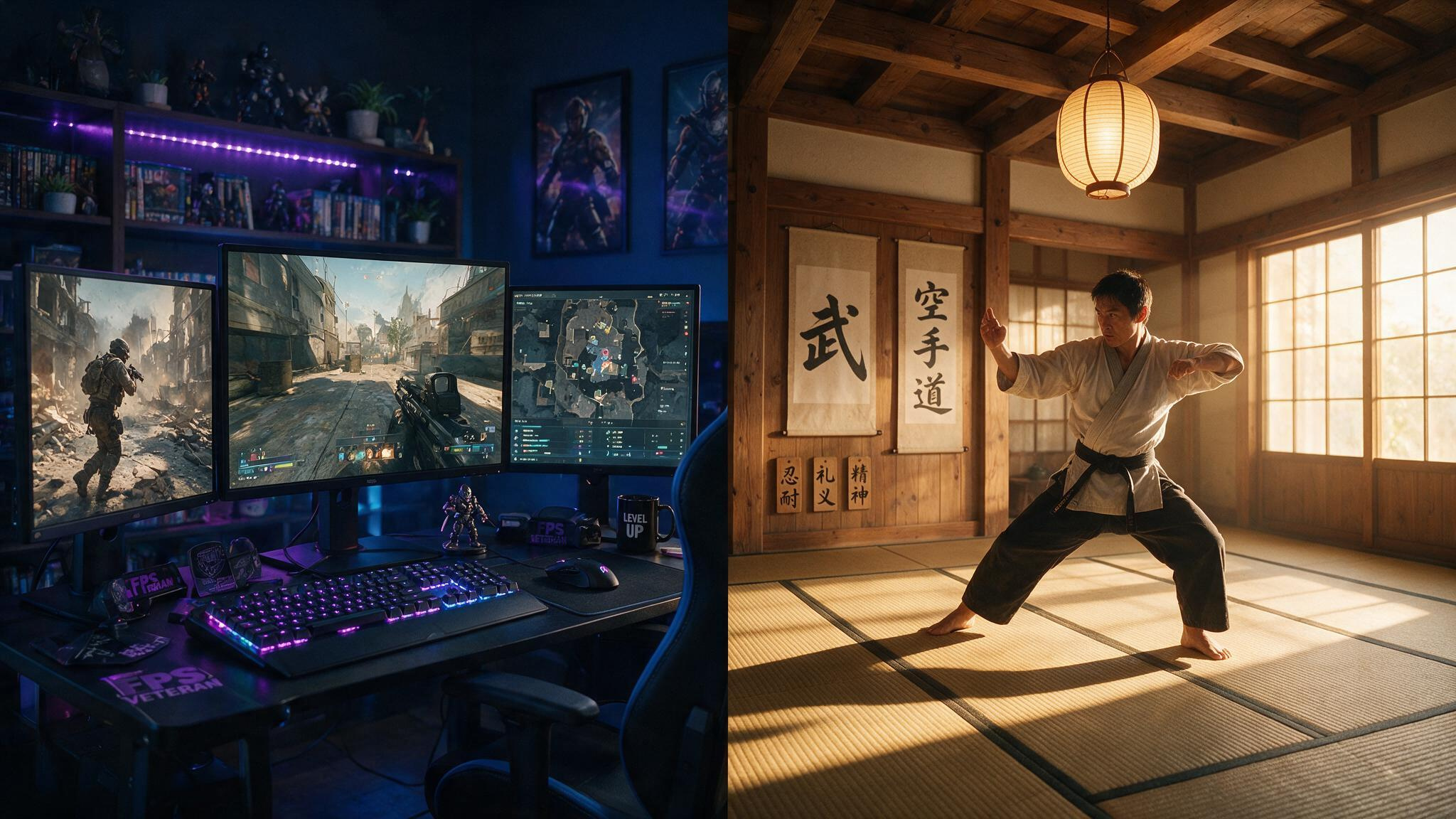
FPS and Sports Gamers (Fortnite, Call of Duty, FIFA) You crave adrenaline and competition. Martial arts (karate, judo, jiu-jitsu, taekwondo) are literally a fighting game IRL, listed as an alternative for FPS and Sports gamers. Competitive sports give you that team-based rush. Roller coasters or airsoft/paintball deliver the thrill without a screen, described as providing a sense of danger and thrill.
MMORPG and Clan Gamers (Final Fantasy 14, World of Warcraft, Clash of Clans) You seek community and shared purpose. Volunteering—animal shelters, Habitat for Humanity, food drives—is a real-world guild quest, listed as an alternative for Clan and MMORPG gamers. Boy Scouts/Eagle Scouts are a long-term RPG campaign, described as community-based activities. Join a meetup or a club.
Strategy and CCG Gamers (Civilization, XCOM, Hearthstone, Gwent) You love complex systems and planning. Coding (JavaScript, Lua, Unreal Engine Blueprints) is like deck-building for a living, listed as an alternative for RPG, Turn-Based Strategy, and CCG gamers. Internships at startups are a strategy game with stakes, listed as an alternative for CCG and Strategy gamers and described as complex and competitive systems requiring strategizing and problem-solving. Stock market simulators (phantom portfolios) let you optimize without losing money, listed as an alternative for CCG and Turn-Based Strategy gamers. Tutoring other gamers turns your knowledge into a skill — and nerdy hobbies like these can boost your problem-solving and creativity.
Adventure and RPG Gamers (Zelda, Skyrim, Dark Souls, Witcher) You crave exploration, creativity, and narrative. Hiking and whitewater rafting are real-world exploration quests, listed as alternatives for adventure, MOBA, and sports gamers. If you want to connect emotionally with video games by playing ones that have meaningful stories, you can also draw, make music, or write creatively to build the worlds yourself. Woodworking is a crafting system you can hold, described as activating parts of the brain that interpret sensory information.
Mentally Engaging Hobbies (The Grind Category)
These scratch the “leveling up” itch and require active skill-building with improvement metrics.
- Learning a new language: A side quest for your brain. Deep, mentally engaging grind.
- Learning an instrument: A skill tree with muscle memory and satisfying feedback loops. A natural fit if you’re into exploration games.
- Computer programming: You start with “hello world” (tutorial level), then functions (unlock ability), then full apps (boss fight).
- Starting an online business: A real-world sandbox where you manage resources, optimize systems, and deal with unpredictable events.
- Photography: Like a stealth game where you hunt for the perfect shot. Creative and technical.
- Writing: World-building and narrative crafting that rewards planning and revision.
- Online courses: Leveling up a skill tree at your own pace.
- DJ-ing: Cam’s own mentally engaging go-to. It’s a rhythm game in real life.
Resting Hobbies (The Casual Mode Category)
For when you’re tired but don’t want to sit there bored. These replace the “wind down after a long day” function of gaming.
- Listening to podcasts: Passive engagement. Lore dumps for real life.
- Reading: The caveat stands—it might feel slow if your dopamine tolerance is high right now. Don’t lead with this. Come back to it later once your brain adjusts.
- Cooking: An RTS with a tangible reward. Immediate feedback like completing a quest.
- Graphic design: UI modding for the real world.
- Music production: Building a complex mod or level with sound.
- Drawing: Low-barrier creative outlet. Sketching characters or maps.
- Lego building: A physical crafting system.
- Beer brewing / making cocktails: Alchemy mini-game with a tasty reward.
- Collecting: A completionist run in real life.
- Jewelry making: Crafting a rare item you can actually wear.
Social Hobbies (The Guild Category)
Replace the multiplayer and clan aspect of gaming with interaction and belonging, much like you find when exploring the best online pokies to play or picking up new hobbies to beat loneliness that distract your brain and focus on something other than your loneliness.
- Meetups: Finding a local server for your interests.
- Sports: The original competitive multiplayer. Teamwork, strategy, physical skill.
- Martial arts: A guild that trains together. Discipline and progression.
- Rock climbing: A puzzle you solve physically. Route-finding and grip strength.
- Volunteering: A team working toward a shared goal. Animal shelters, neighborhood cleanups, Habitat for Humanity.
- Dance classes: A rhythm game for your entire body.
- Adventure races: A real-world open-world quest. Navigation, teamwork, endurance.
- Airsoft / paintball: Tactical FPS IRL. Communication and movement.
- Starting or joining a club: Forming your own party around a shared interest.
- Public speaking / Toastmasters: A boss fight you prepare for and level up through practice.
- Gym / calisthenics: A daily quest with visible stat increases. No gear needed.
Intellectual and Creative Hobbies (The Deep Dive)
For the system-builders and optimizers who love engagement with objectives.
- Board games and tabletop RPGs: The caveat on pacing is real. If you force modern board games as a replacement, they can feel painfully slow. Tabletop RPGs like D&D work better because they share the narrative and progression systems of video game RPGs.
- 3D modeling with Autodesk Maya: Building game assets from scratch. Industry-standard tool, deeply technical and creative.
- Woodworking: A crafting system you can hold. Measuring, cutting, assembling into something tangible.
Outdoor and Physical Hobbies (The Real-World Adrenaline)
Hiking, whitewater rafting, rock climbing, adventure races, sports, martial arts, calisthenics. The advantage? Your console isn’t here. You’re not fighting the temptation to play “one more round” because the option doesn’t exist. These provide objectives, physical challenge, and a break from the gaming environment that chores can’t escape, and you can find tips on making room for non-gaming hobbies like coding projects or creative stuff so your brain gets variety and you don’t burn out.
From Consumer to Creator (The Respec Path)
You don’t have to binary-switch from gamer to gardener. Staying in the ecosystem—moving from player to coach or creator—is one of the most successful pivots.
- Video game tutor or coach: You’re a raid leader IRL. Connect with other gamers via Discord, share your expertise, earn money. Strong fit if you’re into RPGs, strategy games, or CCGs.
- YouTube channel / Twitch streaming: Teaches video production, editing, audience engagement. A massive skill tree in itself. Twitch gives you interaction; YouTube lets you craft polished content.
- Learning to code or 3D model: JavaScript, Lua, Unreal Engine Blueprints, Autodesk Maya. You build career-relevant skills while staying game-adjacent. It’s basically modding as a profession.
For Parents: How to Help Without Causing Resentment
The default parent move is to take away the console. That often backfires hard. The approach is counterintuitive.
Get on the child’s team. Make it “me + child vs. video games” instead of “me vs. child.” Build trust before you suggest any changes. If the kid feels attacked, nothing will work.
Understand the game genre. An FPS kid needs adrenaline and competition. An RPG kid needs creativity and narrative. Use the genre matching section above to find appropriate alternatives. You can’t suggest alternatives without knowing what they play.
Avoid forcing ineffective replacements. Reading is too slow for their current dopamine tolerance. Board games can create negative associations if forced as a replacement. Telling them to “go play outside” is too abstract.
Chores keep them next to the console; source warns household chores are ineffective because the gamer remains in an environment where games are accessible. You might think these are healthy swaps, but for a gamer’s brain, they can make the situation worse.
The Cognitive Barrier: Close-Ended vs. Open-Ended Problems
Games train your brain to solve close-ended problems: rules, feedback, defined win condition.
Real-world hobbies present open-ended problems: vague goals, no path.
This is why “get fit” is paralyzing, but “do 10 push-ups” is a quest. The fix is simple: break open-ended tasks into game-like objectives.
Example: “Clean your room” (open-ended, terrifying) ? “Clean your cupboard” (quest 1) ? “Pick up clothes off the floor” (quest 2) ? “Make the bed” (quest 3), listed as an example of breaking down an open-ended task into smaller steps. Suddenly you have a quest log. Apply this to any hobby that feels overwhelming.
When You Need More Than a Hobby List
For some people, hobby lists aren’t enough—and that’s okay. There are structured programs built for this.
Signs of addiction: Excessive preoccupation, neglecting responsibilities, declining grades, social withdrawal. 1–2 hours a day is a hobby. 16 hours a day is a crisis.
Structured programs designed for this:
- Respawn program from Game Quitters. A structured path for quitting or cutting back.
- HG Coaching: Over 14,000 clients have received help with gaming-related anxiety, depression, and lifestyle balance.
- White River Academy: Residential treatment for adolescent boys in Utah.
- The Parents Course is also available for families navigating this together.
What Other Gamers Say
- AlexTheGrape didn’t think they’d be interested in most of the 60+ hobby ideas list. They tried anyway and found they actually enjoyed the activities.
- SB checked Cam’s list and finally attended a Toastmasters meeting—something they’d wanted to do for a year but never acted on.
- Rusaw downloaded the list and discovered new outdoor activities to try.
- Paul A and Schwing both recommend downloading the list as the first move.
Your First Move
- Identify one need (mental engagement, rest, or social connection) that gaming fills for you.
- Pick one activity from this article that matches your game genre.
- Try it for 15 minutes today. No pressure, no guilt.
- If it sucks, try something else tomorrow. You’ve got 70+ options—one of them is likely to click.
Cam’s 70+ Hobby Ideas list is a free resource if you want more.
Frequently Asked Questions
What is a good alternative to video games?
There’s no single alternative because gaming covers three distinct needs: mental engagement, low-effort rest, and social connection. The best approach is to pick a portfolio of hobbies—one from each category. For example, an FPS player might try martial arts for adrenaline, while a strategy gamer might enjoy coding or stock market simulators. The key is matching the hobby to the specific itch your favorite game genre scratches.