
The Hikeep K6S Electric Dirt Bike (also styled as the Hikeep K6-S or High Keep K6S) is a $999 dirt-bike-styled e-bike that beats its advertised 35 mph top speed in the real world. At the same time, it inflates its motor wattage, battery capacity, and range numbers on the box. Independent field tests from YouTube channels and reviewers Colin Leung at Amped Cycle, Trail Tested, The Islander, and Brandon Wagstaff clocked the bike at 36 to 38 mph with a tailwind. Meanwhile, controller label math and multimeter drain checks pulled its 3000W peak motor, 52V 40Ah battery, and 110-mile range claims back down to earth.
Key Takeaways
The installed 52V 32A controller calculates to roughly 2,000W of real-world power rather than the advertised 3000W peak, and full-throttle riding burned roughly 60% of the battery in 15 miles instead of hitting the claimed 110-mile range.
Light riders (150 to 160 lbs) beat the 35 mph spec with 36 mph flat and 37 to 38 mph downhill runs, while Logan dual-piston hydraulic brakes on 180 mm rotors hauled the 95 lb bike down from top speed in about 17 feet.
Despite shipping with a horn, front light bar, and brake-activated tail light, the K6-S exceeds 28 mph and 750W US class e-bike limits, creating real police impoundment risk on public roads.
Table of Contents
Hikeep K6-S at a glance: what $999 buys
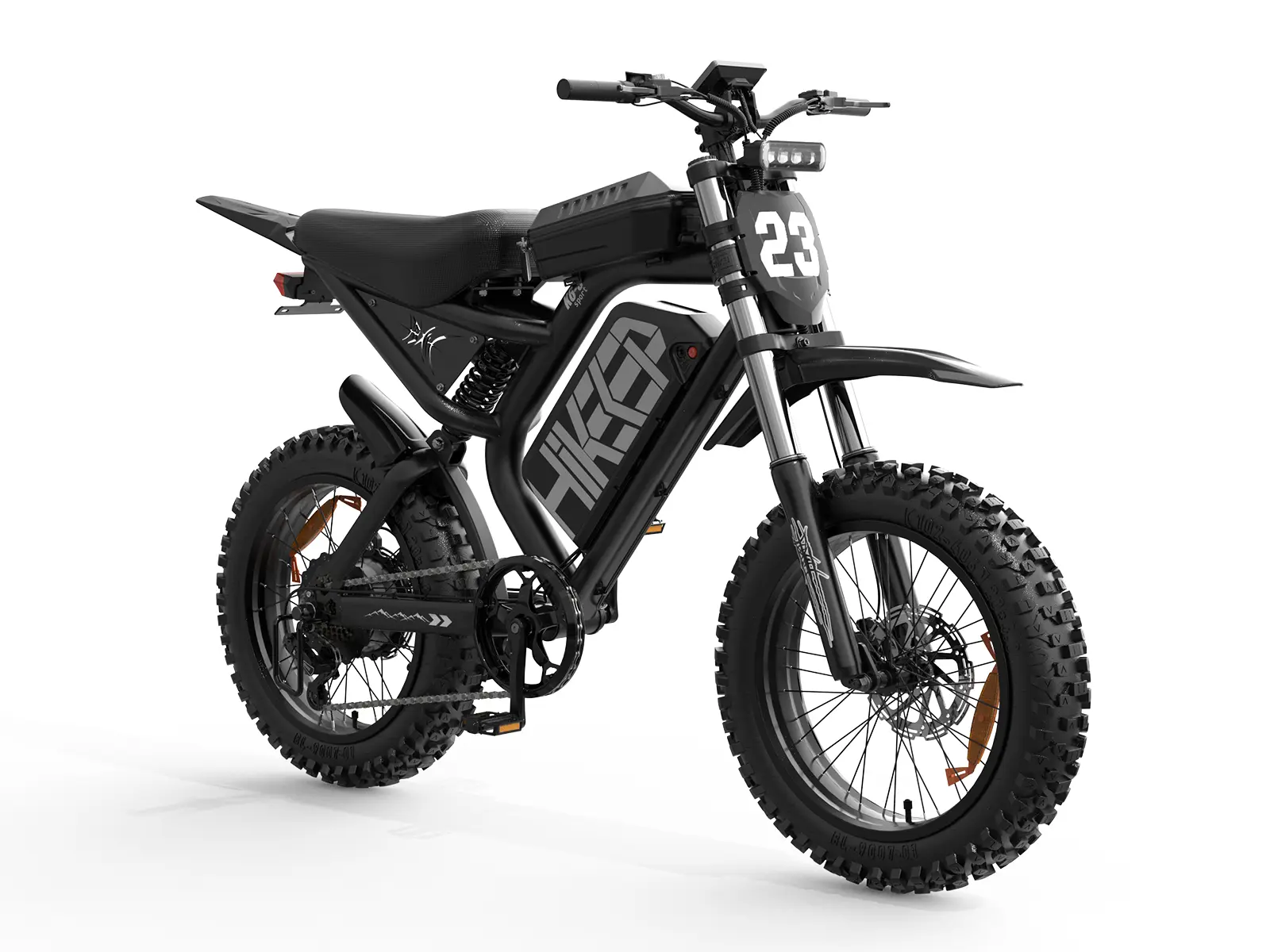
The $999 retail price relies on warehouse-direct shipping and customer assembly, skipping brick-and-mortar showroom markups to put a full-suspension, Surron-styled e-bike under the $1,000 line. Three independent reviewers pegged the ride feel closer to a $2,000 machine, making it a standout budget starter bike or a $2,000 two-bike garage upgrade, a price point where testers noticed men in their 50s and 60s buying matching fat-tire pairs for themselves and their partners.
Spec sheet vs measured reality: motor, battery, and range
Here at GeekExtreme, our favorite part of any budget hardware teardown is checking what the stickers on the internal components say when they think marketing isn’t looking. The K6-S is rated IPX5 for water resistance (meaning rain and trail splashes are fine, despite “waterproof” marketing copy), and its core powertrain numbers follow a familiar budget e-bike curve.
| Component / Metric | Manufacturer Claim | Measured / Calculated Reality | Source Attribution |
|---|---|---|---|
| Peak Motor Output | 3000W rear hub motor | ~2,000W realistic output (52V x 32±2A controller) | Amped Cycle & Trail Tested |
| Battery Capacity | 52V 40Ah | 20 to 25Ah estimated from ride drain | Reviewer multimeter & drain estimate |
| Riding Range | 110 miles | ~15 miles used ~60% charge (~51V, 2 display bars) | Field range & multimeter testing |
| Full-Throttle Floor | 110 miles max range | 56% battery remaining after hard full-throttle run | Full-throttle field test |
| Charger Output | Paired for 40Ah pack | 3A output (slow relative to claimed 40Ah size) | Unboxing hardware inspection |
| Water Resistance | Marketed as waterproof | IPX5 splash and rain protection | Official ingress rating |
Motor: 3000W claimed vs ~2000W calculated
Hikeep claims a 3000W peak rear hub motor, but reading the physical label on the installed controller reveals a 52V, 32±2A rating. Multiply 52 volts by 32 amps and you get roughly 2,000W of realistic output. Amped Cycle and Trail Tested both flagged that math. It’s the exact overstated-power pattern seen on an earlier Hikeep MAS review. Two kilowatts in a single hub motor is still plenty of punch for a $999 frame, even with an optimistic sticker.
Battery: 40Ah claim and the 20-25Ah estimate
Budget riders who only need medium-range throttle fun will be happy with the key-removable, frame-strapped battery, provided they treat the 52V 40Ah sticker as an exaggerated label rather than a true 40 amp-hour pack. Forty amp hours would be roughly double the 13 to 20Ah packs found on typical e-bikes, and one reviewer estimated actual capacity at 20 to 25Ah based on real-world riding drain rather than a bench discharge test. The casing shows no visible discharge rating, and the bundled 3-amp charger is sluggish if you try to square it with a claimed 40Ah pack.
Range: 110 miles claimed vs observed drain
Real-world range lands at a fraction of the unverified 110-mile claim because full-throttle riding pulls heavy current from the pack and triggers noticeable voltage sag. About 15 miles of riding consumed roughly 60% of the charge, leaving the pack at about 51V on a multimeter and dropping the handlebar display to 2 bars, while a separate full-throttle run ended at 56% remaining.
Hikeep K6S top speed, brakes, and hill climbing: tested
Numbers on a bench only tell half the story once 95 pounds of bike hits pavement and dirt. Testers from 150 to 160 lbs (including a 5’9″ rider with a 31-inch inseam) up to roughly 200 lbs ran the K6-S through speed traps, panic stops, and named climbs.
Top speed vs the 35 mph claim
The K6-S hits and even beats its 35 mph advertised top speed when ridden by lighter testers on flat ground or with a tailwind, though heavier loads and speed-trap runs pull the numbers down slightly. Under 150 to 160 lb riders, the bike posted 26 to 30 mph in speed-trap verification, 36 mph on flat pavement with a tailwind, and 37 to 38 mph slightly downhill with wind assistance.
Loaded closer to 200 lbs, it settled around 33 to 34 mph, while the three pedal-assist modes govern top speed to roughly 14 mph in mode 1, 25 mph in mode 2, and 34 to 36 mph in mode 3. The full twist throttle has a noticeable dead zone at the very top of its rotation, but once it engages, gunning it off a curb pops the front wheel straight into an instant wheelie.
Braking: Logan hydraulics and the 17-foot stop
Stopping power comes from Logan dual-piston hydraulic calipers running mineral oil on 180 mm rotors front and rear. The levers feel slightly soft at the very top of their pull, but when clamped hard from max speed, they locked the tires predictably and hauled the bike to a complete stop in roughly 17 feet.
Hills: where the hub motor runs out
Steep grades expose the natural torque ceiling of a rear hub motor, though reviewers split on how much it hurts the ride. In instrumented grade testing, the K6-S slowed to 14 to 15 mph up a brutal 35% grade, held 19 to 21 mph on a 30% grade, tackled the 15% grade on Cemetery Hill, and crested Peter’s Hill at 27 mph. While those numbers show clear hub-motor bogging on steep pitches, Colin Leung reported that his test unit handled steep hills without issue.
Off-road capability: real trails, real suspension limits
The Hikeep K6-S is a capable light-trail e-bike dressed in motocross plastics rather than a true dirt bike replacement, because its rear hub motor and simple suspension lack the steep-grade torque and linkage control of a dedicated off-roader. Off-road, the bike doesn’t exactly feel like a dirt bike: some hills are too steep and too deep for most bikes, and it’s missing that four-link suspension in the back.
On the Prehistoric trail and open dirt tests, it still managed 33.8 mph on gravel, 30 mph on grass, 22 mph on a wall ride, 20+ mph on general trails, and roughly 20 mph uphill off-road. One reviewer even filmed a skate park montage on it while explicitly warning viewers on camera not to take this bike into skate parks.
Suspension: comfortable on street, bottoming out on trails
The dual-suspension setup pairs a soft rear mono shock with a stiff, cheap-looking, non-adjustable front fork that requires break-in time. On pavement, dirt, and gravel, the ride stays plush. Push it onto proper trails or over a small hill, however, and the rear shock bottoms out with fast rebound even under a 160 lb rider.
Tires: grip, noise, and the range tradeoff
Rolling on 20×4-inch knobby tires laced to heavy-duty spokes, the bike hooks up well on dirt and grass, and the standard 20×4 sizing makes future tire swaps easy. On pavement, those aggressive lugs drone like a Jeep on mud tires, costing you both range and top speed.
Dirt-bike styling on e-bike hardware: the Surron look question
For a beginner shopping under $1,000, the $999 K6-S delivers the aggressive Surron visual vibe while remaining a hub-driven bicycle underneath its plastics, whereas an actual Surron is a purpose-built mid-drive e-moto. Hikeep nailed the aesthetic pitch: an all-black colorway, a Jordan-style #23 front number plate, moto fenders, a Surron-style rear fender and moto seat, and a bright e-moto headlight and tail light.
Peel back the silhouette and you’re looking at standard e-bike architecture, including a key-removable battery you can carry upstairs to charge without hauling the whole frame inside, plus a 7-speed Shimano drivetrain with metal pedals, a small guarded chainring, and chain and derailleur guards. One tester praised the 7-speed rear derailleur for helping keep the pedals turning up steep climbs, though another found that pedal assist wouldn’t kick in while pedaling until after touching the throttle.
Is the Hikeep K6S street legal in the US or will it get impounded?
No, the Hikeep K6S Electric Dirt Bike exceeds the 28 mph and 750W class e-bike limits despite its street-legal lighting and horn, putting riders at real risk of police impoundment on public roads. While the broader Hikeep K6 series spans budget fat-tire full-suspension electric bikes and light dirt bikes, US state frameworks such as Illinois e-bike classification law cap street-compliant class e-bikes at 28 mph and 750W. With a tested top speed of 36 to 38 mph and roughly 2,000W of calculated controller output (3000W peak claimed), the K6-S blows past both thresholds.
That creates a trap for buyers who judge legality by accessories. The bike ships with a horn, a bright e-moto front light bar, and a brake-activated tail light, though it has no turn signals, which reviewers flagged as the most obvious missing upgrade. Brandon Wagstaff warned that police officers actively google e-bike specifications during traffic stops and impound bikes that cross class power and speed lines.
Startup, security, and the Hikeep app: owning it day to day
No standalone printed user manual or display error-code chart is published in the test record, so day-to-day operation and fault checking come down to the on-bike startup sequence and the companion app’s self-diagnostics.
The three-step startup and NFC unlock
You can’t just hop on and twist the grip. Firing up the K6-S takes three steps: flip the physical switch on the battery, press the handlebar power button, and tap the NFC key fob against the display to clear the “P” (park) lockout mode.
Pedal assist levels and their speed caps
Alongside a zero-assist setting, the bike runs three pedal-assist levels that act as speed governors: mode 1 tops out around 14 mph, mode 2 around 25 mph, and mode 3 at 34 to 36 mph.
The companion app, honestly evaluated
Hikeep’s Bluetooth-connected app packs a surprisingly long feature list on paper: lock/unlock controls, speed and battery telemetry, pedal-assist adjustments, a ride-tracking map, a community tab, maintenance videos, a self-system diagnostic check, bike renaming, and lock-code changes. In practice, a couple of reviewers found the app shallow and mostly redundant once the bike is rolling.
Assembly, build quality, and documented flaws
Unpacking a warehouse-direct bike always feels a little like opening a giant flat-pack hardware kit, and the K6-S has a few factory quirks you’ll meet with a wrench in hand.
Assembly experience and included kit
Out-of-the-box assembly is straightforward and comes with a full accessory kit, though first-time builders will have to install the seat and rear fender without printed instructions. One tester spent more time cutting away protective foam than turning bolts, and the box includes a tool kit, the 3A charger, an air pump, a phone holder, a removable front storage bag, 4 keys, and a basic bike lock. The printed manual skips the seat and rear-fender steps entirely, and one reviewer had to manually trim the rear fender plastic just to make it fit.
Flaws worth knowing before you buy
Budget shoppers comfortable with minor DIY tweaks will get along fine with the K6-S, provided they know which stock components cut corners to hit $999. Peeling the protective shipping film cracked and lifted the body stickers, and while the main frame tubes show smooth, solid, safe welds, some cobbled welds hide in tight corners. Throw away the bundled bike lock immediately since it cuts easily, and expect the top-end throttle dead zone, soft initial brake lever pull, stiff non-adjustable front fork, slow 3A charger, awkward pedaling geometry, and hub-motor slowdowns on steep hills.
Fit, comfort, and everyday usability
The K6-S weighs 95 lbs (43 kg) with a 330 lb maximum load rating and handles riders from 150 to 200+ lbs without feeling unwieldy. Teens through 60-year-olds get mid-weight handling that’s noticeably lighter and easier to maneuver than the rival Panda e-bike.
Who fits the K6-S: height, weight, and ergonomics
Most of that 95 lb heft sits in the battery pack. Despite a tall moto-style seat height, a 5’9″ rider with a 31-inch inseam can flat-foot the bike at a stop, settling into a slightly hunched forward posture. Up front, the well-made removable storage bag easily holds a phone and keys.
Riding comfort and the pedaling problem
Left on the throttle, the bike is quiet, nimble, and plush: the wide seat and suspension soak up gravel and rough pavement without leaving riders with a sore back or butt. Pedaling, on the other hand, is strictly an afterthought. The wide moto saddle pushes your knees out near the handlebars, and pushing 95 lbs of bike on high-drag 20×4 knobby tires without power assist is a chore nobody wants.
Hikeep as a brand: track record and sibling models
Only the K6-S was put through hands-on testing in these field reviews, separating it from unverified sibling variants like the K6 Pro, K6 Max, K6-G, and K6 Mini, while verified brand history comes from testing five or six Hikeep machines including the Hikeep MAS and Hikeep MAD. Across those five or six bikes, Hikeep’s personality stays consistent: the company routinely inflates motor wattage on the spec sheet, just as it did on the MAS, yet backs up its hardware when parts fail. When a prior Hikeep MAS suffered locked-up front forks, Hikeep shipped out replacement forks without hassle. Stacked against the competing Panda e-bike, the K6-S is lighter, runs softer suspension, and takes less muscle to move around the garage, though the Panda holds the edge in frame engineering with a four-link rear suspension and a battery tray that survived crashes.
Where to buy the K6-S and every accessory price that matters
The Hikeep K6-S Electric Dirt Bike sells for $999 direct through hikeepebike.com and on Amazon, making it a strong sub-$1,000 pickup for solo beginners or couples buying two matching bikes for $2,000. Because Hikeep ships direct from the warehouse for at-home assembly rather than selling through dealer showrooms, checking reviewer video descriptions for active discount links or promo codes is the smartest move before checkout. Each box arrives with the 4 keys, tool kit, air pump, phone mount, front storage bag, 3A charger, and throwaway lock, though retail prices and stock availability may vary.
Buying the bike: price and purchase path
The $999 sticker stays consistent across independent tests on Hikeep’s direct storefront and Amazon. If you’re eyeing the two-for-$2,000 partner setup, factor in an hour of foam unwrapping and basic wrenching per bike.
Parts and accessories: prices and what each one fixes
Hikeep sells replacement parts directly through the 12-page Shopify “All Accessories” collection at hikeepebike.com. Components run from $29 to $259 and cover the bike’s documented stock weak points (though a couple of brake assemblies are already sold out):
- Front Suspension Fork ($99): Direct swap if the stiff, non-adjustable stock front fork doesn’t break in to your liking.
- K6T Hydraulic Brake Kit ($69), K6 Brake Disc ($39), K6 Caliper Brake ($29), and K6 V3 Brake Pads ($29): Keeps the 180 mm stopping power sharp and addresses the soft top-of-lever feel; note that the K6-L / K6-G Brake System ($29) and a $49 hydraulic brake system were listed as sold out.
- High-Performance Motor ($259 on sale, regularly $459): The biggest markdown in the 12-page catalog if you ever cook the rear hub motor.
- Hikeep MA-S K6-S MAX Mudguard ($29 on sale, regularly $39): Replaces the rear fender if your manual trimming job gets out of hand.
- Front Wheel Axle ($39) and Crankset ($29): Cheap crash-repair insurance for the drivetrain and front end.
Verdict: who the Hikeep K6-S is for, and who should pass
The Hikeep K6-S Electric Dirt Bike is a strong $999 buy for beginners and throttle cruisers who want Surron-inspired styling and 35+ mph flat-ground speed, provided they accept e-bike hub-motor physics and inflated battery specs. In the sub-$1,000 fat-tire class, getting a ride that feels like a $2,000 machine means trading showroom polish for real-world hardware compromises.
Tested runs prove the bike hits 36 to 38 mph under 150 to 160 lb riders and stops from top speed in about 17 feet on Logan hydraulic brakes, even while its 52V 32A controller caps real power around 2,000W and hard riding burns roughly 60% of the pack in 15 miles. One reviewer liked the balance enough to gift his test bike to a young local rider as a first e-bike.
Who should buy the Hikeep K6-S:
- First-time e-bike riders, teens, and adults up to their 60s who want an approachable, comfortable throttle cruiser for pavement, gravel, and light dirt trails.
- Couples or friends splitting two matching bikes for $2,000 total instead of dropping that full budget on a single premium frame.
- Tinkering-friendly buyers who don’t mind trimming a plastic fender or waiting on a 3A charger to get a $2,000 ride feel for $999.
Who should pass:
- Hardcore trail riders expecting a true dirt bike or Surron substitute on steep climbs, where the rear shock bottoms out at 160 lbs and 35% grades drop speed to 14 to 15 mph.
- Long-distance commuters who actually need 110 miles of range or ergonomic, unassisted pedaling.
- Riders in strict enforcement areas who need a compliant 28 mph / 750W class e-bike that won’t draw police impoundment attention.
It comes down to rider respect: keep it out of skate parks, don’t weave through traffic, and treat a 38 mph hub bike like the miniature motorcycle it is.
Frequently Asked Questions
Hikeep K6S battery capacity: is the 52V 40Ah battery really 40 amp hours?
Treat the 52V 40Ah sticker as marketing inflation rather than true capacity. Based on real-world riding drain and multimeter checks, actual capacity lands closer to 20 to 25Ah, which is right in line with the slow 3A charger included in the box. Pushing the bike hard on full throttle burned roughly 60% of the charge in just 15 miles, making the 110-mile range claim equally unrealistic.
Hikeep K6S top speed test: does it actually hit the advertised 35 mph?
Yes, lighter riders between 150 and 160 lbs actually beat the spec sheet, clocking 36 mph on flat pavement and 37 to 38 mph going slightly downhill with a tailwind. Heavier riders around 200 lbs still see 33 to 34 mph, while speed-trap runs registered 26 to 30 mph. You can also govern your speed using the three pedal-assist modes, which cap out around 14 mph in mode 1, 25 mph in mode 2, and 34 to 36 mph in mode 3.
Where can I buy Hikeep K6S parts and accessories like brake pads and mudguards?
You can order replacement components directly from the 12-page Shopify accessories catalog at hikeepebike.com, where parts range from $29 to $259. K6 V3 Brake Pads, a K6 Caliper Brake, a Crankset, and a replacement Hikeep MA-S K6-S MAX Mudguard (marked down from $39) each cost $29. If you need heavier hardware, Hikeep also stocks a $39 K6 Brake Disc, a $39 Front Wheel Axle, a $69 K6T Hydraulic Brake Kit, a $99 Front Suspension Fork, and a High-Performance Motor on sale for $259 down from $459.
Where can I buy the Hikeep K6S electric dirt bike and what is the price?
The K6-S retails for $999 directly through hikeepebike.com and on Amazon, shipping straight from the warehouse for home assembly. Every box arrives with a 3A charger, 4 keys, a tool kit, an air pump, a phone holder, a removable front storage bag, and a basic lock you should immediately replace. Before checking out, look through independent reviewer video descriptions for active promo codes or discount links.
Is the Hikeep K6S electric dirt bike worth buying in a real-world review?
At $999, it is a standout buy for beginners, teens, or couples splitting a $2,000 two-bike setup who want a plush 36 to 38 mph throttle cruiser with strong Logan hydraulic brakes that stop in about 17 feet. The catch is accepting budget hardware quirks: the 3000W motor claim calculates to roughly 2,000W via its 52V 32A controller, pedaling the 95 lb frame on noisy 20×4 knobby tires is awkward, and you may have to trim the rear fender plastic yourself during assembly.
