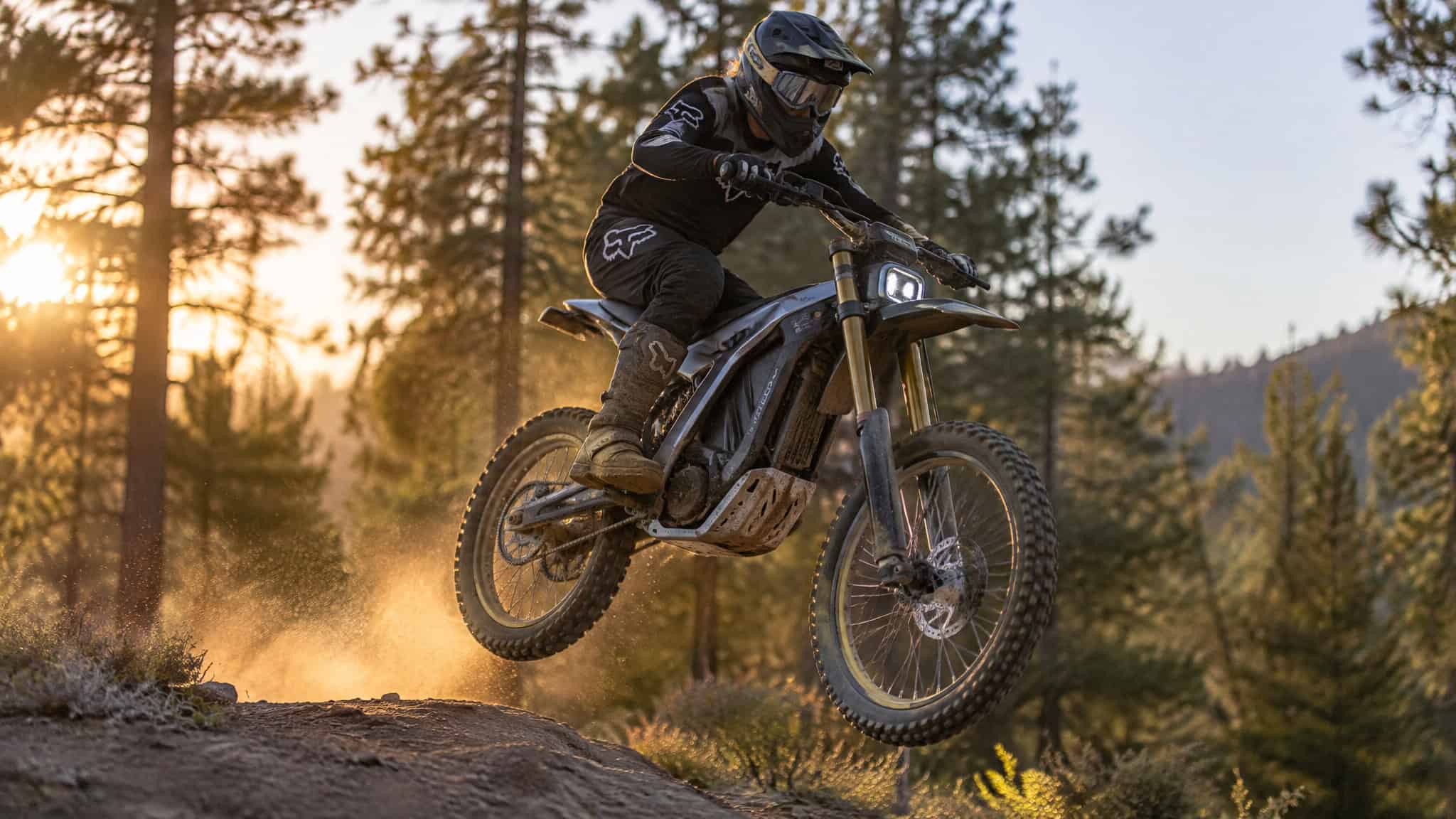
Electric dirt bike suspension sits in an engineering blind spot between 30-lb pedal mountain bikes and full motocross machines, forced to manage instant electric torque and heavy battery packs that standard setup guides ignore.
Look at the Yozma IN10 (covered in PC Guide‘s August 30, 2026 deal report, with a $120 Amazon discount noted as of October 9, 2026; bike prices vary): it weighs roughly 110 lbs, measures about 61.42 x 28.74 x 37.4 inches, and pairs a 2600W peak mid-drive motor, a removable UL-certified 48V 23Ah (~1,104Wh) battery with BMS (claimed 53-mile max range, 40mph top speed, and 30-degree incline climbing), and hydraulic disc brakes with electronic EABS with a 220mm-travel hydraulic front fork and nitrogen-charged rear shock built for rough trails rather than city streets.
Key Takeaways
Trail travel scales by chassis weight and speed: hardtail e-MTBs stay composed on 100 to 130mm forks, technical full-suspension eMTBs run 150 to 170mm front and rear, and 110-lb electric dirt bikes like the Yozma IN10 use 220mm hydraulic forks with nitrogen-charged rear shocks.
Extra sprung mass from motors and batteries across a 21.7-kg (Giant Talon E+) to 110-lb (Yozma IN10) spectrum demands stiffer spring rates or more preload to hit a 25% to 35% (~30%) sag target, plus 2 to 3 clicks slower rear rebound than the front fork.
Mid-drive motor and battery packaging reshapes frame kinematics, forcing Santa Cruz to drop its signature VPP layout for its first-ever Horst-link (4-bar) design on the Bosch CX-powered Vala ($11,949) and pushing Forbidden ($12,999 Druid CorE) and Norco ($9,999 Sight VLT) toward high-pivot layouts.
Table of Contents
How electric dirt bike suspension works
Electric dirt bike suspension is a mechanical spring-and-damper system of front forks and rear shocks engineered to control wheel tracking and absorb off-road impacts under the added sprung mass of a battery pack and instant electric motor torque. While a regular gas dirt bike deals with shifting fuel loads and engine vibration, an electric off-road rig carries dense, fixed battery mass and delivers peak torque from zero RPM. The Yozma IN10 illustrates that middleweight hardware shift by pairing a 220mm-travel hydraulic front fork and a nitrogen-charged rear shock with hydraulic disc brakes and electronic EABS to keep the chassis controllable at a claimed 40mph.
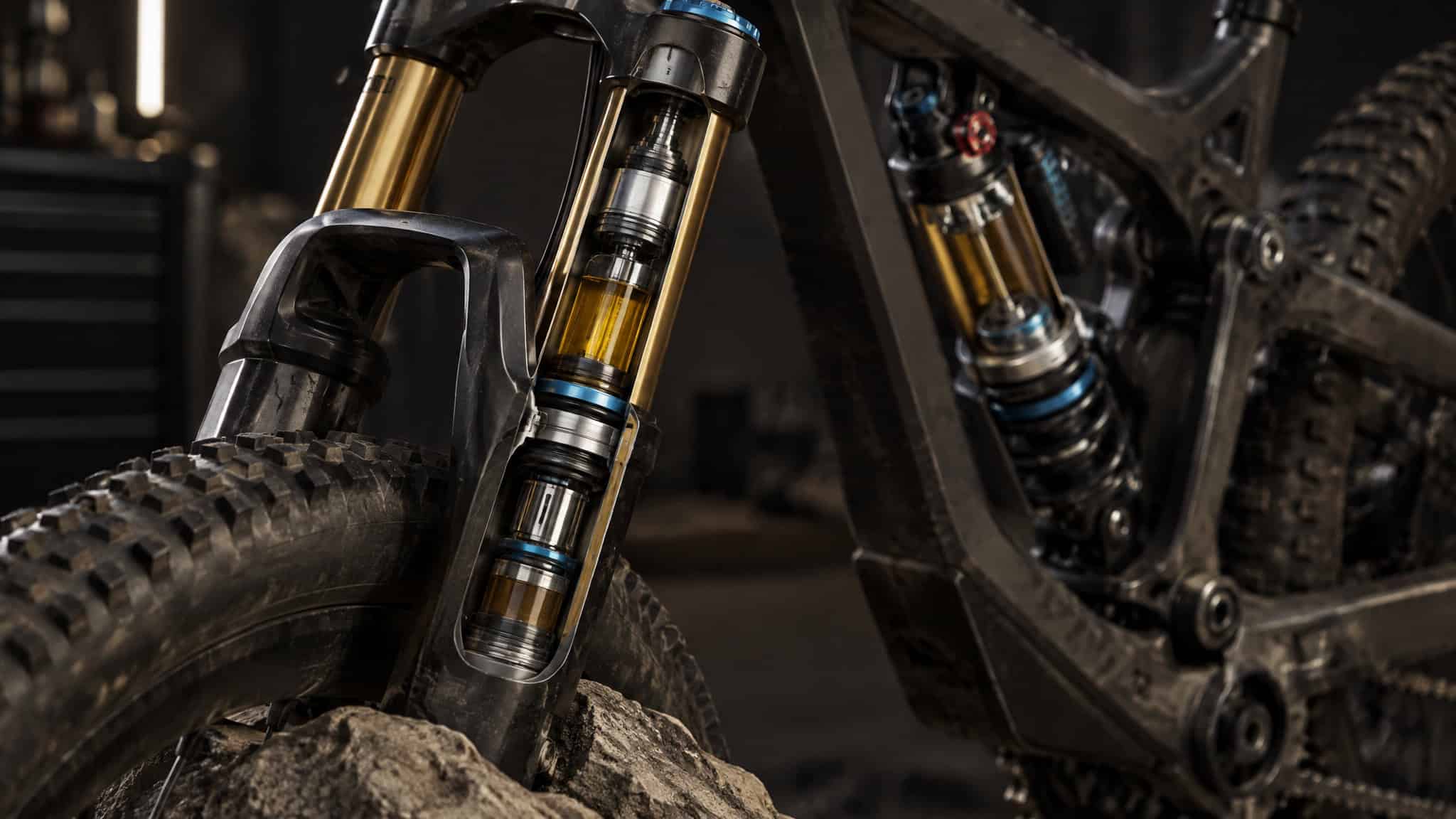
The front fork
The front fork steers the bike and absorbs initial trail hits, with travel measured in millimeters representing the total stroke available to soak up rocks and drops. On budget hardtail e-bikes for adults, you’ll often see a basic 100mm coil fork like the SR Suntour XCM ATB DS on the Giant Talon E+ (tested in Cycling Electric‘s UK hardtail guide). Step up the trail ladder and named air forks take over: the 120mm RockShox Recon Silver RL on the Trek Marlin+ 8, the 120mm FOX 34 AWL on the Canyon Grand Canyon:ON AL 8, the 130mm RockShox fork on the Aventon Ramblas ADV (tested in Electric Bike Report‘s July 31, 2026 guide), or the KKE fork on the full-suspension Juiced Scrambler FS. At the faster e-dirt bike end, the Yozma IN10’s 220mm hydraulic fork provides nearly double the stroke of a trail hardtail so the front end doesn’t bottom out on square-edge hits.
The rear shock
The rear shock controls rear-wheel tracking and puts motor power to the dirt without bucking the rider. When a 2600W peak mid-drive punches up a 30-degree climb or hammers through braking bumps, the rear shock cycles rapidly, generating intense heat inside the damper oil. On the Yozma IN10, a nitrogen-charged rear shock pressurizes that hydraulic oil against a floating piston or bladder. That nitrogen pressure stops the oil from cavitating (foaming into air bubbles) during rapid, repeated off-road hits, preventing damping fade when the trail gets ugly.
Springs and damping
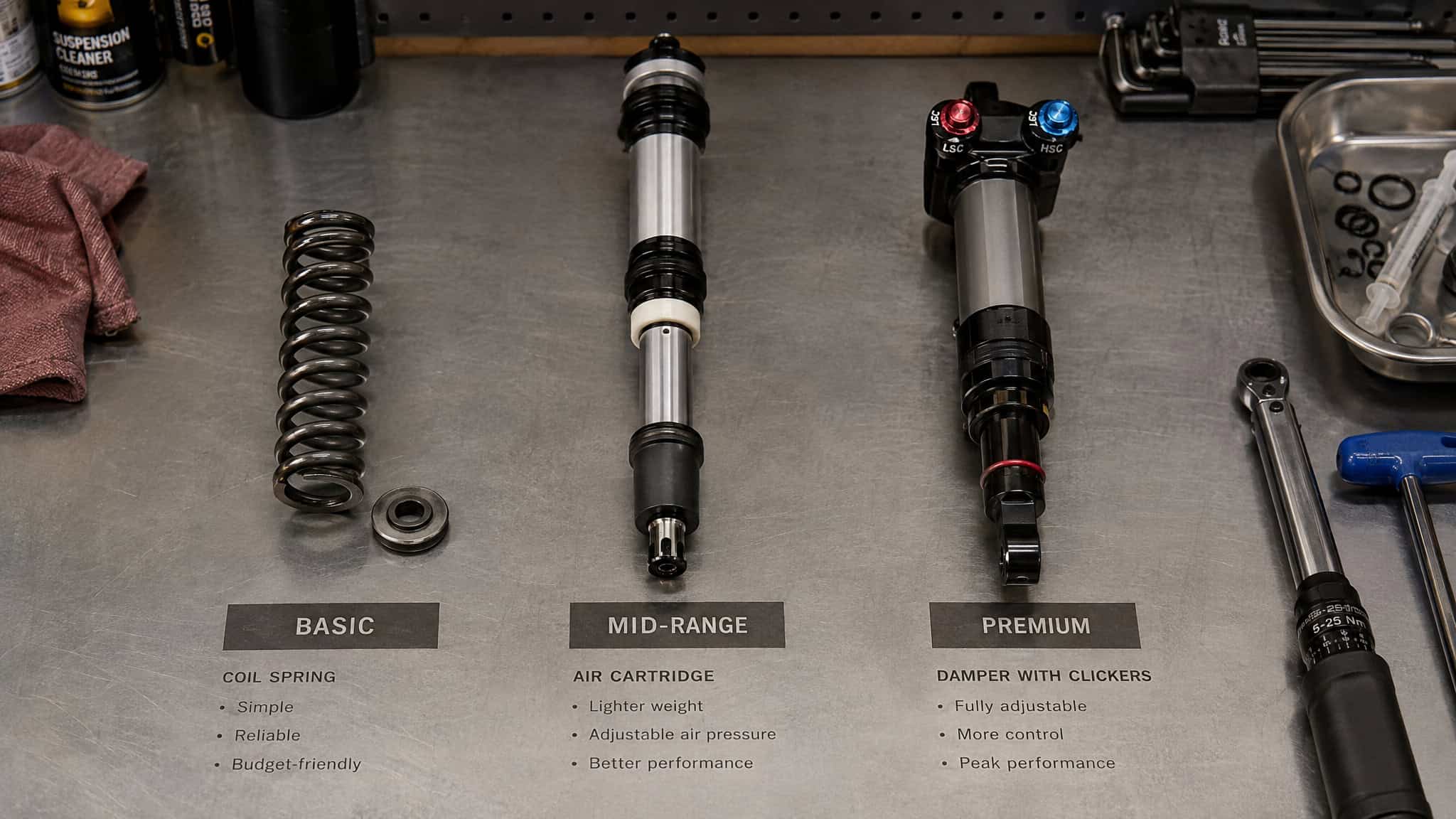
Choosing between a coil fork and an air fork on a heavy electric bike comes down to linear durability versus tunable weight savings. Coil springs use a wound metal helix that delivers linear, durable support under heavy e-bike mass, while air springs use a pressurized chamber that lets you tune the spring rate to your exact weight with a shock pump while shaving grams. Once the spring absorbs the hit, hydraulic damping pushes oil through valved ports to control shaft speed. Compression damping regulates how fast the suspension compresses on impact so you don’t blow through the travel on big drops, and rebound damping controls how fast the spring pushes the wheel back to the ground so the bike doesn’t pogo like a pogo stick or pack down across chattery roots.
How much suspension travel you need for trails
Trail suspension travel for electric off-road bikes splits into three tiers: 100 to 130mm for hardtail e-MTBs on bridleways and trail centres, 150 to 170mm front and rear for full-suspension eMTBs on technical descents, and 220mm for heavier, higher-speed electric dirt bikes like those in HappyRun’s off-road lineup. Selecting the right millimeter number depends on how rough your trails get and how much speed and chassis weight the fork has to catch on landings. Cycling Electric’s UK testing shows that 100 to 130mm forks keep hardtail e-MTBs composed without adding weight or complexity, Outside and Pinkbike‘s August 2026 eMTB Field Test benchmarks technical long-travel rigs at 150 to 170mm, and the 110-lb Yozma IN10 steps up to 220mm of front travel for dirt-bike-style hits.
The suspension’s performance is dictated by the interplay between mechanical damping and powertrain specifications. Motor torque in Newton-meters (Nm) determines how eagerly a bike punches up steep pinches, while battery capacity in watt-hours (Wh) dictates how long that suspension gets hammered, with 400 to 500Wh suiting short mixed loops and 600 to 800Wh opening up all-day rides.
The weight problem: why analog setup advice fails on electric machines
Yes, a heavier electric dirt bike or e-MTB requires stiffer spring rates and heavier damping than an analog bike when motor and battery mass sit above the suspension as sprung weight. Because that extra weight rides inside the main triangle, it pre-loads the fork and shock before your boots even touch the pegs or pedals, requiring more preload or a stiffer spring rate to prevent excessive sag. Across current electric off-road machines, weight spans from the 21.7-kg Giant Talon E+ and 46-lb Trek Slash+ up to the 110-lb Yozma IN10.
The weight spectrum from 46 lbs to 110 lbs
The Giant Talon E+ weighs roughly 21.7 kg with a 430Wh battery and 75Nm SyncDrive Sport 2 motor, while the 46-lb Trek Slash+ ($7,800, TQ HPR50 motor, 580Wh battery plus 160Wh extender) out-climbed most full-power eMTBs in vertical feet through sheer drivetrain efficiency. Heavy-duty hardtails and commuters climb quickly: the Specialized Turbo Tero 4.0 EQ hits 27 kg (£2,799, 710Wh hardtail battery, 70Nm motor), and the Specialized Turbo Vado 3 EVO 5.0 (£4,499, range from £3,599) packs an 840Wh integrated battery and 105Nm/810W peak motor.
What extra sprung mass does to springs and sag
Copy-pasting sag settings from a 30-lb analog mountain bike forum onto an electric rig leaves the suspension sitting way too low in its stroke, causing immediate bottoming out on the first rough descent. Off the trail, 110 lbs (and an approximately 61.42 x 28.74 x 37.4-inch footprint) makes carrying the Yozma IN10 upstairs or loading it into a vehicle much harder than a 40 to 60-lb e-bike. On the trail, though, mass isn’t purely a penalty: on the Santa Cruz Vala, extra motor and battery weight calms the chassis and holds lines through rough patches, and the IN10’s 110-lb weight helps it feel planted and ride more like a conventional dirt bike.
Setup fundamentals: sag, clickers, and terrain tuning
Dialing in an electric dirt bike suspension setup means balancing spring preload against hydraulic damping so the extra battery weight stays controlled across changing dirt.
Setting sag for your weight
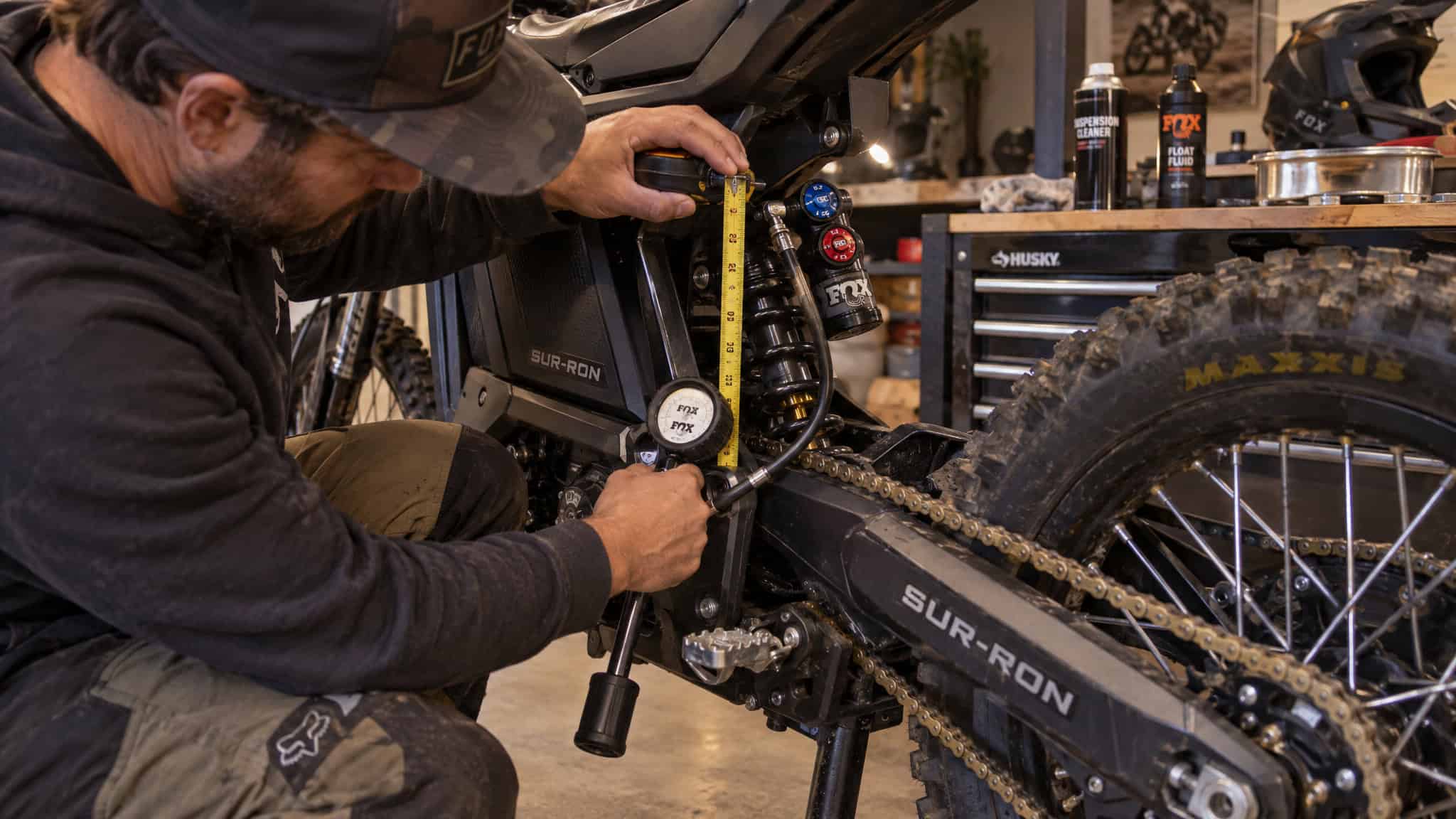
Setting sag on an electric dirt bike is the baseline step of adjusting spring preload or air pressure so the suspension compresses 25% to 35% (ideally around 30%) of its total travel under the rider’s geared weight. Because manufacturer spec sheets for e-dirt bikes rarely print a setup procedure, applying standard dirt bike tuning math prevents the frame’s battery mass or a heavier rider (around 230 lbs) from collapsing the stroke on flat ground.
- Measure total uncompressed fork and shock travel, then sit aboard in full riding gear and measure compressed travel to hit 25% to 35% (~30%) sag.
- Add spring preload or air pressure (or swap to a stiffer spring rate for ~230-lb riders and heavy battery frames) if sag exceeds 35%.
Compression and rebound clickers
Using a dirt bike suspension tuning chart requires cross-referencing your geared rider weight and terrain against baseline clicker counts turned out counter-clockwise from the fully closed (clockwise) position.
- Turn compression clickers clockwise to stiffen bump absorption if the heavy frame bottoms out, or counter-clockwise for plusher wheel contact.
- Set the rear shock 2 to 3 clicks slower on rebound than the front fork so rear hub or mid-drive torque and battery weight don’t buck the back end.
Tuning for terrain
Why an electric dirt bike feels harsh over bumps even with good suspension comes down to excessive preload, sag copied from an analog bike, overly stiff low-speed compression, overly high tire pressure, or rebound set too slow so the shock packs down on successive hits. Budget coil forks like the Giant Talon E+’s 100mm SR Suntour XCM have few or no damping clickers (flagged by Cycling Electric as its main con) and must be ridden as-is, whereas higher-tier forks and the IN10’s 40mph-class hydraulic/nitrogen setup rely on real damping adjustments:
- Hard-pack and intermediate dirt: soften compression front and rear to improve ground tracking.
- Sand and loose dirt: add low-speed compression and balance rebound so instant electric torque doesn’t bury or pack down the rear wheel.
- Rocks and roots: reduce compression and rebound slightly so the wheels track sharp edges without deflecting.
Tuning tools: why the charts and apps don’t exist yet for e-dirt bikes
Dedicated dirt bike suspension tuning apps or calculators for electric dirt bikes don’t exist yet, leaving riders to adapt printed motocross suspension calculators, KTM suspension settings charts, and Keefer-style tuning guides built for lighter analog mountain bikes or full gas motocross machines. If you search your app store expecting a wizard that calculates clicker counts for a 110-lb electric chassis, you’ll only find powertrain tools. On the e-MTB side, the Bosch eBike Flow app (part of the Bosch Smart System) lets riders retune the Bosch CX motor on the Megamo Reach HT 10 (£3,797, or £3,999 Equipped; 25.2 kg, 600Wh Bosch PowerTube 600, 100mm Suntour XCR 34 fork) from 85Nm up to 100Nm and 750W peak. On the electric dual-sport side, the Zero FX ($12,495, 289 lbs advertised weight, up to 102-mile range, with few updates since its 2013 release) uses its Next Gen smartphone app to tweak ride modes and regenerative braking. Until digital suspension telemetry trickles down to consumer e-dirt bikes, including HappyRun electric dirt bike models, tuning happens with a tape measure, a shock pump, and physical clickers.
Hardtail vs full suspension, and why e-bike layout differs
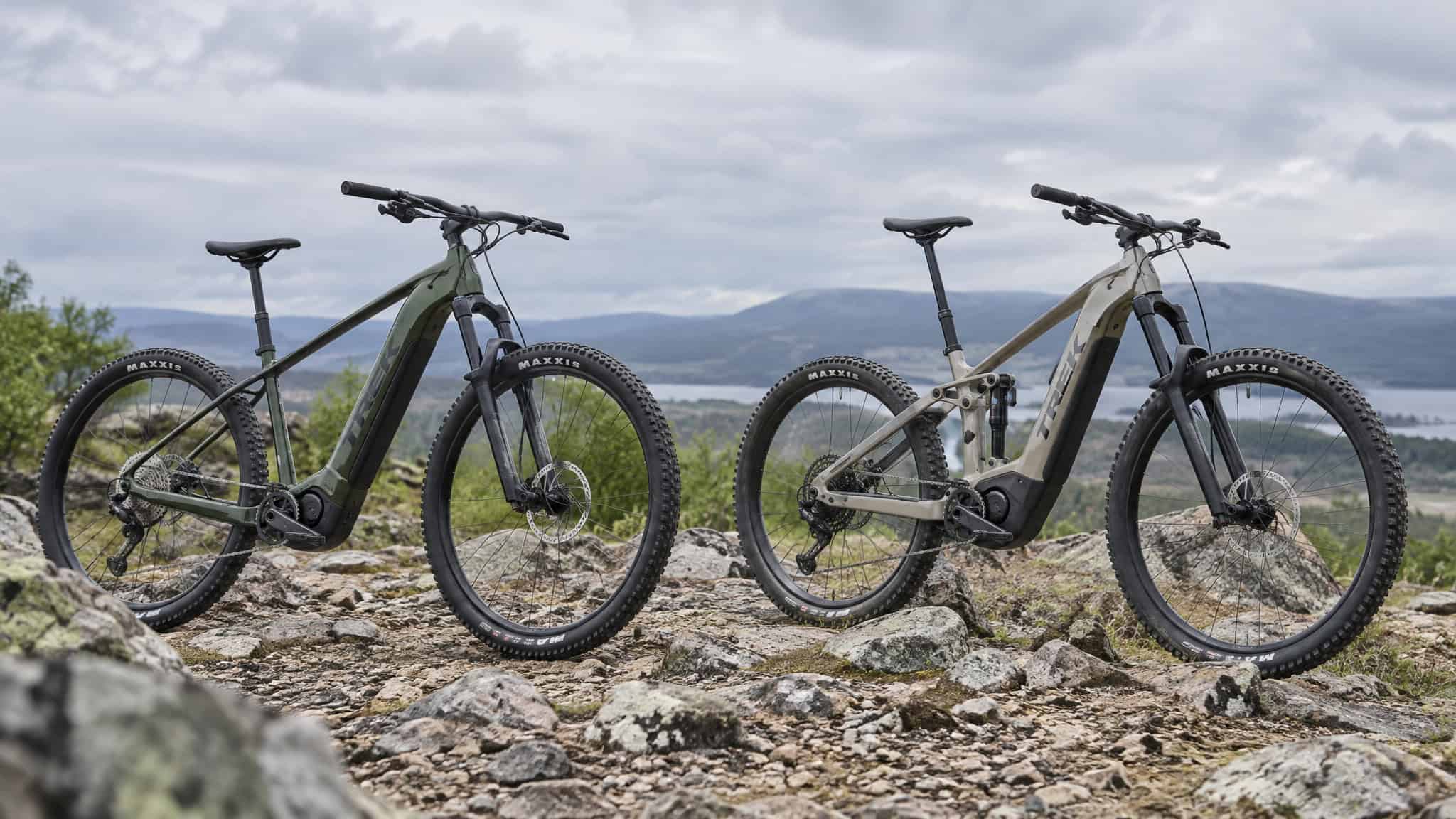
Full-suspension electric mountain bikes outperform hardtails on technical, rough terrain by maintaining rear-wheel traction over roots and rocks, while hardtail e-MTBs are lighter, simpler to maintain, and cheaper for the component spec on trail centres, bridleways, cross-country loops, and mixed commutes. That traction gap shows up immediately under power on steep dirt. In Electric Bike Report’s headquarters hill test, the full-suspension Juiced Scrambler FS beat its lighter hardtail sibling up the climb purely because its rear suspension kept the tire biting instead of skipping.
The core trade-off
Hardtails put every pound of your budget into the front fork, motor, and battery without pivot bearings to service. Full-suspension rigs cost and weigh more, as shown in Outside and Pinkbike’s August 2026 eMTB Field Test, which spent two weeks testing seven long-travel eMTBs back-to-back in Bentonville and Bella Vista, Arkansas across Bosch, Specialized, and Avinox motor platforms (also noting technology like the GENIE rear shock and prioritizing on-trail performance over spec sheets).
How motor packaging dictates suspension design
Stuffing a mid-drive motor and a 600 to 800Wh battery into the lower frame forces engineers to rethink classic suspension linkages. On the Santa Cruz Vala, Bosch CX motor and battery packaging constraints forced Santa Cruz to abandon its signature VPP layout and build its first-ever Horst-link (4-bar) bike, which also helped tune its target suspension curve; its 600Wh battery drew criticism for range without the optional extender, and while the front end can feel lifty on steep high-power climbs, rider body position fixes it. Forbidden paired a high-pivot layout with the Avinox M1 motor on its first eMTB, the Druid CorE, while Norco used a high-pivot design on the Sight VLT for a spritely, balanced feel that doesn’t force you to plow, even if it’s slightly less capable on the roughest trails. Yeti’s LTe (following its 160E lineage) won Editors’ Choice using Sixfinity suspension with a lower shock-mount flip-chip that alters the leverage curve and adjusts wheel size for calm bump erasure and traction. Meanwhile, Bosch’s 100Nm/750W Performance Line CX proved the Field Test standard for reliability and usable power, keeping pace with 120Nm/1000W Avinox M1/M2/M2S bikes on all but the hardest climbs with better battery life, whereas smoother mid-drives (Bosch Performance Line, Specialized 2.0, Yamaha PW-CE) prioritize natural efficiency and mid-power units suit group rides with analog bikes.
| Model | Field Test Award | Price | Travel (Rear / Front) | Motor Platform | Battery | Suspension Layout / Weight Note |
|---|---|---|---|---|---|---|
| Yeti LTe | Editors’ Choice | $12,900 base / $13,500 T3 XO AXS | 160mm / 170mm | Bosch CX or CX-Race | 800Wh | Sixfinity with lower-mount flip-chip |
| Santa Cruz Vala | Best All-Rounder | $11,949 ($10,749 Backcountry) | 150mm / 160mm | Bosch CX | 600Wh (extender optional) | Horst-link (4-bar) |
| Forbidden Druid CorE | Best Climber | $12,999 | Long-travel class | Avinox M1 | 800Wh | High-pivot layout |
| Norco Sight VLT (C1) | Best Value | $9,999 | 150mm / 160mm | Bosch CX | 800Wh | High-pivot layout |
| Trek Slash+ | Best Lightweight | $7,800 | Long-travel class | TQ HPR50 | 580Wh + 160Wh extender | 46 lbs total weight |
Geometry and the stable front end
Motor choice, battery size, and geometry matter most when choosing a build: aim for a slacker head angle and sensible reach so the front end stays stable when descending steep, choppy terrain.
The price-to-suspension ladder: what your money buys
Upgrading the front fork on a budget electric dirt bike or hardtail e-MTB rarely pays off financially, so riders should ride basic coil forks as-is, spend initial upgrade cash on tubeless tyres, a dropper post, and wet-weather brake pads, and shop by named fork models rather than generic “dual hydraulic suspension” headlines. At GeekExtreme, we look past marketing labels to the actual stanchions and dampers tested by Cycling Electric (an in-person UK publication covering European-legal e-bikes led by an editor with 20 years’ experience alongside testers Geoff Waugh, Mark Sutton, Richard Peace, Mike Stead, and a novice female tester) and Electric Bike Report (which has reviewed e-bikes for 10+ years, disclosed affiliate commissions, and hill-, brake-, range-, and ride-quality-tested 130+ e-bikes at its headquarters over the past 12 months).
Budget tier: £899-£1,599
- Falcon Turbine (£899): Best-value sub-£1,000 pick via distributor scale; 120mm fork, 35Nm Motinova hub motor, 368Wh removable battery, ~26 kg, 64km range, 7-speed Tourney; playful on singletrack but needs a dropper, has high gearing, weak brakes, and no mudguards/lights.
- Roxform Gravion (£1,190, was £1,390): Hydraulic discs, 45Nm Aikema hub motor (~5% gradient limit), 460Wh LG pack, 24-speed Altus; inaccurate battery gauge, no front mudguard mount.
- Mark2 Scrambler (£1,399, was £1,799): RST Blaze 120mm fork, 250W/54Nm Promovec hub motor, 375Wh battery, 27 Shimano gears, Schwalbe Nobby Nic tyres; struggles on steep hills, dated triple chainset, two sizes only.
- Ampere X-Trail (£1,599, summer 2026 review): 65Nm rear hub, 360Wh battery (504/630Wh options), 22.4 kg, CUES 9-speed; capable on trails, lacks winter mudguards/rack.
Mid tier: £2,299-£3,400
- Giant Talon E+ (£2,299 Editor’s Choice): SR Suntour XCM ATB DS 29in 100mm coil fork (main con alongside no dropper and low-tread Maxxis Rekon 29×2.4 tyres), 75Nm SyncDrive Sport 2, 430Wh EnergyPak Smart (+200Wh EnergyPak Plus compatible), ~21.7 kg, 130km eco / 52km high range, CUES 11-41T 9-speed, MT200 180mm brakes.
- Trek Marlin+ 8 (£2,550): 120mm RockShox Recon Silver RL, 50Nm Bosch Active Line Plus with Auto mode, 400Wh CompactTube (+PowerMore option), Deore 1×12, ~21.3 kg, strong dealer support.
- Merida eBIG.NINE 400 (£2,750): 100mm fork, ~85Nm Shimano EP, 630Wh, 25 kg, 90km range, conservative geometry, strong UK dealer network.
- Liv Lurra E+ 2 (£2,999, RRP £3,299): 130mm fork, dropper fitted, women-specific geometry, 75Nm SyncDrive Sport2, 625Wh, up to 180km range, CUES 11-46t.
- Merida eFloat cc 400 (£3,250): Bosch CX climber, 600Wh removable pack, 25kg rack, wired lights, wheel lock; lacks a dropper.
- Canyon Grand Canyon:ON AL 8 (£3,299): FOX 34 AWL 120mm fork, dropper, Bosch CX Gen 5, 600/800Wh + extender, Deore 1×12, Magura MT Thirty brakes; great direct-sales spec, thin dealer support, fast sellouts.
- Trek Powerfly+ 6 Gen 5 (£3,400): 120mm Recon Silver RL, 85Nm Bosch CX Gen 5, 800Wh, Deore 1×12, 29in wheels, ~26 kg; superb e-MTB mode and commuter, heavy and pricey. Above £3,400 sit the Aventon Trava EXP (£3,500 belt-drive / £2,500 chain-drive ADV, 800Wh, Ultro S motor, 380% Enviolo auto hub that shifts slowly at times, 193km range, 27kg rack, geofencing, cheap mudguards), the snow-proven Megamo Reach HT 10 (£3,797, cheap mudguards, no dropper, Bosch subscriptions), and the Specialized Turbo Vado 3 EVO 5.0 (£4,499, optional 12A lunch-stop fast charger).
Full-suspension tier: $2,500-$13,500
Below $2,500 sit US utility rigs: Lectric XP 4 ($999, America’s best-selling e-bike, 500W or 750W/17.5Ah upgrade, base 48V 10.4Ah, suspension fork, 3-inch tires, 8-speed, 150-lb rack, 180mm hydraulic rotors, 70 lbs, pull the battery before lifting folded), Aventon Aventure 3 (sub-$2,000, 750W, suspension fork + seatpost, Shimano drivetrain, 35-60 mi tested range, ACU 4G geofencing/alarms/lock/tuning), Velotric Nomad 2X (750W/1400W peak, 105Nm, 120/80mm travel, IPX7, Stealth Mode multicam, 560-lb payload), Mokwheel Obsidian (full-suspension fat-tire, 1000W/105Nm, 941Wh, Class 3, optional inverter), and Juiced Scrambler FS (revived by Lectric’s founders post-2024 shutdown; KKE fork, 750W/90Nm, 1,764W peak, 998Wh, 43.4-mi throttle range, 3-year warranty). Trail rigs start with the hardtail Aventon Ramblas ADV ($2,500-$3,000, 130mm RockShox, 100Nm A100 mid-drive, SRAM Eagle, top-3 EBR hill/range finishes) and Specialized Turbo Levo Comp Alloy Gen 4 (EBR Best eMTB, 150/160mm travel, 666W/101Nm Specialized 3.1 motor, 840Wh, SWAT storage, mullet wheel option) up to the $7,800-$13,500 Field Test bikes.
The motorcycle benchmark
In Dirt Bike Magazine’s 2026 dual-sport guide, upgrading from the 2026 Beta 500RS/430RS ($12,690/$12,590 base with new frame, twin-injector EFI, Voyager GPS) to the Special Editions ($13,990/$13,790) revolves around adding KYB suspension (plus a quick-release front axle, reinforced hand guards, and alloy footpegs), the same KYB hardware fitted to the $12,990 Stark Varg EX.
The category spectrum: e-MTB, e-dirt bike, electric motorcycle
Three things put a bike on one side or the other of the e-MTB / e-dirt bike / electric motorcycle line: how much the whole chassis weighs, how fast it goes, and how its damper is valved. A 21.3 to 27-kg e-MTB with 100 to 170mm of travel sits at one end; the 110-lb Yozma IN10 (2600W peak, claimed 40mph, 220mm fork) sits in the middle; and the street-legal 264-lb Stark Varg EX ($12,990, KYB suspension), the bike that finishes two-hour off-road races on a charge and beats gas dual-sports at everything except range, sits at the other. Dirt Bike Magazine’s 2026 gas benchmarks, the KTM 690 Enduro R (WP Xplor suspension, trellis frame, under-seat tank, ABS, ride modes, sharing its platform with the $13,399 693cc six-speed Husqvarna 701 Enduro), KTM 500EXC-F (PDS no-linkage shock, coil-spring WP Xact fork, modest smooth stock power, deep aftermarket), Honda XR650L ($6,999, decent suspension, unchanged since 1992), Suzuki DR650S ($7,299), 400-lb street-biased Can-Am Origin ($11,499), Kawasaki KLX300, KLX230 ($5,199, ABS +$300, Sherpa S ABS $5,899, DF ABS $5,999), Yamaha TW200 ($4,999, launched 1987, unchanged since 2001), Yamaha WR125R ($3,999), and Honda XR150L ($3,399, EPA/DOT dual-sport), show what true motorcycle-grade suspension is built to survive.
Legality: where your suspension setup can be used
Yes, a 40mph-class electric dirt bike like the Yozma IN10 is appropriate for older teenage riders only when the rider is aged 16 or older, supervised by an adult, and riding strictly on recreational off-road trails or private land where local rules permit. Yozma explicitly frames the IN10 for off-road and private-land riding rather than urban commuting, where its 220mm hydraulic fork and hydraulic disc brakes with electronic EABS are critical for keeping a 110-lb machine stable at a claimed 40mph. Before you turn a wheel, check the local licensing, registration, age, and equipment rules where you actually plan to ride.
Across the Atlantic, UK e-bike law caps street-legal pedal assistance at 15.5mph (25km/h) and 250W nominal power. Because anything faster is illegal on UK public roads and bridleways, Cycling Electric advises spending your budget on motor torque, battery Wh, and suspension handling rather than headline top speed. In the US motorcycle world, Dirt Bike Magazine notes that a true 50-state street-legal dual-sport requires full federal EPA/DOT compliance across strict emissions and equipment standards to leave the showroom with a license plate; state-level OHV-to-street conversions don’t give you official 50-state legality.
Ownership: maintenance, service, and when to see a suspension tuner
Maintaining electric dirt bike suspension starts with greasing the rear linkage and pivot bearings before your first hard ride and inspecting fork seals, tire pressure, brakes, and drivetrain before every outing, because manufacturers don’t publish standardized hour intervals for fork oil, seals, or nitrogen recharges across budget e-dirt bikes, and local tuner availability depends on regional motorcycle or MTB suspension shops. Factory electric dirt bikes routinely ship with minimal assembly grease in their linkage bearings, and dry pivots wear out fast under instant electric torque and heavy battery mass. Once your clicker adjustments and preload changes stop curing harshness or bottoming out, hand the fork and shock to a regional enduro or MTB suspension tuner for custom valving or stiffer springs.
For the rest of the chassis, prioritize frames with clean internal cable routing, removable batteries, and reliable app or display firmware support, whether that’s Bosch Smart System, Shimano E-Tube, or Specialized MasterMind TCD. Remember the buying trade-off: direct-sales brands like Canyon deliver higher component spec for the money (like a FOX 34 AWL fork at £3,299), while dealer-backed networks like Trek give you a local workshop when motor software or warranty issues crop up.
Frequently Asked Questions
How does electric dirt bike suspension work compared to a regular dirt bike?
An electric dirt bike uses forks and shocks with springs and hydraulic dampers just like a gas machine, but it has to manage fixed, heavy battery weight and instant torque from zero RPM instead of shifting fuel loads and engine vibration. On a 110-lb middleweight rig like the Yozma IN10, that means pairing a 220mm hydraulic front fork with a nitrogen-charged rear shock. The pressurized nitrogen keeps the damper oil from foaming into bubbles when a 2600W peak mid-drive hammers up a 30-degree climb or cycles rapidly through braking bumps.
How do I set sag on electric dirt bike suspension for my weight?
Aim for your suspension to compress by 25% to 35% (ideally around 30%) of its total stroke when you sit on the bike in full riding gear. Measure the fully extended fork and shock first, sit aboard to take the compressed measurement, and tighten the spring preload or add air pressure if you sink past 35%. If you weigh around 230 lbs or ride a heavy battery frame that collapses the stroke on flat ground, you will likely need to swap to a stiffer spring rate.
Dirt bike suspension tuning chart: how do I use one to adjust compression and rebound?
Start by turning your adjusters fully clockwise to the closed position, then count clicks out counter-clockwise based on your geared weight and the dirt in front of you. Turn compression clockwise to stiffen the stroke if the heavy frame bottoms out on big hits, or counter-clockwise for plusher tracking over hard-pack, rocks, and roots. Always run the rear shock 2 to 3 clicks slower on rebound than the front fork so battery mass and instant motor torque don’t buck the back end.
Is there a good dirt bike suspension tuning app or calculator I can use at home?
No dedicated suspension tuning app exists for electric dirt bikes yet, so you have to adapt printed motocross calculators, KTM settings charts, or Keefer-style guides with a tape measure and a shock pump. Smartphone apps in the electric space only handle powertrain duties, like using the Bosch eBike Flow app to boost a Megamo Reach HT 10 from 85Nm to 100Nm and 750W peak, or using the Zero FX’s Next Gen app to tweak ride modes and regenerative braking.
How much suspension travel do I need on an electric dirt bike for trails?
Match your travel millimeter count to your chassis weight, speed, and trail roughness across three distinct tiers. Hardtail e-MTBs stay composed on trail centres and bridleways with 100 to 130mm forks, while technical full-suspension eMTBs use 150 to 170mm front and rear for steep descents. If you step up to a 110-lb, 40mph-class electric dirt bike like the Yozma IN10, look for a 220mm front fork to catch the extra mass on square-edge hits and landings.
Coil fork vs air fork on an electric dirt bike: which is better for the extra weight?
A coil fork uses a wound metal spring that handles heavy e-bike mass with linear, low-maintenance durability, whereas an air fork uses a pressurized chamber that shaves weight and lets you dial in the exact spring rate for your body weight with a shock pump. Budget hardtails like the Giant Talon E+ rely on basic 100mm SR Suntour XCM coil forks that lack damping clickers and must be ridden as-is. Step up to mid-tier trail bikes and you get tunable air forks like the 120mm RockShox Recon Silver RL on the Trek Marlin+ 8 or the 120mm FOX 34 AWL on the Canyon Grand Canyon:ON AL 8.
Why does my electric dirt bike feel harsh over bumps even with good suspension?
Harshness on a capable rig usually means you dialed in too much preload, copied sag numbers from a lighter analog bike, ran your tire pressure or low-speed compression too high, or set rebound too slow. When rebound damping is overly slow, the shock cannot recover between successive roots and rocks, causing the suspension to pack down and ride on the stiffest part of its stroke. If backing off your clickers and fixing sag doesn’t cure the chatter, take the fork and shock to a regional MTB or enduro suspension tuner for custom valving.
