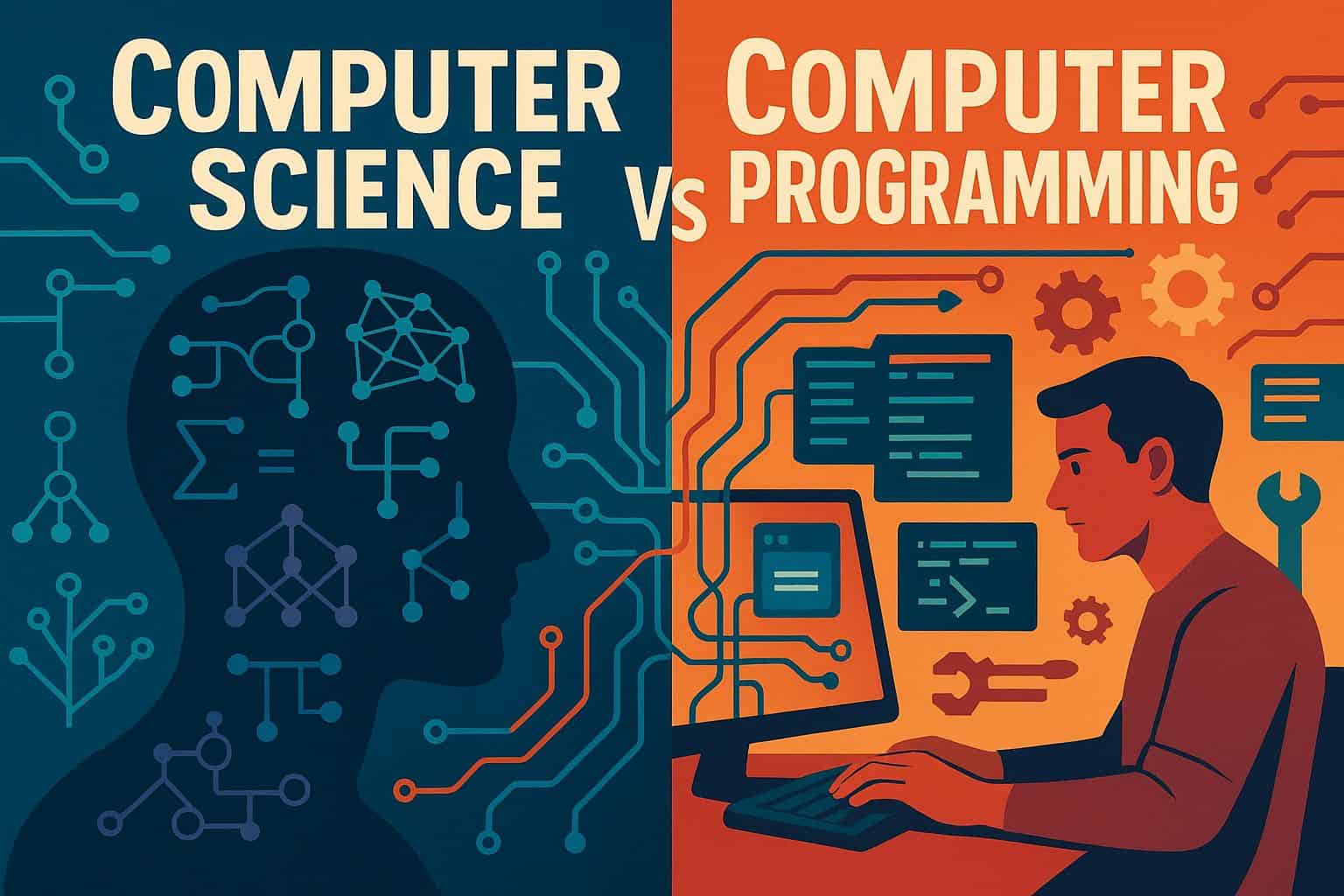
Ever felt like you were staring at two sides of the same coin when trying to figure out computer science vs computer programming? You’re definitely not the only one.
It’s a common point of confusion, especially when you hear wild stats, like how there are over 700 programming languages out there, yet most companies stick to just a handful.
I want to clear up the fog around these two fields.
We’ll walk through what each one is really about, the skills you need to succeed, and how to figure out which path is the perfect fit for your brain. Ready to find your place?
Key Takeaways
Computer science is the broad study of computation, exploring the theory behind algorithms, data structures, and complex systems like AI and cybersecurity. Think of it as the architecture and engineering behind what’s possible.
Computer programming is the practical craft of writing code in languages like Python or JavaScript to build real things like apps, websites, and games. It’s the hands-on construction that brings a computer scientist’s blueprint to life.
Computer scientists often need a bachelor’s or master’s degree, with median salaries for those with advanced degrees reaching over $140,910 per year, according to the Bureau of Labor Statistics.
Programmers can get started with coding bootcamps or associate’s degrees. Entry-level pay hovers around $72,000 for those with 0-1 years of experience and can climb to over $101,000 with a decade of experience.
Looking ahead to 2025 and beyond, AI tools like GitHub Copilot are changing the game. This shift puts a higher value on computer scientists who can design complex systems and programmers who can work alongside AI to build and debug them.
Table of Contents
What Is Computer Science?

Computer science is all about the “why” and “how” behind computers. It dives deep into the logic, math, and theory that make computation possible.
Instead of just writing code, computer scientists design the algorithms and data structures that programmers use every day. It’s about understanding the fundamental principles that allow a machine to “think” and solve problems.
Theoretical foundations of computing
At its heart, computer science is built on a bedrock of logic, math, and abstract theories. Thinkers like Alan Turing laid the groundwork with concepts like automata theory, which explores the limits of what machines can compute. His work on the Halting Problem, for instance, proved that no program can determine if another program will ever stop running, a foundational concept in understanding computational limits.
Another giant in the field, Edsger Dijkstra, developed algorithms that are still critical for everything from network routing to GPS directions. His famous quote captures the essence of the discipline perfectly.
Dijkstra famously stated: Computer Science is no more about computers than astronomy is about telescopes.
This theoretical side explores questions of algorithmic complexity, asking if a problem is even solvable in a reasonable amount of time. Concepts like Big O notation, which measures an algorithm’s efficiency, are essential knowledge for passing technical interviews at top-tier companies like Google and Meta.
Key areas of study in computer science
If you major in computer science, you’ll tackle a wide range of fascinating subjects. You’ll build a strong foundation in algorithms, data structures, computer architecture, and the theory of computation.
From there, you can dive into specialized fields that are shaping our future:
- Artificial Intelligence and Machine Learning: This is where you learn to build systems that can learn from data. You might work with large language models like OpenAI’s GPT-4 or design new neural network architectures.
- Cybersecurity: Demand for cybersecurity specialists is booming. The U.S. Bureau of Labor Statistics projects that jobs for information security analysts will grow much faster than the average for all occupations.
- Human-Computer Interaction (HCI): This field focuses on designing technology that is intuitive and easy for people to use.
- Robotics and Big Data: You could be designing autonomous systems or creating ways to analyze massive datasets for scientific or business insights.
Top universities like MIT, Stanford, and Carnegie Mellon are renowned for their computer science programs, offering cutting-edge research and incredible networking opportunities. Many graduates from these programs go on to pursue advanced degrees to lead research or manage complex technical projects.
What Is Computer Programming?

Computer programming is the art of giving a computer a set of instructions to perform a specific task. It’s the practical, hands-on work of writing, testing, and maintaining code using languages like Python or JavaScript.
If a computer scientist is the architect who designs the blueprint, the programmer is the skilled builder who brings that blueprint to life, brick by brick (or line by line).
Practical application of writing code
Writing code is all about turning ideas into functional software. Programmers build the websites you browse, the mobile apps on your phone, and the video games you play. The process involves breaking down a large problem into smaller, manageable steps and then translating those steps into a language the computer understands.
A huge part of a programmer’s day is debugging, which is the detective work of finding and fixing errors in the code. A famous “insider” technique for this is called “rubber duck debugging,” popularized by the book *The Pragmatic Programmer*. The idea is to explain your code, line-by-line, to a rubber duck. In doing so, you often find the source of the bug yourself.
Programmers work in teams using tools like Slack for communication and GitHub for version control, allowing multiple people to collaborate on the same codebase without stepping on each other’s toes.
Common programming languages and tools
While there are hundreds of programming languages, the professional world revolves around a select few. According to the 2025 Stack Overflow Developer Survey, the most popular languages continue to be JavaScript, HTML/CSS, SQL, and Python. Python, in particular, has seen a huge surge in popularity due to its dominance in AI and data science.
I still remember writing my first “Hello, World!” script in Python using a simple text editor. It was a game-changer when I moved to an Integrated Development Environment (IDE) like Visual Studio Code, which bundles a code editor, debugger, and other essential tools into one powerful application.
Here’s a quick look at some popular languages and where you’ll see them:
| Language | Primary Use | Beginner Friendliness |
|---|---|---|
| Python | AI, Data Science, Web Development | Very High |
| JavaScript | Web Development (Front-end & Back-end) | High |
| Java | Enterprise Applications, Android Apps | Medium |
| C# | Windows Apps, Game Development (Unity) | Medium |
Programmers also rely on version control tools like Git to track changes and collaborate. Understanding these core tools is just as important as knowing the language itself.
Key Differences Between Computer Science and Computer Programming

Think of it this way: a computer scientist designs the engine, figuring out the physics of combustion and efficiency. A programmer builds that engine, torques the bolts, and makes sure it runs smoothly.
Both are essential for making a car go, but they focus on very different parts of the process. Computer science is about the big ideas and underlying principles, while programming is about the practical implementation of those ideas.
Scope and focus
Computer science has a vast scope, covering everything from the theory of computation to modern applications like artificial intelligence and cybersecurity. A computer scientist might spend their time designing a new, more secure encryption algorithm or developing a machine learning model to predict stock market trends.
Programming, on the other hand, is much more focused. It’s centered on the task of writing code to create a specific piece of software. A programmer might use an existing encryption library to secure a new mobile banking app or implement a pre-designed algorithm to sort user data on a website.
One works behind the scenes puzzling out how computers think; the other brings those thoughts to life.
Theoretical vs. applied approach
This is the biggest difference. Computer science is fundamentally theoretical. Students learn the math and logic that prove why an algorithm is correct and efficient before they even write a line of code. They study concepts like graph theory and algorithmic complexity at a deep, abstract level.
Programming is entirely applied. Programmers take those proven theories and use them to build real-world applications. Their day is filled with practical challenges like debugging code, integrating with APIs, and making sure the software works as expected for the end-user. As one user on Reddit put it, computer science is the “what and why,” while programming is the “technically how.”
Problem-solving methods
A computer scientist solves problems by designing new algorithms and models. They use mathematical proofs and logical reasoning to invent solutions for complex, large-scale challenges, like how to efficiently route internet traffic across the globe.
A programmer solves more immediate, practical problems. They use debugging tools to find a bug in a mobile app or apply a framework like Agile or Scrum to manage the development of a new feature. The 18th Annual State of Agile report is expected in late 2025, but the methodology is already a standard for helping teams manage changing priorities and deliver value quickly. This focus on workflow and tangible results is central to a programmer’s problem-solving toolkit.
Roles and Responsibilities

The day-to-day work in these fields can look very different. One path leads to designing the systems of tomorrow, while the other focuses on building the applications we use today.
Roles in computer science
A degree in computer science opens doors to roles that require deep theoretical knowledge and a big-picture view of technology. These aren’t just coding jobs; they’re about architecture, research, and strategy.
Common roles include:
- Systems Architect: Designs the high-level structure of complex software systems, ensuring all the parts work together efficiently and securely.
- Machine Learning Engineer: Develops and trains AI models to do everything from recognizing faces to recommending movies.
- Cybersecurity Lead: Protects an organization’s data and systems from threats by designing and implementing security protocols.
- Research Scientist: Works at places like Google DeepMind or Meta AI to push the boundaries of what’s possible in fields like artificial intelligence, publishing papers and creating new technologies.
These roles often involve more research, planning, and design than actual coding, though programming is still a necessary skill.
Roles in programming
Programming roles are all about the hands-on creation of software. These are the people who write the code that powers our digital world.
The field has many specializations:
- Front-End Developer: Builds the visual part of a website or app that you interact with, using languages like HTML, CSS, and JavaScript.
- Back-End Developer: Works on the server-side logic and databases that power the application from behind the scenes.
- Full-Stack Developer: A jack-of-all-trades who can work on both the front-end and back-end of a project.
- DevOps Engineer: Bridges the gap between development and IT operations, focusing on automating the software deployment pipeline using tools like Docker and Kubernetes.
Programmers spend most of their day writing, testing, and debugging code, and often collaborate closely in teams to build and maintain applications.
Education Paths
How you get into these fields can be quite different. One path typically involves a traditional university degree, while the other offers more flexible entry points like bootcamps and certifications.
Degrees for computer science
To become a computer scientist, a bachelor’s degree is usually the minimum requirement. This degree provides the crucial theoretical foundation in mathematics, algorithms, and systems design that the role demands. Programs from top universities like Stanford or MIT are highly sought after by tech giants.
For more specialized or senior roles, especially in fields like AI or research, a master’s degree or even a Ph.D. is often necessary. An advanced degree from a school like Rice University not only deepens your technical knowledge but also equips you with project management and strategic thinking skills, preparing you for leadership positions.
If you want to crack big problems, start by mastering small concepts—degree by degree; bit by bit.
Want tips about courses? Check this guide here: how to study computer science.
Certifications and training for programming
While many programmers have computer science degrees, it’s not the only way in. The path to becoming a programmer is often more flexible and skill-based.
Here are some common routes:
- Coding Bootcamps: These are intensive, short-term programs (usually 3-9 months) that teach practical, job-ready coding skills. They are a popular and fast way to break into the industry.
- Online Courses: Platforms like Coursera and Codecademy offer a wealth of courses and specializations in specific programming languages and technologies.
- Certifications: Earning a certification can prove your expertise in a specific area. In 2025, certifications in cloud technologies like AWS Certified Solutions Architect or security credentials like Certified Information Systems Security Professional (CISSP) are incredibly valuable for boosting your career and salary.
The key for programmers is to build a strong portfolio of projects that showcases their skills to potential employers. Hands-on experience often speaks louder than a formal degree.
Skills and Competencies Required
While both fields require strong problem-solving skills, the specific abilities needed to excel in each are distinct. One leans heavily on abstract thinking and math, while the other demands attention to detail and mastery of specific tools.
Skills for computer scientists
A computer scientist needs a powerful toolkit of analytical and theoretical skills. At the top of the list is a deep understanding of mathematics, especially areas like discrete math, calculus, and linear algebra, which are the language of algorithms and data structures.
Strong problem-solving and abstract thinking are also crucial. You have to be able to look at a massive, complex problem and break it down into logical, manageable parts. I remember using Python to work through complex statistical models in college; that ability to translate theory into a working model is a core computer science skill.
Finally, communication is key. Computer scientists must be able to explain complex ideas clearly to both technical and non-technical audiences, whether they are writing a research paper or designing a new software architecture for a team of developers.
Skills for programmers
For a programmer, the skills are more concrete and tool-oriented. First and foremost, you need fluency in one or more programming languages like Python, Java, or JavaScript. This is your primary tool for building things.
Attention to detail is non-negotiable. A single misplaced semicolon can bring an entire application to a halt, so the ability to write clean, precise code is essential. This naturally leads to another critical skill: debugging. You’ll spend a lot of time hunting down and fixing bugs, so patience and a logical approach are your best friends.
Lastly, programmers need to be masters of their tools. This means being proficient with version control systems like Git, understanding how to use an IDE like Visual Studio Code effectively, and knowing how to work with APIs to connect different software services.
Career Opportunities
Both fields offer exciting and lucrative career paths, but they lead to different destinations. One path takes you toward research, architecture, and high-level strategy, while the other is focused on the craft of building software.
Career paths in computer science
With a foundation in theory, computer scientists are well-positioned for roles that shape the future of technology. I started my own journey as a teaching assistant for a data structures course before moving into a software engineering role where I could apply those principles on a larger scale.
Many computer scientists pursue leadership roles or specialized careers that require advanced degrees:
- AI and Machine Learning Engineer: Building the intelligent systems that power everything from self-driving cars to personalized medicine.
- Data Scientist: Analyzing large datasets to uncover trends and insights that drive business decisions.
- Cybersecurity Architect: Designing security systems to protect critical infrastructure and sensitive information.
- Technical Product Manager: Guiding the vision and strategy for a technology product, bridging the gap between engineering teams and business goals.
Career paths in programming
Programming careers are all about building and maintaining software. There are countless opportunities across every industry imaginable, from entertainment to finance.
You can start with a bootcamp or even by teaching yourself, and then specialize in an area that interests you:
- Web Development: Creating websites and web applications, either on the front-end (what the user sees) or the back-end (the server and database).
- Mobile App Development: Building the apps we use on our phones every day for iOS or Android.
- Game Development: Writing the code that brings video games to life, often using engines like Unity or Unreal Engine.
- Robotic Process Automation (RPA): Building bots to automate repetitive business tasks, freeing up humans for more creative work.
The career ladder for a programmer often goes from a junior developer to a senior developer, and then to a tech lead or engineering manager, where you guide a team of other programmers.
Salary Comparison
Let’s talk money. Both fields are known for offering competitive salaries, but the numbers can vary significantly based on your role, experience, and education.
Average salaries for computer scientists
Roles that require a computer science background, especially those needing an advanced degree, tend to command higher salaries. According to the U.S. Bureau of Labor Statistics (BLS), the median annual pay for computer and information research scientists was $140,910. The top 10 percent in this field can earn more than $232,120.
Specialized fields like artificial intelligence, data science, and cybersecurity often offer even higher pay. Companies like Amazon, Google, and Meta are constantly competing for top talent with deep theoretical knowledge to solve their biggest technical challenges.
Average salaries for programmers
Programmers also earn excellent salaries, with plenty of room for growth. According to data from Coursera and Glassdoor as of late 2025, a programmer with 0-1 years of experience can expect to make around $72,000 per year. This can rise quickly with experience.
Here’s a general breakdown of how salaries can progress for a programmer:
| Experience Level | Average Annual Salary |
|---|---|
| Entry-Level (0-1 years) | $72,000 |
| Mid-Level (4-6 years) | $88,000 |
| Senior (10-14 years) | $101,000 |
Specializing in a high-demand language like Python or in a field like mobile app development can push these numbers even higher. While the BLS projects a slight decline in the overall number of “computer programmer” jobs as some tasks become automated, the demand for skilled software developers who can build complex systems remains very strong.
Choosing Between Computer Science and Computer Programming
So, which path is right for you? It really comes down to what makes you tick. Are you energized by abstract puzzles and big ideas, or do you get a thrill from building something tangible and seeing it work right away?
Aligning with personal interests
If you genuinely love math, logic puzzles, and asking “why,” then computer science is likely your calling. It’s a field for people who are curious about the fundamental principles of computation and want to design the next wave of technology. Think of Alan Turing, who was fascinated by the theoretical limits of machines long before modern computers were a reality.
On the other hand, if you’re a builder at heart, computer programming might be a better fit. Programmers get immense satisfaction from writing code and seeing it come to life as a working application. They love the hands-on process of creating, debugging, and refining. If you enjoy jumping into projects and learning by doing, you’ll thrive in the world of software development.
If math makes you nervous but coding excites you, check out this guide: computer science and math.
Considering career goals and strengths
Think about where you see yourself in ten years. If your goal is to be in a leadership position, a research lab, or a role where you’re designing complex systems from the ground up, a computer science degree will provide the strong theoretical foundation you need.
If you want to get into the tech industry quickly and start building things, programming offers a more direct path. You can learn job-ready skills through a coding bootcamp and be working as a software developer in under a year. This path values practical skills and a strong portfolio of projects.
The great news is that both paths lead to stable, well-paying careers at the forefront of innovation. The key is to choose the one that aligns with your natural strengths and long-term ambitions.
How Will Computer Science and Computer Programming Change in 2025?
The rise of artificial intelligence is the biggest change on the horizon, and it’s reshaping both fields. The old fear was that AI would replace programmers, but that’s not what’s happening.
Instead, AI-powered tools like GitHub Copilot are becoming essential “pair programmers.” A 2022 study showed developers using Copilot completed tasks 55% faster than those without it. These tools handle the repetitive parts of coding, freeing up human developers to focus on more complex problem-solving and system design.
A recent Gartner report emphasized that AI will not replace software engineers but will transform their roles, requiring them to upskill in areas like AI integration. The report predicts that human creativity and expertise will remain essential for creating innovative software.
For computer scientists, this means a growing demand for expertise in big data, machine learning, and cybersecurity. For programmers, the focus will shift from just writing code to effectively using AI tools, debugging AI-generated code, and integrating intelligent features into applications.
Remote work is also here to stay, giving skilled professionals in both fields more flexibility than ever. The future isn’t about replacement; it’s about augmentation. The most successful tech professionals in 2025 and beyond will be those who can leverage AI to become even more powerful creators and thinkers.
People Also Ask
What is the main difference between computer science and computer programming?
Computer science is the theoretical foundation, focusing on algorithms, data structures, and concepts like computational tractability. Computer programming is the practical execution, using languages like Python and tools like Git to build and maintain software.
Do I need to know software engineering for both fields?
Yes, but computer science studies the theories behind software engineering design patterns, while computer programming applies them to build products. A practical software development role often involves managing code with version control systems like Git and project tracking in platforms like Jira.
How do classifications of programming languages fit into these areas?
A computer scientist studies the theoretical trade-offs between paradigms like object-oriented Java and functional Haskell, while a programmer focuses on the practical execution and mastery of a specific language to build applications.
Is machine learning part of both fields?
Absolutely, a computer scientist might design a new neural network architecture or algorithm. A computer programmer then uses a framework, like Google’s TensorFlow or Meta’s PyTorch, to implement and train that model on a specific data science problem.
Which field should I choose if I want to focus on building apps fast?
For rapid mobile app development, focus on computer programming and learn a specific framework like Google’s Flutter or Apple’s Swift. This path gets you building functional applications much faster than the theoretical route of computer science.
