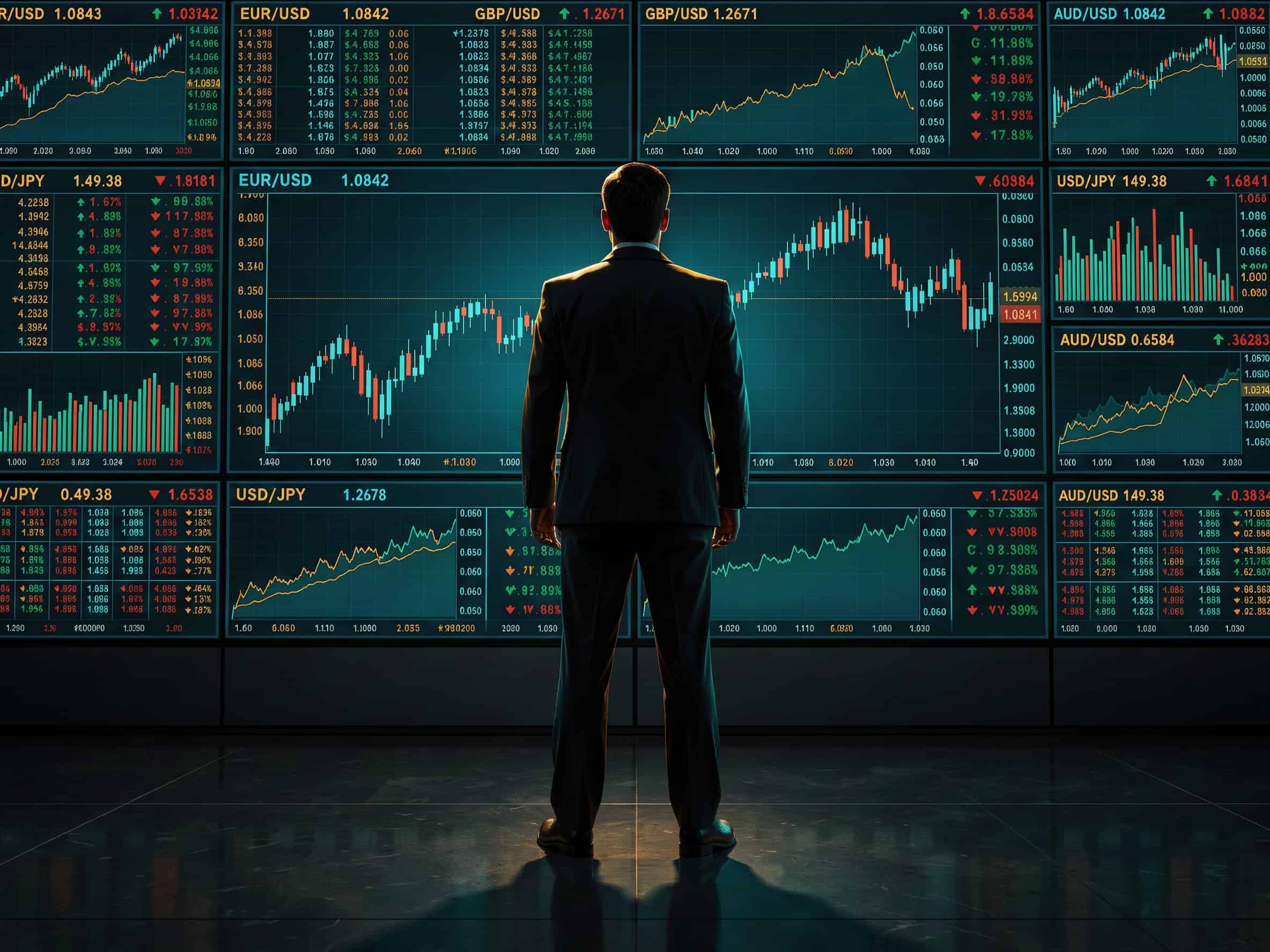
Somewhere in a trading Discord right now, someone with three weeks of screen time and a laser-eyed avatar is getting called a forex god. The same word gets attached to George Soros, the man who made over a billion dollars in a single day betting against the British pound. We decode specs and fandom jargon for a living, and this term is a fun one, because it’s a fandom title that can also be bought. A forex god is a trader with exceptional, near-mythical success in forex trading, the highest compliment trading communities hand out.
The catch, and the reason this is worth decoding: the label describes a learnable process standard, not supernatural skill. Soros says he’s right only about 50% of the time, and he’ll tell you so himself.
Key Takeaways
Soros made over $1 billion in one day shorting the pound on September 16, 1992, and says he’s right only about 50% of the time.
The documented edge is asymmetric payoff, not prediction: legends cut losers fast and size winners big, using public strategies like trend following and breakouts.
Consistent profitability typically takes 2-5 years of active trading, with 1-2% of capital risked per position, in a market where 70-80% of retail traders lose money.
Table of Contents
What is a forex god?
A forex god is a trader with exceptional, near-mythical success in currency markets; in trading communities it’s the highest compliment you can hand someone. The compliment means anything because of what the market does to everyone else. Forex is the foreign exchange marketplace where traders buy and sell currencies to profit from price changes, with roughly $7.5 trillion changing hands daily worldwide (BIS, April 2022). It’s the biggest market almost nobody discusses at dinner, it moves on global news and politics, and 70-80% of retail traders lose money.
It’s fascinating context, not a warning label: mastery over a market that humbles most participants is rare, which is why the title lands.
The same phrase, though, shows up in educator marketing. A November 18, 2024 Newswire announcement promoted Christian J Smith (Frost) of FrostFXTheMarketMasters as “God of Forex,” citing a claimed community of 3,000+ members across multiple countries. That’s self-branding, we’re reporting it, not endorsing it, and the filter is simple: ask who gave the title and who took it. Real legends admit their failure rates; self-branded gods project flawlessness.
Forex gods are made, not born, through years of disciplined practice. No special powers required.
The traders who earned the title
Five traders whose documented, verifiable success shows what the label describes. Each profile leads with the detail the listicles skip.
George Soros and Black Wednesday
Arguably the most famous forex trader in history. He judged the pound’s artificially high exchange rate inside the European Exchange Rate Mechanism unsustainable, the Quantum Fund took a short, and when the Bank of England abandoned the peg on September 16, 1992, Black Wednesday paid out over $1 billion in a day. His edge was reflexivity theory: biased participant perceptions create self-fulfilling prophecies, so markets run on how people perceive and react to fundamentals, not just the fundamentals. The humbling detail: he says he’s right only about 50% of the time, with wins larger than losses and losers cut fast.
Stanley Druckenmiller
Instrumental in executing the 1992 pound trade at Quantum. He posted roughly 30% annual returns over 30 years with no losing year. His method is aggressive sizing on high conviction and fast loss-cutting, a sizing-discipline contrast to Soros’s reflexivity-driven macro conviction. The way to build long-term returns is through preservation of capital and home runs.
Paul Tudor Jones
Predicted and profited from the 1987 Black Monday crash, and the documentary Trader captured the thinking, not just the result. Worth a watch for exactly that reason. He runs on technical analysis, price action, and market structure over fundamentals, and never risks more than he can afford to lose on a single trade. Don’t focus on making money; focus on protecting what you have.
Andrew Krieger
Okay, so check this out. After the 1987 crash, he spotted the New Zealand dollar as overvalued at Bankers Trust. His short position was reportedly larger than New Zealand’s entire money supply, it made roughly $300 million for his bank in a single trade, and the New Zealand government reportedly complained to Bankers Trust. Both “reportedly”s stay, and honestly they help: a short bigger than a country’s money supply is ridiculous enough that the hedging reads as honest reporting.
Bill Lipschutz
The most relatable arc of the five. He turned a $12,000 college inheritance into $250,000, then lost all of it, and that failure is the point. He went on to generate hundreds of millions in forex profits at Salomon Brothers, with a counterintuitive take: missing profitable trades hurts more than small losses, because winners must outpace losers.
The real edge: asymmetric payoff, not prediction
The gods lose roughly half the time. The “god” label describes how they size wins and cut losses, not how they see the future. Soros’s ~50% figure is his own self-estimate, not a verified statistic, which makes it more credible, not less. Lipschutz’s view that missing winners hurts more than small losses and Druckenmiller’s preservation-of-capital-plus-home-runs formula are the same idea arriving from three directions.
The real edge is repeatable process, risk control, clear setups, and discipline: position sizing, tested strategies, a written plan on every trade. The job is managing risk and execution better than most, not out-guessing the crowd. Prediction implies certainty; probability acknowledges uncertainty. These traders react to probabilities. These aren’t market wizards, they’re process technicians.
The seven disciplines forex gods share
Strip out the mystique and you’re left with seven documented disciplines: emotional control, 1-2% risk caps, patience, continuous learning, simplicity, process over outcome, and independent thinking. Prop-firm educator material corroborates the same list from the outside with its own four: discipline, control, knowledge, and being reserved about risk. Same virtues, different packaging. Take patience: doing nothing is often the most profitable decision, waiting for high-probability setups instead of forcing trades out of boredom or FOMO, sometimes that means only a few significant positions a month. None of it is secret, and that’s the honest hook: the boring truth is the interesting truth.
- Emotional control under pressure. Trained, not natural. The ego detaches from individual trade outcomes, losses register as part of the job, and a losing streak doesn’t hijack decision-making. The prop-firm framing describes what it looks like from outside: never let emotions cloud judgment, calm and unfazed by market shifts. In practice it’s reps, not temperament.
- Risk management. Most limit risk to 1-2% of capital per position, with 1% as the experienced-trader cap, never violated regardless of confidence. That “regardless of confidence” is the part people break. Position sizing, stop losses, diversification: foundational, not fancy.
The discipline scales flat, because 1% of $10,000 is the same discipline as 1% of $10 million. And the failure pattern is quiet: traders who follow the 1% rule on paper but quietly size up after a winning streak.
Red flag: A trading journal where position size quietly grows alongside confidence means the 1% rule is being broken after winning streaks.
- Patience and selectivity. Jesse Livermore, the old-school speculator worth knowing by name: “Money is made by sitting, not trading.” Doing nothing is often the most profitable decision, and it’s the hardest skill for anyone who likes pressing buttons. Elite traders may take only a few positions per month, waiting for high-probability setups instead of forcing trades from boredom or FOMO.
- Continuous learning. Strategies that worked in 2010 may fail in 2025. Traders who last autopsy both losses and wins for causes, and wins get reviewed too, which is the part most people skip. The reading list never ends: economics, geopolitics, market structure, psychology.
- Simplicity over complexity. Most successful traders run relatively simple strategies, one or two deeply understood setups.
- Process over outcome. Judge by system adherence, not individual trade results. A losing trade per plan is a success; a winning trade that violated the rules is a failure. Process generates results over hundreds of trades regardless of short-term variance.
- Independent thinking. Form opinions from your own analysis and take contrarian positions when the analysis supports it. Soros shorting the pound against consensus is the standing example. Doing your own research, literally.
Five myths about forex gods, debunked
Forex gods do not use secret strategies. The toolkit is public: trend following, mean reversion, breakout trading. The edge is execution and psychology.
Myth: they never lose
Soros is right only ~50% of the time by his own admission; Lipschutz lost his entire $250,000. Expecting never to lose makes you hold losers too long and refuse valid stop losses.
Myth: they use secret strategies
No magic indicators, no hidden formulas. We’ve gone looking; there’s nothing there. The “secret” is execution and psychology, a satisfying reveal that isn’t a reveal.
Myth: they’re always trading
Elite traders spend more time waiting than trading, preserving capital in bad conditions and deploying aggressively in good ones. Overtrading is the classic retail mistake, and not trading is itself a position.
Myth: they predict the future
They react to probabilities, find favorable risk-reward, and accept they might be wrong.
Myth: anyone calling themselves a forex god online is one
A recurring pattern in forex social media: a few winning screenshots, a god-style handle, signals and course sales before any verified multi-year track record. The November 2024 FrostFXTheMarketMasters press release and its All-in-One Forex Bible, a step-by-step guide covering strategies, risk management, Smart Money Concepts, and millionaire-mindset psychology, are documented examples of the self-branding pattern, described neutrally. Searches like “forex god net worth” have no verified answers behind the self-branded labels, and that absence is part of the filter. The novice mistakes repeat underneath it all: overtrading, ignoring stop-losses, lack of emotional control.
How to start: the realistic path toward god-tier discipline
The sequence matters: risk management first, then pair specialization, a trading journal, demo practice with emotional awareness, and an honest 2-5 year timeline.
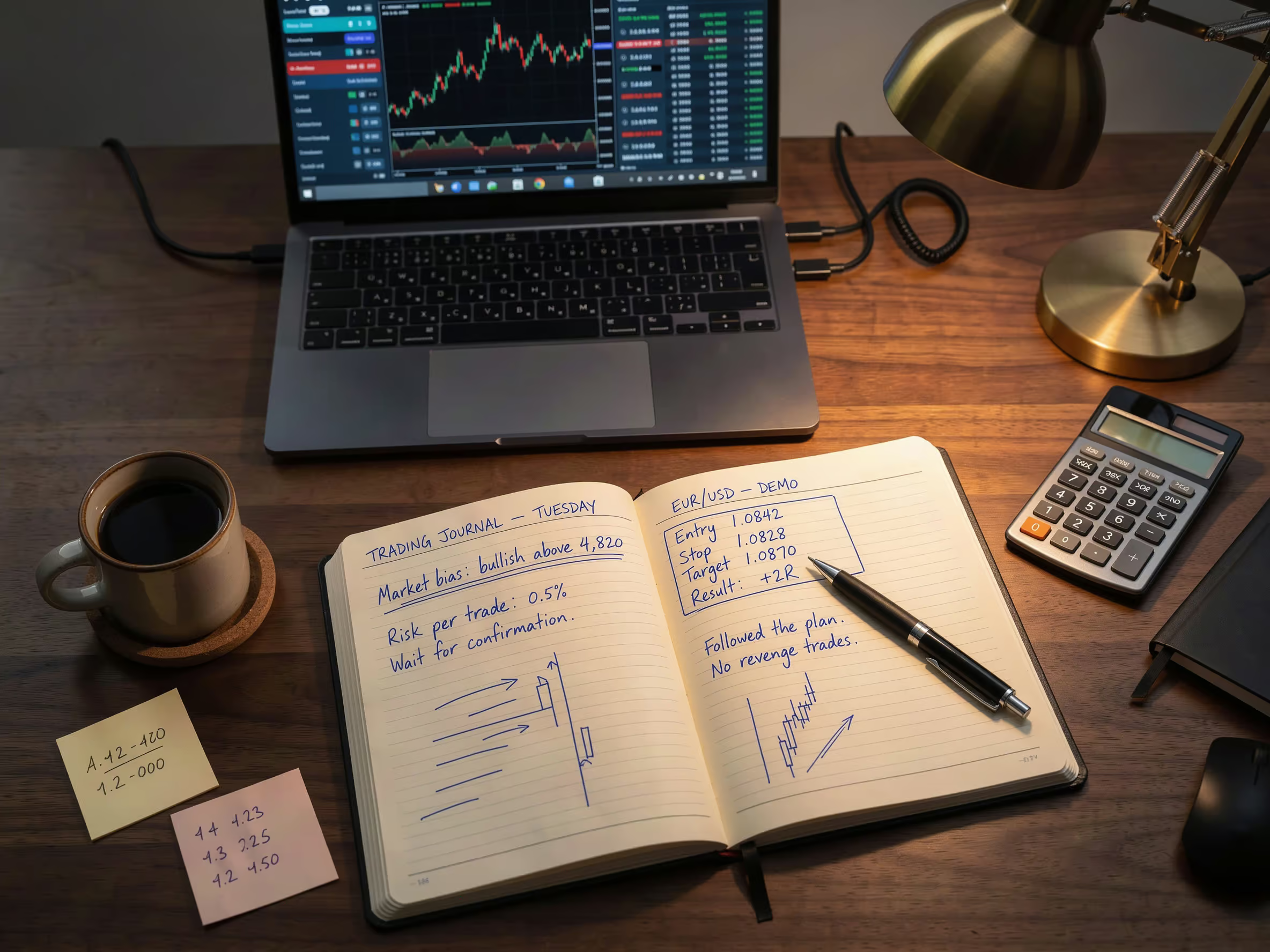
Start with risk management, not strategy
Set a maximum risk per trade, 1-2% standard, and never violate it regardless of confidence. Risk parameters come first because they keep you in the game long enough to develop skill. Survival first, skill second.

Specialize in one or two major pairs
EUR/USD, GBP/USD, and USD/JPY are the usual recommendations, and the reason is liquidity and lower spreads. Trying to trade everything results in mastering nothing. Demo traders running several pairs and strategies at once often only see their one real edge in the journal after narrowing to a single major pair.
Keep a trading journal
Log entry reasons, stop placement, outcomes, and lessons, then review regularly to surface your own behavioral patterns. The journal is the feedback loop, the closest thing traders have to unit tests, and it’s useless if you never read it back.
Practice emotional awareness on a demo account
Fear, greed, hope, and frustration are signals to pause and return to the plan, not enemies to eliminate. If you can’t execute your plan objectively, you shouldn’t be trading right now. Demo accounts use simulated funds under real market conditions at no financial risk, which Maven’s education material frames as building decisions and a trading plan without losing money, free reps before real market sentiment swings test your discipline. The same material’s corroborating steps fit here: know your trading goals, learn the market inside-out from experienced traders and reputable sources, and build a strategy tailored to your risk tolerance with entry and exit points and risk rules.
Accept that mastery takes time
Expect 2-5 years of active trading before consistent profitability. That’s a typical range traders report, not a guarantee. Anyone promising quick mastery is selling something.
The trader’s toolkit and execution infrastructure
Infrastructure won’t make you a forex god, but poor infrastructure holds you back. One flag up front: the latency numbers below come from a VPS vendor’s own marketing.
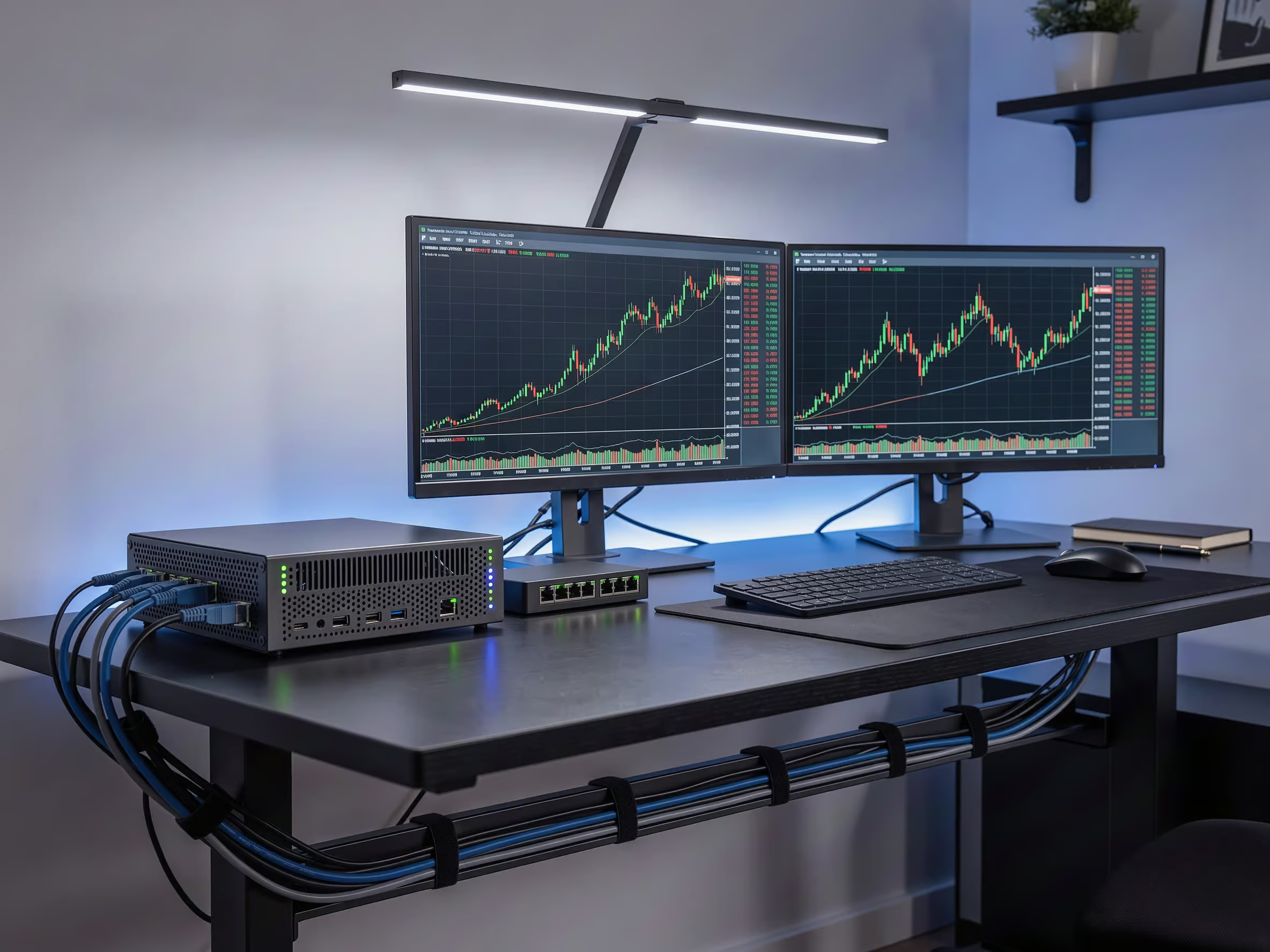
Three analysis pillars
Technical analysis reads price charts and patterns for entry and exit points. Fundamental analysis tracks the economic and political drivers underneath. Sentiment analysis gauges market mood.
Tools that support discipline
A supply and demand indicator maps key price levels and support/resistance, a currency strength meter compares relative pair strength, a risk manager enforces stop-losses and leverage limits, and a trade panel speeds up order execution. Algorithmic trading executes quickly and helps avoid emotional pitfalls.
Execution speed and the VPS question
NYCServers, a VPS provider, publishes figures putting retail home-computer latency at 100-500ms to broker servers versus 1ms for a forex VPS with 24/7 uptime, with delay causing slippage and missed fills. Those figures are uncorroborated; treat them as marketing. The real VPS wins are uptime, stability, and consistent execution, because your bot doesn’t care that your laptop went to sleep. Treating vendor claims critically is itself one of the disciplines from earlier in this article.
Can you become a forex god? The attainability tension, resolved
Consistent profitability typically takes 2-5 years of active trading, 70-80% of retail traders lose money, and “forex god” is a process standard rather than a promised outcome. Promotional prop-firm framing claims anyone can become a Forex God with the right game plan, and the softer version, that forex gods aren’t mythical but traders who learned the art, aligns with the thesis here. The statistical reality is the 70-80% loss rate and Soros-level success being exceptionally rare. The principles work at any scale, but the title is earned through sustained improvement, not promised by a game plan.
Why most lose is no mystery: overtrading, ignoring stop-losses, lack of emotional control, the same failure modes the myths exposed. Measure yourself against who you were last month, not against Soros.
Forex god FAQ
Is becoming a forex god realistic?
One trader making over $1 billion in a single day is the outlier, not the baseline; the principles help any trader get consistently profitable at their own scale.
How long does it take?
2-5 years of active trading and learning, with substantial screen time and no shortcuts.
Do forex gods use automated trading?
Some do, some don’t; many combine discretionary and systematic approaches. The key is a method you can execute consistently and fully understand.
What’s the most important trait?
Risk management. You can’t compound returns if the account is blown.
Can you trade part-time?
Yes, often on daily or weekly timeframes; elite levels typically require substantial time commitment.
How much capital do you need?
Risk percentages scale with account size: 1% of $10,000 is the same discipline as 1% of $10 million. Start with what you can afford to lose while learning.
Is forex trading gambling? The ethical and religious objection
Tossing money into anything without understanding the market, past charts, market drivers, and socio-economic factors is gambling; calculated risk grounded in study is not. That distinction comes from Matthew of Aleccu on the Tetrarch World TV channel, answering a viewer who emailed asking whether forex and bitcoin trading is gambling in the sight of God and admitted fearing execution. His argument, framed as his religious perspective rather than financial advice: Joseph going from prison to palace to run Pharaoh’s abundance-and-drought years shows a concern for economic stewardship, and the parable of the talents commends investment, with the faithful servants given control of ten cities. He quotes Matthew 25:27 (ESV) directly: Then you ought to have invested my money with the bankers, and at my coming I should have received what was my own with interest. His dollar valuation of a talent, roughly half a million today, is his own estimate, not scriptural.
His conclusion: every investment type carries risk, comparable to gold, business, or property ownership, so the approach, not the asset, decides the question. Which loops back to the secular thesis: the same study-and-discipline standard that separates gods from gamblers answers the moral question.
The standard worth chasing
Forex god is a journey, not a destination: a nickname for traders who stay consistent, manage risk, and follow their plan without emotional takeover. No one wins every trade; the habits are what make a trader look godlike. Judge yourself by process adherence and by who you were last month. The 1-2% risk cap, the journal, and the patience to sit are the entire standard. This article is general information, not financial or investment advice.
Frequently Asked Questions
Who is called the god of trading?
George Soros is the closest thing trading has to an official god. He made over $1 billion in a single day shorting the British pound on September 16, 1992 — Black Wednesday — when the Bank of England abandoned its currency peg. The title gets thrown around Discord constantly, but Soros is one of the few who earned it with documented, verifiable results.
Who is the forex god and what did George Soros do on Black Wednesday?
Soros judged the pound’s artificially high exchange rate inside the European Exchange Rate Mechanism unsustainable, and his Quantum Fund took a massive short position. When the Bank of England abandoned the peg on September 16, 1992, the trade paid out over $1 billion in a day. His edge was reflexivity theory — the idea that biased perceptions create self-fulfilling market prophecies.
Do forex gods use secret strategies or simple ones like trend following and breakouts?
Simple, public ones. The toolkit is trend following, mean reversion, and breakout trading — no magic indicators, no hidden formulas. The actual edge is execution and psychology: cutting losers fast, sizing winners big, and never letting a winning streak talk you into breaking your own risk rules.
Why do 70-80% of retail forex traders lose money?
The failure modes are well documented: overtrading, ignoring stop-losses, and lack of emotional control. The quiet killer is sizing up after a winning streak — traders who follow the 1% rule on paper but break it the moment confidence grows. The fix is boring: risk caps, a journal, and patience.
How do I start forex trading for beginners with proper risk management?
Sequence matters: risk management first, then specialize in one or two major pairs like EUR/USD or GBP/USD, keep a trading journal, and practice on a demo account with emotional awareness. Set a maximum risk per trade of 1-2% and never violate it regardless of confidence. Survival first, skill second.