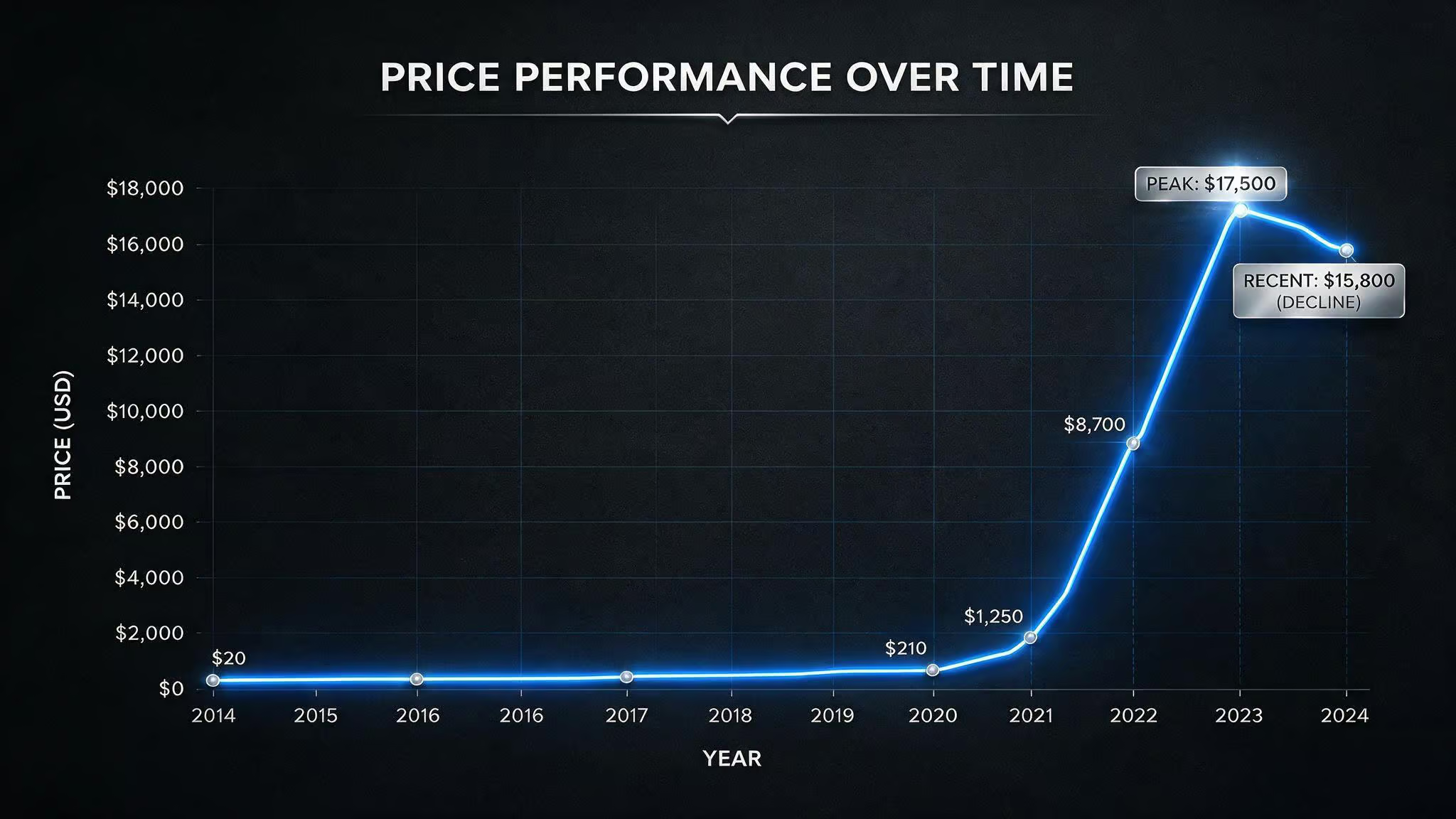
It started at $20. It peaked at $17,500. That’s not a typo.
I was digging into the price history of the AWP | Gungnir for a different article, and I had to stop and double-check the numbers. An 850x increase in less than six years is notable. The current price sits around $11,872, which means it’s technically in a correction phase, but the story of how a single digital skin—a cosmetic item from a discontinued in-game collection—became one of the most valuable items in Counter-Strike 2 is a rabbit hole worth exploring.
This isn’t a market prediction or a “buy now” pitch. It’s the full story of the Gungnir: where it came from, why it’s so scarce, what drives its value, and how a $20.56 skin became a five-figure grail.
Key Takeaways
The AWP Gungnir’s value skyrocketed from an all-time low of $20.56 (September 25, 2020) to an all-time high of $17,500 (May 6, 2025), representing an 850x increase driven by a discontinued collection, capped float range, and no StatTrak or Souvenir versions.
Unlike pattern-dependent skins like Case Hardened or Doppler, every Gungnir looks identical — its finish is fixed, value is purely determined by wear condition, and the float is capped at 0.60, making even Battle-Scarred copies look unusually clean.
Pro players m0nesy, dank1ng, and jl currently own the Gungnir in their inventories, while NiKo and ZywOo have used it on the main stage, cementing its status as a visible endgame skin.
Table of Contents
Design and Lore — Odin’s Spear on an AWP
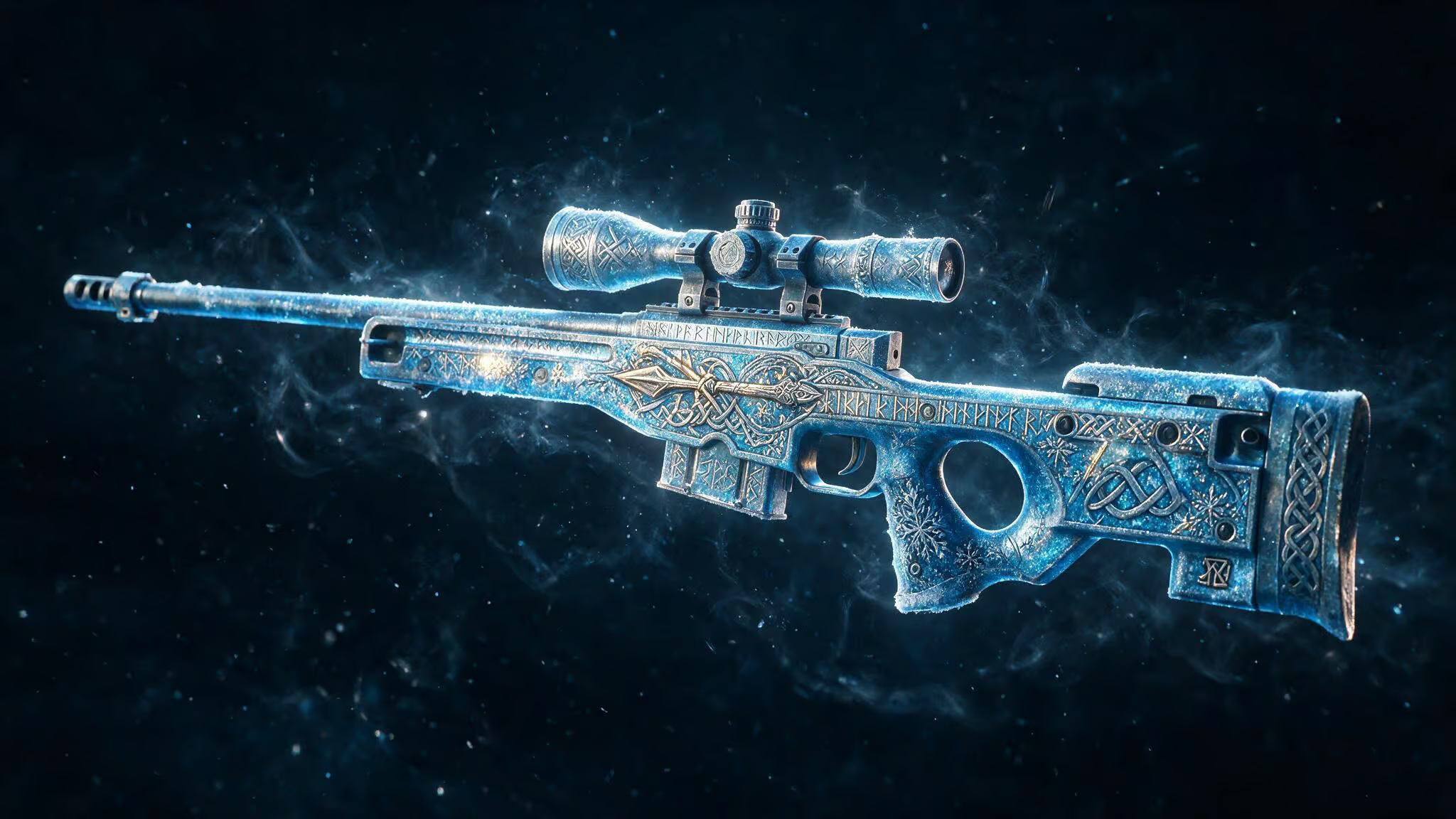
The Norse Collection is an oddball in CS2’s skin ecosystem. It dropped on November 18, 2019, as part of Operation Shattered Web, and it’s the only time Valve leaned into a full mythological theme. Alongside the Gungnir, you’ve got the Negev | Mjölnir (Thor’s hammer), the Desert Eagle | Emerald Jörmungandr (the world serpent), and a bunch of other Norse-named skins like the P90 | Astral Jörmungandr and AUG Flame Jörmungandr. The whole collection has 18 items.
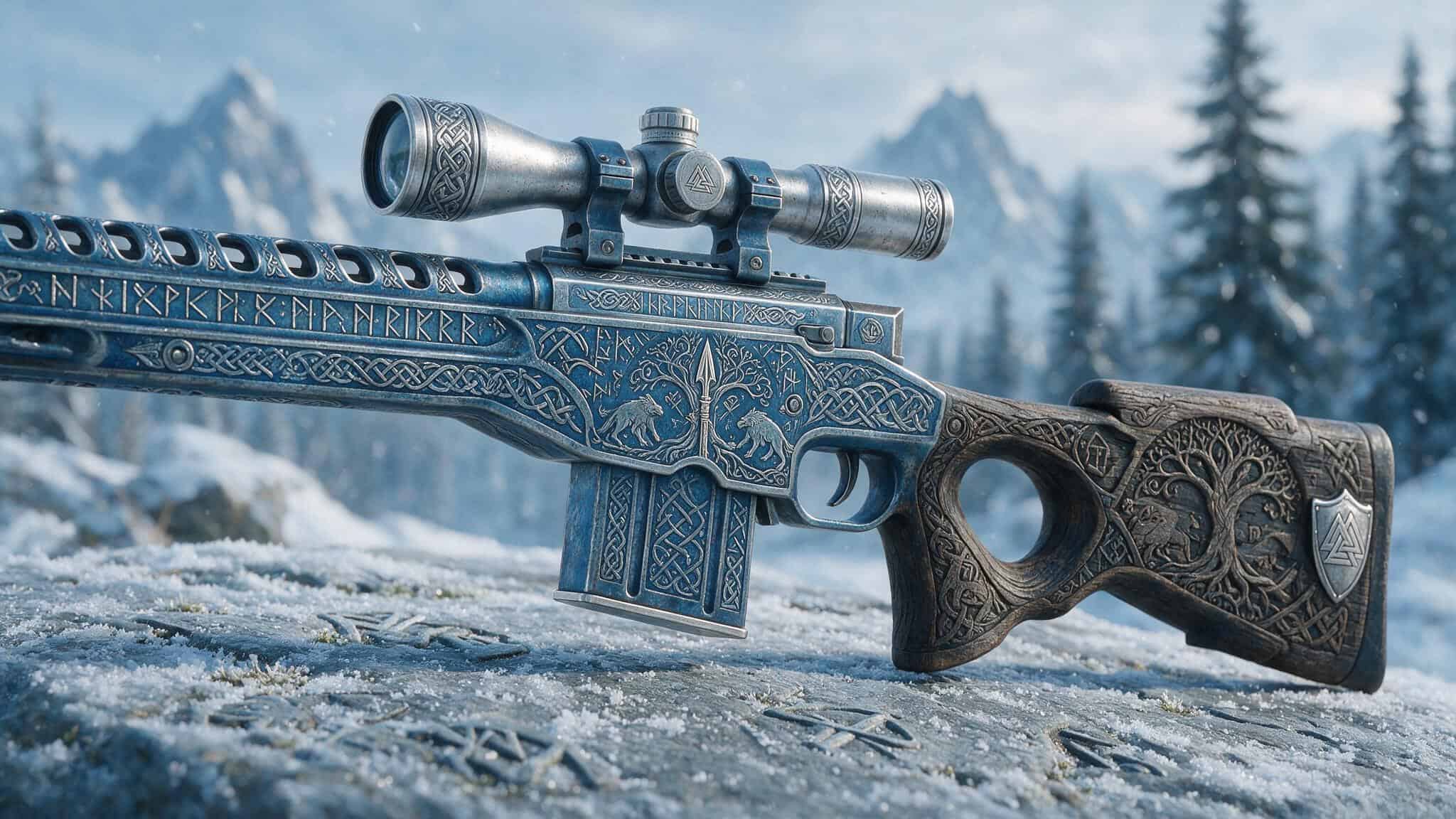
The Gungnir, though, is the crown jewel. The in-game description is simple: “Odin’s spear travels down this custom paint.” You see that in the finish. The color scheme is blue, cyan, white, ivory, and silver — icy, clean, Norse.
It uses the Gunsmith finish style, which means it’s a combination of patina and custom paint. The finish catalog number is 756, which is a detail you’ll only find if you’re scraping the game files.
Here’s the part that matters for its value: there are no pattern variants. Every single AWP Gungnir looks identical in its finish. Pattern index, which drives the insane price swings on skins like the Karambit Doppler (Sapphire) or any Case Hardened, has zero effect here. That’s unusual for a skin.
It simplifies the buying logic. You aren’t gambling on whether you got the “right” pattern. You’re only choosing your wear condition.
One more technical detail that the nerds will appreciate: the Gungnir uses the old CS:GO legacy model version, not the updated CS2 model. In practice, it still looks good in CS2, but it’s a piece of the game’s history baked into the asset.
Rarity and Scarcity — Why It’s So Hard to Find
The Gungnir’s scarcity is not an accident. It’s the result of multiple layers working together, and understanding each one will tell you why it’s so expensive.
Let’s start with the drop rate. It’s a Covert-grade skin, which puts it at roughly 0.64% per drop. That’s rare but not extreme. The scarcity drivers are elsewhere.
The float is capped at 0.00–0.60. This is the detail many people miss. A standard skin can hit 1.00 float, which means the Battle-Scarred versions can look beat to hell. Because the Gungnir has a 0.60 cap, even the worst-condition copies look less worn than a typical BS skin. Minimal Wear becomes a strong value proposition because the pattern hides wear pretty well.
No StatTrak or Souvenir versions exist. Zero. Nothing. The Gungnir was never available as a StatTrak (kill counter) or Souvenir (tournament drop) skin. For collectors who want the cleanest version of a skin, this is a feature, not a bug.
There’s no variant that outclasses the standard one. Every copy is the same base item.
The Norse Collection is discontinued. Once Operation Shattered Web ended, those drops stopped. No new cases contain Norse Collection skins. The only way to get one now is through a trade-up contract.
Supply is fixed at 3,300 copies in circulation. That number does not go up.
The trade-up route is where many people hit a wall. To get a Gungnir via trade-up, you need 10 Classified-grade Norse Collection skins. That’s already expensive. But here is the catch: all 10 input skins must have floats below 0.60 to guarantee a Gungnir output.
If even one input has a higher float, you risk getting a different outcome from the collection. Many guides skip this detail, but it is the difference between a calculated gamble and throwing money away.
Market Price History — From $20 to $17,500 and Back
Let’s walk through the timeline, because the numbers tell a story.
On September 25, 2020, the Gungnir hit its low: $20.56. At that point, it was another Covert skin from an operation that had ended. Nobody knew the collection would become iconic, with the Gungnir eventually ranking among the Best AWP skins in CS2. The operation had wrapped up in March 2020, and the Gungnir was still obtainable through existing drops and trade-ups. Supply was abundant, and demand had not caught up yet.
Then things shifted. The discontinued collection meant no new copies entered the market. Players who held onto their Gungnirs realized they had a finite asset. The CS2 transition hype in 2023 was a catalyst — the skin market surged as the community anticipated the new engine, and the Gungnir rode that wave of interest in the Counter-Strike AWP.
The peak came on May 6, 2025: $17,500. That is the high. To put that in context, if you had bought one at the ATL for $20.56, you would be looking at an 850x return at the top.
Current trajectory as of writing: the price sits around $11,872. The 30-day change is flat ( -0.24%, so -$28), and the 7-day is stable ( -1.07%, -$128). But the 1-year change tells a story: -21.69%, which is a drop of $3,287. That means the Gungnir is in a correction from its May 2025 peak.
The 7-day range is tight ($11,872 to $12,000), and the 30-day range is narrow ($11,872 to $12,075). There is a hint of stabilization at this level.
The per-wear pricing runs from $6,314 (Battle-Scarred) to $12,544 (Factory New). Field-Tested median is $7,904. Factory New averages have been $15,000–$28,000 in 2025, and you will still find FN copies listed on Skinport for $4,700 if you are lucky, though many sit above $15,000.
How to Get an AWP Gungnir — Acquisition Pathways
Okay, you want one. Here are your options.
Direct purchase on third-party marketplaces is the straightforward route. The Steam Community Market has a $2,000 price cap, which makes it useless for the Gungnir. You cannot list one there. You will need to use a third-party platform.
- CSFloat currently has the lowest price at $7,190 for a Battle-Scarred copy.
- CS.MONEY shows promoted prices at $12,308 and a higher alternative at $13,032.
- Skinport, DMarket, and Buff163 are viable options, with Buff163 having competitive prices due to regional differences.
- Clash.gg shows zero Steam listings for the Gungnir, which tells you how hard it is to find even listed.
Fees matter here. Steam takes a 15% cut. Third-party marketplaces charge 2–10%. That difference adds up on a five-figure skin.
Trade-up contract route is theoretically possible, but I want to be clear about how impractical it is for many people. You need 10 Classified Norse Collection skins. The cheapest of those (like the MAG-7 Chainmail or Galil AR Tornado) still run tens to hundreds of dollars each. And you need floats below 0.60 on every one. The risk is significant, and the cost is high enough that you might as well invest in CS2 skins like the Gungnir directly.
One thing you cannot do: open a case and hope. The Norse Collection is not in any active case. Zero chance.
Community and Pro Player Endorsement
It is one thing for us to geek out over the price trajectory. It is another thing when the best AWPers in the world are debating whether the AWP vs OP in Counter-Strike and running it on the main stage.
Three pros have the Gungnir in their active inventories: m0nesy, dank1ng, and jl. That is a small club. On the main stage, NiKo and ZywOo have used it. When ZywOo—the best AWPer on the planet—is rocking your skin in a Major, that is visibility you cannot buy.
The community ratings back up the hype. CSGOSKINS.GG shows a 4.5 out of 5 from 48,097 votes, with a 4.6 out of 5 from another 2,000 votes elsewhere. Popularity sits at 99%. Liquidity is 86%, meaning when you want to sell, it will move quickly. The skin was featured in a ranking of the 10 most expensive CS2 skins, which is the kind of external validation that reinforces its status.
Investment Potential — Risks and Realities
Let’s be honest about what the Gungnir is and is not as an investment.
What works in its favor: the fixed supply (~3,300 copies) combined with a discontinued collection is a fundamental scarcity driver. No new copies enter the market. The lack of pattern variation means you’re not betting on a lottery. You’re betting on the skin itself, not on whether you got pattern 387 or a blue gem.
The capped float at 0.60 means even the cheapest BS copy looks better than a typical worn skin, which supports the floor price. High liquidity (86%) means you can exit quickly if needed.
What’s concerning in the short term: the 30-day decline is flat, but the 1-year change of -21.69% signals a correction from the May 2025 peak. The pro player effect tends to be short-term. When m0nesy or ZywOo gets a highlight clip with the Gungnir, there’s usually a small price bump, but it doesn’t sustain the way scarcity does.
The contrarian angle worth considering: the Gungnir’s lack of pattern variation is actually a value stabilizer compared to skins like the AWP Dragon Lore, which has Souvenir versions that skew the rarity curve, or the M4A4 Howl, which has the Contraband status frozen by Valve. The Gungnir is a purist’s skin. Every copy is the same. That appeals to collectors who don’t want to chase a specific pattern.
Diversification is the smart move in skin collecting. The Gungnir is a core piece, not a short-term flip.
How the Gungnir Stacks Up Against Other Top AWP Skins
Where does it fit in the pantheon of CS2’s most expensive skins?
The AWP Dragon Lore is the king. It has Souvenir versions (only 114 exist), and those command high prices. The AWP Medusa has StatTrak versions. The AWP Desert Hydra and AWP The Prince are expensive, but neither has the same collection-discontinuation story.
The Gungnir’s position is that it has no alternate versions. No StatTrak. No Souvenir. Every copy is standard. That makes it the cleanest collectible for purists who want the “definitive” version of a skin.
In terms of price range, it’s comparable to the AK-47 Fire Serpent and M4A4 Howl, though those have different rarity mechanics (the Howl is Contraband, meaning its supply is frozen). The Gungnir’s ~3,300 supply and 86% liquidity make it more accessible than the AWP Souvenir Dragon Lore, but it’s still in the five-figure tier.
The Bottom Line
The AWP Gungnir started at $20.56. It peaked at $17,500. It’s currently $11,872. Those numbers aren’t just a price chart—they tell the story of a discontinued collection, a floating cap that makes worn copies look good, and a community that decided this was the AWP skin to chase.
For collectors, it’s a grail. The lack of pattern lottery means you buy with confidence, not luck. For traders, it’s a calculated asset with fixed supply and high liquidity, but the short-term trend is bearish. Either way, the Gungnir has earned its spot in CS2’s pantheon of skins.
Frequently Asked Questions
How rare is the AWP Gungnir skin?
Extremely rare. Only about 3,300 copies exist in circulation, and that number is permanently fixed because the Norse Collection was discontinued after Operation Shattered Web ended. No new copies can be unboxed, and there are no StatTrak or Souvenir versions, which further limits supply.
What’s the most expensive AWP skin?
The AWP Dragon Lore is generally considered the most expensive, especially its Souvenir versions (only 114 exist). The Gungnir sits in the same five-figure tier but is more accessible due to its higher supply and lack of pattern variation, making it a purist’s alternative to the Dragon Lore.
Is the AWP Gungnir a good investment right now?
It depends on your timeline. The fixed supply and high liquidity (86%) support long-term value, but the short-term trend is bearish — the price has corrected about 21% from its May 2025 peak of $17,500 to around $11,872. It’s a core collectible, not a short-term flip.