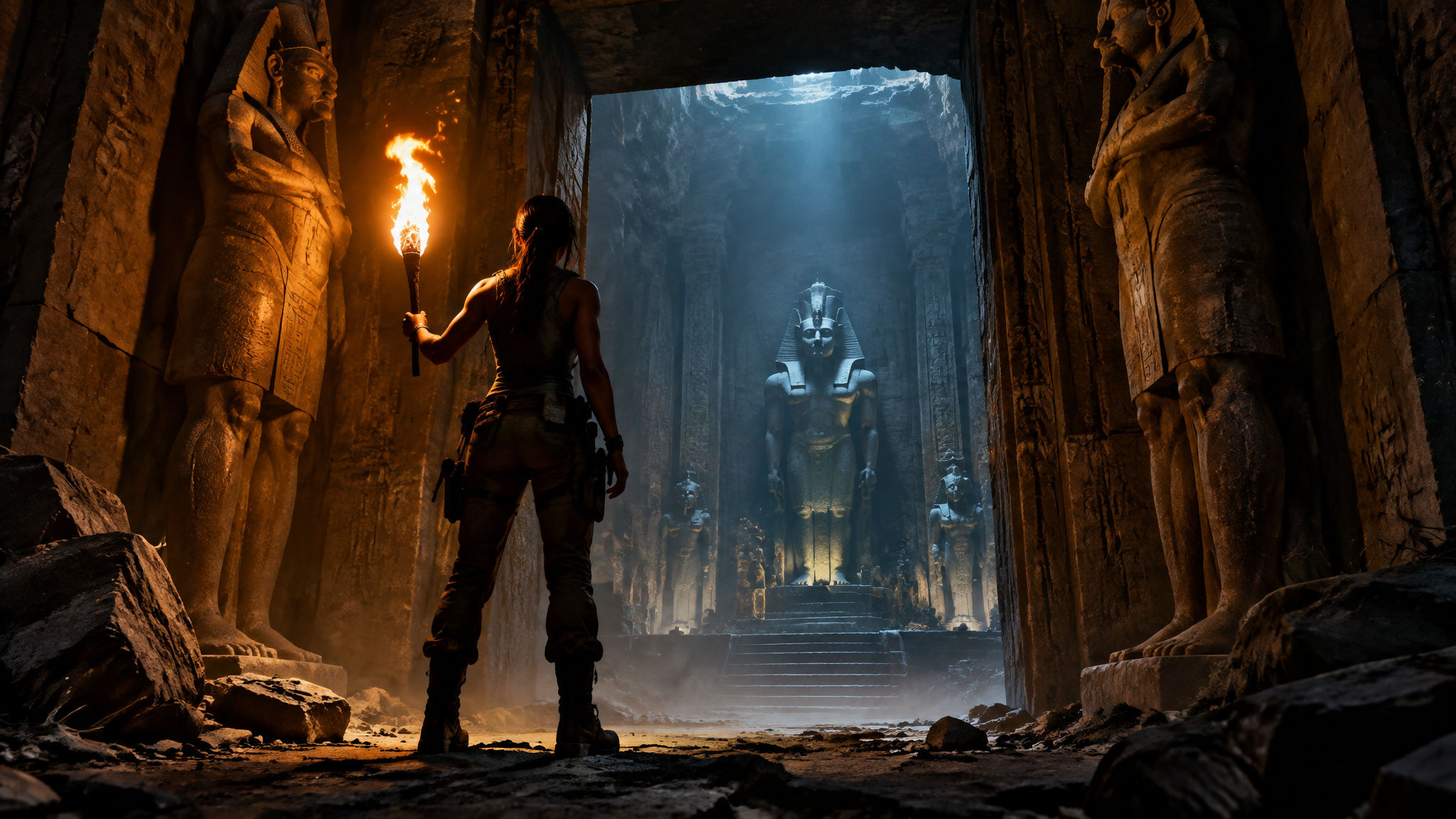
Passing a controller back and forth on the couch is the fastest way to strip the nostalgia goggles off an old franchise. My wife and I have been playing through the Tomb Raider games together as adults, and I’ve had a blast watching how these adventures hold up when two people are arguing over where a hidden lever is or how to survive a sudden avalanche.
At GeekExtreme, we look past marketing hype to examine concrete mechanics, port specs, and real tradeoffs rather than coasting on vague retro affection. That matters here because Lara Croft’s catalog splits across two drastically different design philosophies: the 1996 classic trilogy, rescued from hardware limbo by Tomb Raider I-III Remastered, and the 2013 to 2018 survivor reboot trilogy. Both eras are worth your time once you decide between methodical, trap-heavy puzzle rooms where a botched cheat code makes Lara explode and a cinematic origin story built around stealth, gunfights, and optional challenge tombs.
Key Takeaways
Tomb Raider I-III Remastered earned an 8.5 out of 10 from gamecritics.com and makes the 1996 classic trilogy plus its PC-exclusive expansions playable on PS4, PS5, Xbox One, Xbox Series X|S, Switch, and PC with an instant graphics toggle.
The 2013 to 2018 survivor reboot trilogy (Tomb Raider, Rise of the Tomb Raider, and Shadow of the Tomb Raider) is the smoother starting point for modern players, peaking with Rise’s expanded crafting, Byzantine coin vendor economy, and stronger villain writing.
Aspyr’s Nintendo Switch 2 port of Shadow of the Tomb Raider locks performance to a stable 30 FPS to preserve PS4 and Xbox One graphical asset fidelity, while the classic remaster’s original graphics mode is also capped at 30 FPS.
Table of Contents
Are Tomb Raider games good? The short answer
Yes, Tomb Raider games are good, provided you pick the era that matches your tolerance for old-school friction. The 2013 to 2018 survivor reboot trilogy is the best entry point for players who want modern cinematic polish, while Tomb Raider I-III Remastered suits fans of pure environmental puzzle-platforming.
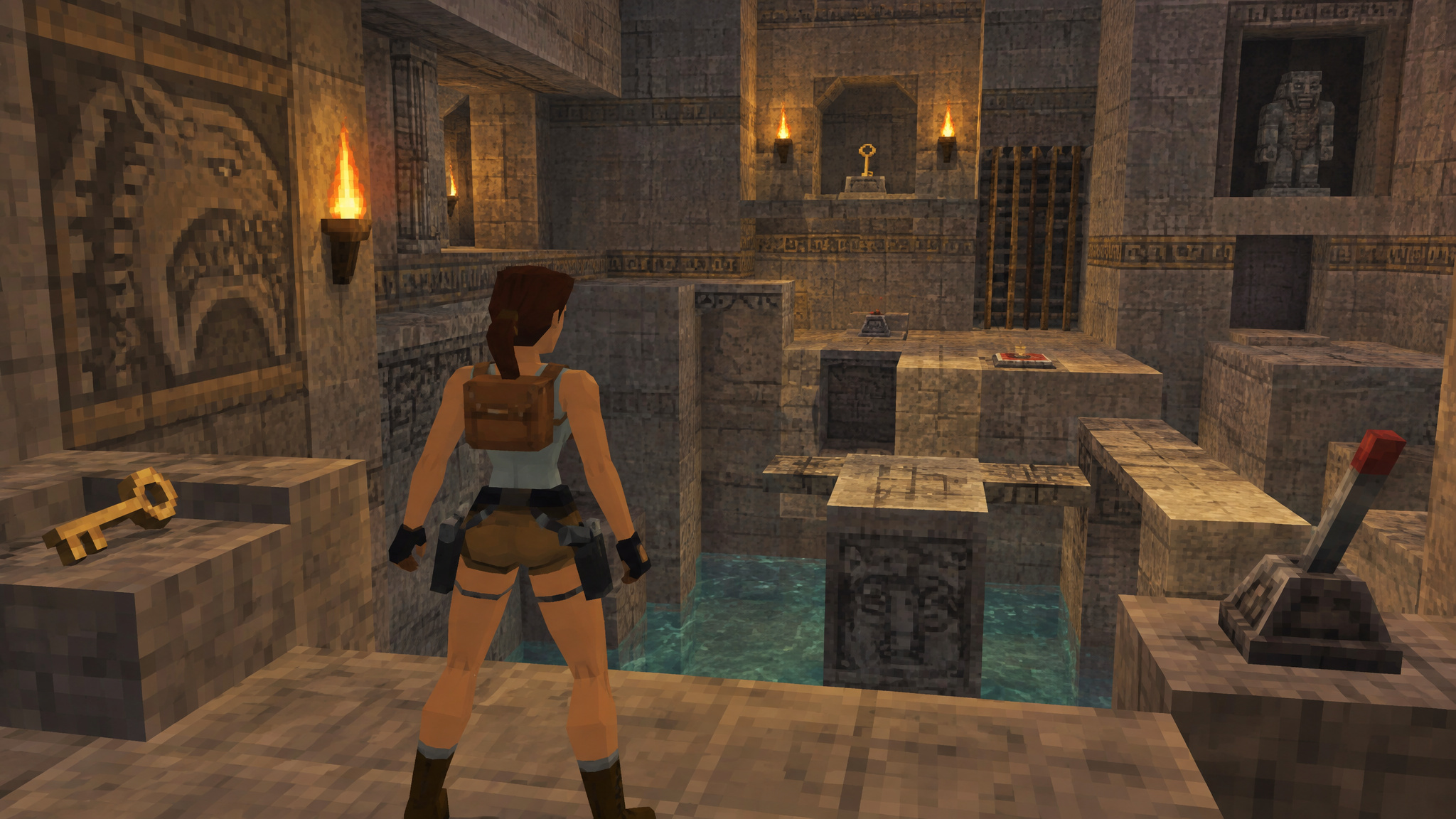
Crystal Dynamics later took over with Tomb Raider: Legend, remade the original in Tomb Raider: Anniversary, and eventually built the modern cinematic action-adventure survivor trilogy. Justin Grandfield at gamecritics.com awarded Tomb Raider I-III Remastered an 8.5 out of 10 on March 10, 2024, confirming that Lara’s earliest adventures hold up for new and returning fans once freed from aging hardware restrictions.
Nearly two decades separate the 1996 original from the reboot trilogy that kicked off with Tomb Raider (2013) and continued through Rise of the Tomb Raider and Shadow of the Tomb Raider. That modern trilogy tells Lara’s origin story as a young archaeologist following in her father’s footsteps, trading isolated key-and-lever labyrinths for guided story paths, stealth-and-cover gunfights, and upgradeable gear. If you bounce off rigid movement or unguided exploration, start with 2013’s reboot.
Platform availability was. As the years went on, the earliest entries became harder and harder to launch, requiring PC mods or an old PS3 until the remastered collection unlocked them for a wider audience.
| Feature or Spec | Classic Trilogy (Tomb Raider I-III Remastered) | Survivor Reboot Trilogy (2013, Rise, Shadow) |
|---|---|---|
| Primary Gameplay Loop | Action-adventure platforming and key/lever puzzles | Cinematic traversal, stealth/gunfight combat, challenge tombs |
| Narrative Framing | Globe-trotting hunt for mystical artifacts | Origin story following Lara’s father’s archaeological research |
| PC-Exclusive Expansions Included | Yes (all 3 expansions, including Unfinished Business) | No (Shadow includes its DLC challenge tombs) |
| Instant Original/Modern Graphics Toggle | Yes (original mode locked to 30 FPS) | No |
| Modern Console Availability | PS4, PS5, Xbox One, Series X | S, Switch, PC |
Are the original Tomb Raider games good?
The original Tomb Raider games are gripping action-adventure platformers when played through Tomb Raider I-III Remastered, which eliminates the severe hardware and modding barriers that kept the 1996 classic trilogy locked away from modern players. While the core loop of Tomb Raider (1996) and its sequels still asks for patience rather than pure nostalgia, the remaster proves its value by bundling all three titles with their originally PC-exclusive expansions, including Unfinished Business, into one complete package.
What the classics actually are
Starting with the 32-bit 1996 PlayStation flagship that turned Lara into gaming history, the classic trilogy focuses heavily on deliberate platforming and puzzle-solving. Lara travels the globe hunting mystical artifacts while dodging dangerous creatures and hostile people. Instead of funneling you down narrow corridors, the levels are fairly open spaces gated by keys and levers, rewarding players who poke around corners to uncover hidden secrets.
Why they were nearly unplayable before the remaster
Before this collection arrived, playing the first three games meant fighting the hardware. On PC, the originals required community mods just to run properly. Console players had it worse: the trio hadn’t appeared on a Sony system since the PS3 and had never released on Nintendo or Microsoft platforms at all. Bringing all three games and their PC-only expansions to modern systems solved that lockout overnight, leaving fans hoping a second remastered collection will eventually rescue The Last Revelation, Chronicles, and Angel of Darkness.
Tomb Raider I-III Remastered: what the 8.5/10 collection gets right
Tomb Raider I-III Remastered is well worth buying because its 8.5 out of 10 execution pairs a faithful mechanical preservation of the late-1990s classics with smart visual and quality-of-life upgrades. Rather than overwriting the 32-bit foundation with poorly implemented modern mechanics, Tomb Raider I-III Remastered lets you flip between remastered and original visuals at any second with zero loading while keeping every legacy speedrunning glitch and corner bug intact.
Instant graphics toggling and the visual overhaul
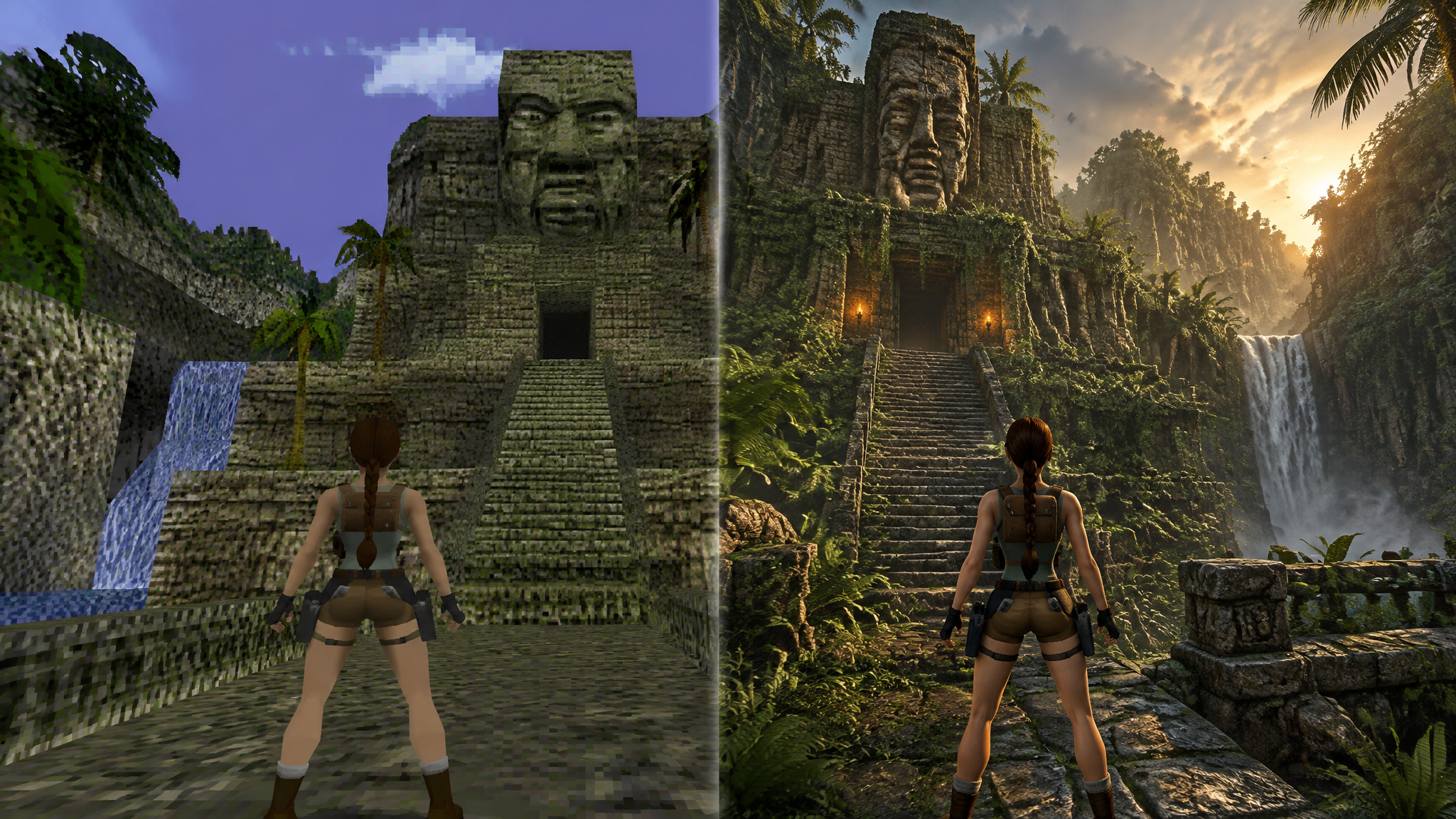
The collection’s standout party trick is its instant graphics toggle. You can flip between the original 1990s polygons and the remastered visuals at any moment without a loading screen, including inside the main and inventory menus, loading screens, and cutscenes. Both graphical modes run at a stable frame rate, though the original graphical mode is locked to 30 FPS.
In the updated mode, every object is re-rendered with new flora, updated object art, fresh skyboxes, foliage, and weather effects. Aspyr and Crystal Dynamics even adjusted level geometry to let natural light in, adding new ceiling openings in the first game’s opening level. Lara’s home got a thorough remodel too, with realistic objects modeled after the originals and ultra-detailed paintings on the walls. Exploring the manor is a welcome change of pace for gamers when they aren’t checking this list of online casinos aimed at New York players to compare game libraries, bonuses, and payout speeds.
Preserved 1990s jank is a feature
Instead of sanitizing the engine, the remaster treats faithfulness as a strength. Grandfield personally tested the old tricks for his review, and community forums back up his findings: legacy cheat codes, speedrunning skips, sequence breaks, and corner bugs all still work.
- The Venice sequence break: In Tomb Raider II‘s Venice level, jumping onto a specific window still lets you bypass a chunk of backtracking.
- The 45-degree corner bug: Positioning Lara at a 45-degree angle against a corner and jumping repeatedly still glitches her up into higher areas, and one level even awards an achievement for pulling it off.
- Explosive cheat inputs: If you botch the button inputs for a cheat code in Tomb Raider II or Tomb Raider III, Lara still violently explodes.
Quality-of-life additions and gameplay tweaks
To soften the 1990s friction without breaking the design, the collection adds a toggleable “!” prompt next to interactables and pickups, which series veterans can switch off in the settings. You also get subtitles for tutorial areas and cutscenes, plus a photo mode that lets you pose Lara alongside creatures and NPCs. Under the hood, the first game’s Unfinished Business expansion reorders its stages so the Atlantis levels come first, and Tomb Raider (1996) borrows Tomb Raider II‘s midair 180-degree jump turn to make combat and platforming more responsive.
Tomb Raider I-III Remastered: technical failures and the missing archive
Yes, the technical flaws in Tomb Raider I-III Remastered are noticeable enough to occasionally frustrate secret-hunters in the updated graphics mode, though they don’t outweigh the quality-of-life improvements or the ability to flip back to the original visuals. While the instant toggle saves you when a room looks off, the remastered visual pass introduces five specific blemishes that keep the package from perfection.
Full-motion video cutscenes (FMVs) were run through AI upscaling and look muddy. Worse, improper texture layering in remastered mode can actively hide level geometry: in one instance, a secret-access swimming hole is obscured behind a rendering of Vermeer’s “Girl With a Pearl Earring.” Lighting doesn’t always match the original mode either, leaving sections of the first game much darker in places where flares aren’t available.
Keys and item pickups are converted into 3D objects that blend into the floor, and camera placements in tight spaces are slightly worse than the originals. Finally, despite Lara Croft being one of the most recognizable videogame icons in history, the collection includes zero archival content on her exploits or development history, a glaring omission compared to similar retro compilations.
Classic trilogy difficulty: play them in order
Playing in release order is mandatory across the Tomb Raider franchise, and while new players wanting modern polish should start with Tomb Raider (2013) or the reboot trilogy’s peak in Rise of the Tomb Raider, anyone tackling the classics must start with Tomb Raider (1996) before Tomb Raider II and Tomb Raider III. Because trap density and environmental hazards escalate sharply across the 1990s sequels, jumping straight into the later games is a recipe for frustration, best illustrated by Tomb Raider III‘s opening level, where Lara rolls down a hill straight into hidden spike pits that catch players off-guard, and a remaster change where save crystals no longer heal or save.
Deciding between the first two classics is much easier now because the remaster ported Tomb Raider II‘s midair 180-degree jump turn back into the 1996 original, closing the mechanical gap and making the first game the natural warmup. By the time you reach the third entry, the levels are difficult, though the remaster helps slightly by adding boss health bars across all three games. Players coming directly from the 2013 reboot trilogy often bounce off the classics’ slower, methodical rhythm and early instant-death traps until they slow down and enable the “!” interactable prompt.
The survivor trilogy’s shared systems: how the modern games play
The 2013 to 2018 survivor trilogy blends older Assassin’s Creed traversal with third-person cover combat, anchored by optional challenge tombs that combine environmental traversal and puzzle-solving and improve with each entry. As detailed by reviewer Sage Mode Jedi, Lara scales ruins, jumps gaps, and rides ziplines along ledges marked by sometimes hard-to-see white paint. Survival Instincts highlights a yellow story-path beam, swingable branches, scalable walls, destructible barriers, crafting materials, salvage, healing leaves, artifacts, journals, and puzzle objects paired with spoken hints, while enemies glow red when a kill will alert others or yellow when a quiet kill won’t.
Base camps handle fast travel, outfit swaps, damage/fire-rate/reload gear upgrades, and XP skills like reduced damage, enhanced Survival Instincts, and deadly finishing moves for your four core weapons (bow, pistol, auto rifle, and shotgun). Combat and setpieces push you through split-second escape sequences like an enemy helicopter chase or an avalanche, pitting you against flanking, explosive-throwing AI where you trigger explosive barrels, Molotov bottles, and ignitable fuel while hiding bodies so guards aren’t alerted.
Tomb Raider (2013) and Rise of the Tomb Raider: foundation and peak
Tomb Raider (2013) starts with a stripped-down shipwreck survival loop and a single-resource economy before Rise of the Tomb Raider expands the formula to the trilogy’s mechanical peak.
Tomb Raider (2013): the streamlined foundation
Tomb Raider (2013) is a deliberately simple, well-paced foundation that starts Lara with nothing after a violent storm shipwrecks the Endurance crew on a Dragon’s Triangle island during her search for Yamatai, using Salvage found in crates and short challenge tombs as its sole weapon-upgrade resource while hostile inhabitants kill crew and take prisoners.
Rise of the Tomb Raider: the trilogy peak
Rise of the Tomb Raider is the best game of the reboot trilogy, upgrading the graphics, puzzles, combat, and story as Lara tracks her father’s research into the Divine Source from Syria to Siberia’s lost city of Kitezh. Along the way, she fights Trinity and its complex villain Constantine, who is fleshed out through audio logs alongside strong supporting characters Jacob and Anna. Mechanically, Rise adds wood, pelt, and healing-leaf crafting for ammo, Molotovs, and manual healing, rewards optional tombs with exclusive abilities, and hides unmarked Byzantine coins, some requiring monolith language translation learned from documents, to spend at a single vendor on the rope ascender and commando assault rifle.
Shadow of the Tomb Raider: divisive, flawed, and underrated
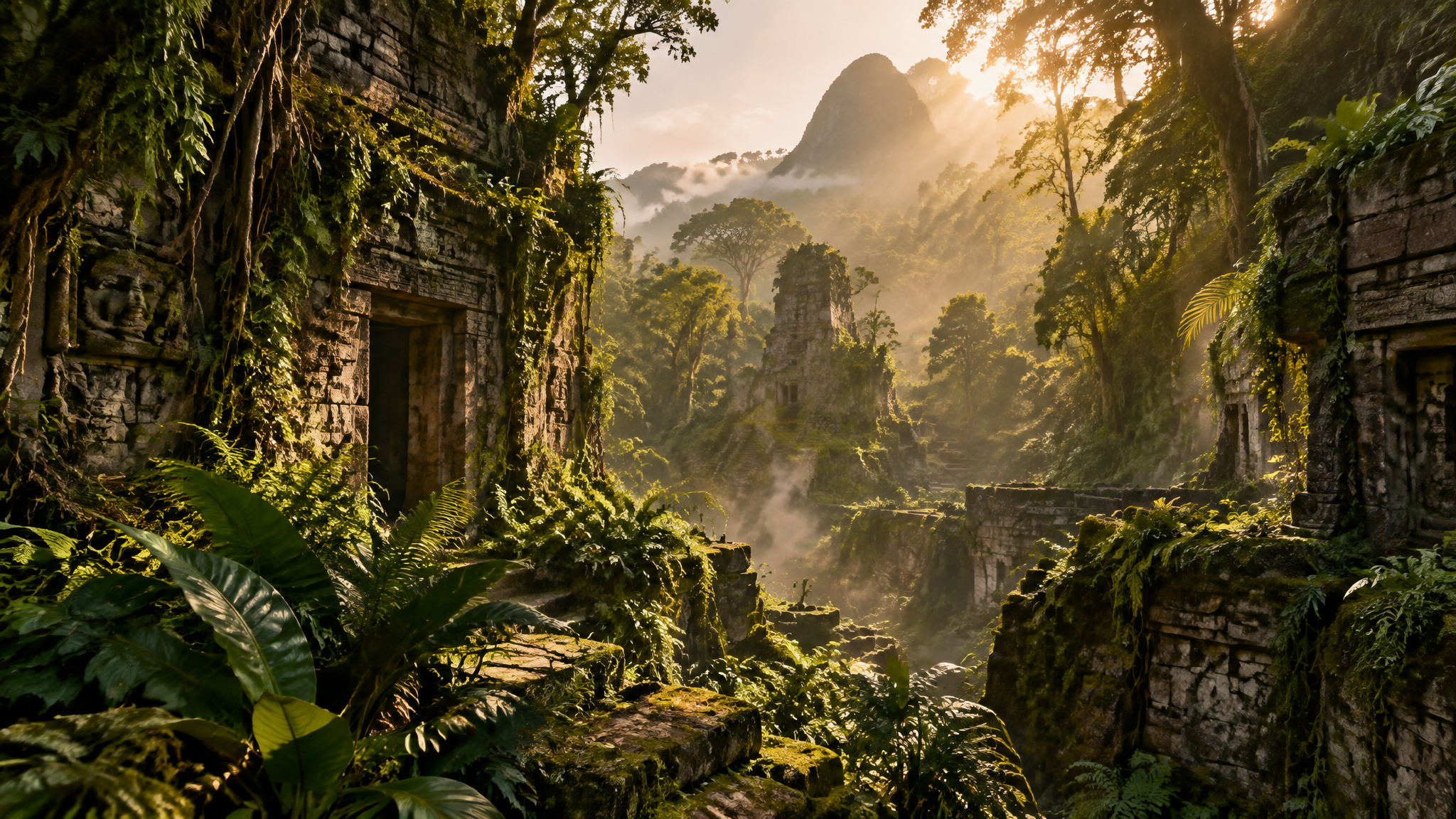
Shadow of the Tomb Raider is worth playing after the first two origin entries (and can technically be played standalone, though starting with the prior two is recommended), standing up eight years after release as the series’ most underrated game thanks to its series-best challenge tombs and a final stretch that sets up a more confident, ruthless Lara heading toward Legacy of Atlantis. With dense jungles, ancient ruins, and fire-filled ritualistic chambers, it’s the most visually striking of the three.
Pacing drops and narrative missteps
The story starts strong as Lara fights Trinity in Mexico, knowingly triggers cataclysms, and travels to Peru for two ancient artifacts to stop them, adding rappelling and lengthy underwater sections to her toolkit. However, the pacing slows noticeably around the halfway point, which is where many players dropped it at launch. Trinity barely appears outside the opening and ending, Lara narrates discovered journals herself rather than letting the original writers’ voices play, and main villains Dr. Dominguez and Commander Work lack the audio-log backstory that made Constantine compelling in Rise.
Peak challenge tombs and a baffling difficulty quirk
Where the story hesitates, the optional tombs shine. Shadow features the trilogy’s most challenging and memorable vaults, including the included DLC tombs, where each space revolves around mastering an evolving mechanical gimmick.
The game also splits difficulty settings across combat, exploration, and puzzles, a great idea on paper that fumbles its puzzle execution. In practice, puzzle difficulty skips a middle ground: normal turns on yellow object highlights and spoken Lara hints, and hard strips both away. Worse, the game never discloses at the start screen that a skill-tree ability unlocks Survival Instincts highlights on hard mode, tricking players into picking normal just to see what’s interactive.
Where to play: platforms, ports, and the Switch 2 tradeoff
The Tomb Raider franchise runs well across modern hardware, making Tomb Raider I-III Remastered an easy pickup on PS4, PS5, Xbox One, Xbox Series X|S, Switch, and PC, while Aspyr’s Nintendo Switch 2 ports of the survivor trilogy give portable players a solid way to catch up. Built by Aspyr alongside Crystal Dynamics, with Aspyr handling publishing (and no multiplayer mode included), the remastered classic trilogy ran smoothly on a publisher-provided PC review copy over roughly 24 hours of play without completing the full three-game run.
After remastering the first six Tomb Raider games, Aspyr spent 12 months porting the survivor trilogy to Nintendo Switch 2, shadow-dropping Shadow of the Tomb Raider on the console after releasing fairly serviceable but slightly underwhelming ports of Tomb Raider (2013) and Rise. As reported by GamingBible, Shadow runs at a stable 30 FPS on Switch 2 that rarely dips below the cap, matching the PS4 and Xbox One versions. Aspyr kept graphical asset quality intact rather than gutting visual fidelity to chase a higher framerate. Even if 30 FPS draws complaints from framerate purists, preserving the lighting and jungle assets was the right engineering call, making the Switch 2 releases decent pickups for newcomers.
Content warnings, accessibility limits, and playing them as an adult
Yes, the Tomb Raider games hold up well for adult players and couples sharing a controller, provided you don’t need colorblind modes, resizable subtitles, or visual secret indicators in the classic remaster and are comfortable with an ESRB M rating. Before booting up the 1990s collection, players should know where its accessibility and content boundaries sit.
What parents and accessibility-conscious players should know
Tomb Raider I-III Remastered carries an ESRB M rating for Blood, Intense Violence, and Suggestive Themes. Lara can be impaled on spikes, crushed, drowned, shot, or set on fire, complete with blood effects, persistent dead bodies, and the cheat-code explosions in II and III. Tomb Raider III‘s South Pacific levels also depict indigenous cannibalism in a way that evokes negative stereotypes.
On the accessibility front, the remaster lacks colorblind modes, and while subtitles are included, they can’t be resized. Hidden secrets rely on audio cues, either a musical sting or Lara saying “aha”, which hard-of-hearing players can easily miss, though the inventory menu’s compass acts as a tracker for level secrets, item pickups, and kills. Controls are mostly remappable, except for weapon hotkeys and quick save/load inputs, which remain locked.
Playing them as an adult on the couch
My wife and I still had a blast playing through both eras together on the couch, with one person driving Lara and the other calling out ledges, switches, and impending spike pits. That two-player rhythm works across the whole franchise: the 1990s classics drop you into open, key-and-lever spaces packed with tucked-away items and environmental traps, and the modern games reward a second pair of eyes for spotting puzzle mechanisms inside sprawling challenge tombs.
Frequently Asked Questions
Is tomb raider i-iii remastered worth buying in 2024
Tomb Raider I-III Remastered launched to an 8.5 out of 10 from gamecritics.com on March 10, 2024, and remains an easy buy because it bundles all three 1990s classics with their previously PC-exclusive expansions. You can swap between the 30 FPS original polygon graphics and a fully re-rendered visual mode instantaneously without loading screens, even mid-cutscene. While the updated visuals suffer from occasional lighting quirks and a texture bug that hides a secret swimming hole behind a Vermeer painting, the ability to toggle back to the original view at any second solves the issue.
What is the best order to play the Tomb Raider games?
You should always play your chosen era in strict release order rather than jumping into later sequels first. For the modern origin story, go from Tomb Raider (2013) to Rise of the Tomb Raider and finish with Shadow of the Tomb Raider so Lara’s gear progression and character arc make sense. In the classic remastered collection, playing Tomb Raider (1996) before II and III is vital because environmental traps get brutally punishing by the third game, which immediately drops you into hidden spike pits and strips out healing save crystals.
How does Shadow of the Tomb Raider perform on Nintendo Switch 2?
Aspyr’s Nintendo Switch 2 port of Shadow of the Tomb Raider locks performance to a steady 30 FPS that rarely drops below its cap. Rather than gutting the dense jungle foliage and lighting to chase a higher framerate, the developers preserved the graphical asset fidelity of the PS4 and Xbox One versions. It is a smart engineering tradeoff that makes the portable release a solid pickup alongside the Switch 2 ports of Tomb Raider (2013) and Rise.
