
Ever find yourself staring at your Steam library, paralyzed by choice? Maybe you’re torn between the high-octane chaos of a shooter and the soothing rhythm of a farming sim. It turns out, that indecision isn’t just about mood—it’s about how your brain is wired. Research into the Big Five personality traits reveals that your gaming habits are a digital mirror of your real-world psychology.
In this guide, we’re going to decode exactly why you play the way you do. Whether you’re a strategic mastermind or a social butterfly, I’ll show you the science behind your playstyle and help you find your next obsession.
So, grab your controller (or mouse and keyboard), and let’s dig into the data. I promise, it’s going to be a fun ride.
Key Takeaways
Your Big Five traits dictate your genre: High Openness correlates with a love for complex RPGs like Baldur’s Gate 3, while high Conscientiousness drives players toward efficiency engines like Factorio.
Strategic thinking is evolving: While “Masterminds” (strategic thinkers) have historically dominated, 2025 reports from Quantic Foundry show a global dip in players prioritizing deep strategy, shifting toward faster-paced “Power” experiences.
Neuroticism drives “coping” play: Gamers with higher emotional volatility often use gaming as a stress-relief valve; avoiding high-stakes competitive ladders in favor of cozy games like Stardew Valley can prevent burnout.
The “Socializer” shift: A 2025 analysis suggests that social gamers in genres like Battle Royales are moving away from “fun/humor” and toward aggressive, win-at-all-costs interactions.
Personality predicts completionism: “Achievers,” who score high in specific motivation metrics, are the players most likely to grind for Platinum trophies or 100% completion ratings.
Table of Contents
Gamer Personality Types Explained
We all bring our real-world baggage into the virtual world. Whether you’re coordinating a raid team or silently exploring a Skyrim dungeon, your actions are driven by the Five Factor Model (Big Five) and gamer-specific frameworks like the Quantic Foundry motivation model. Understanding these can help you stop buying games you’ll never finish.
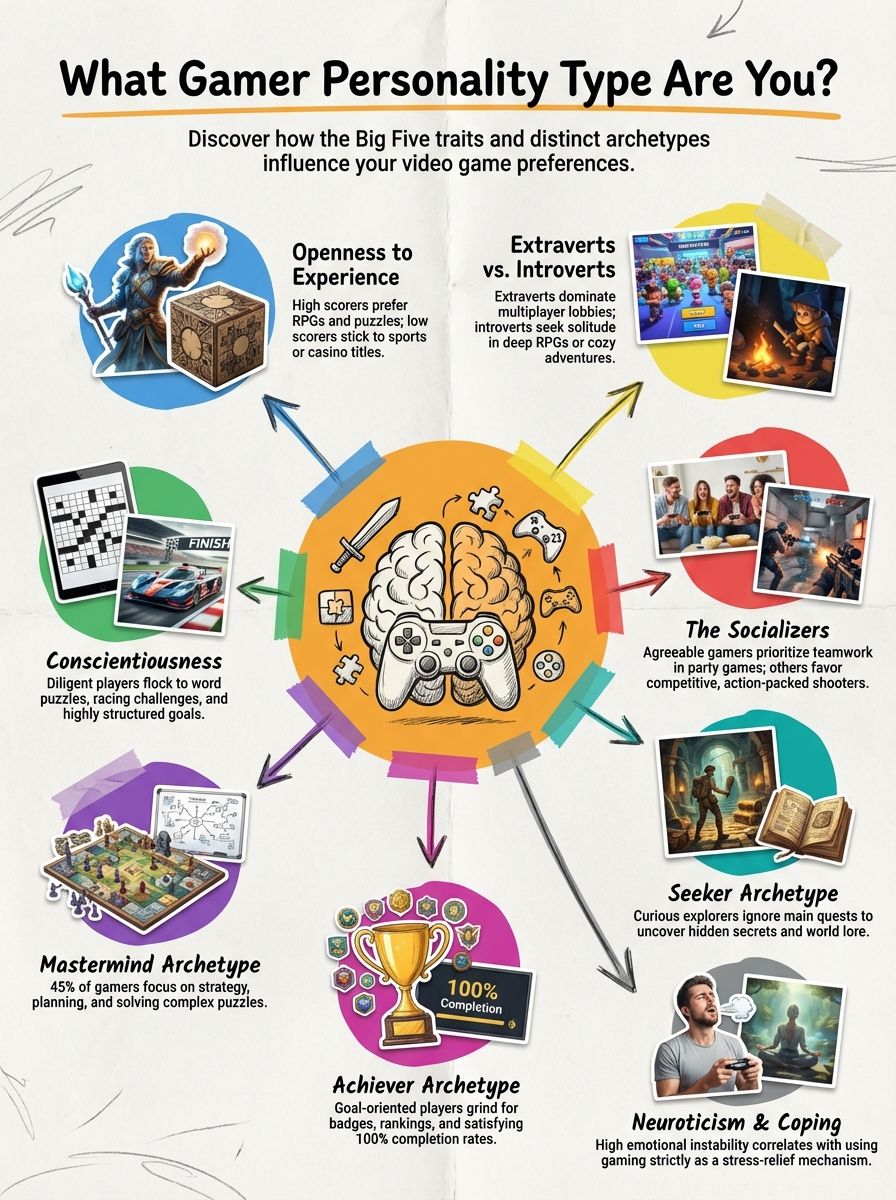
What Are the Big Five Personality Traits in Gamers?
Psychologists break human personality down into five core dimensions, often remembered by the acronym OCEAN. Here is how they translate to your Steam achievements:
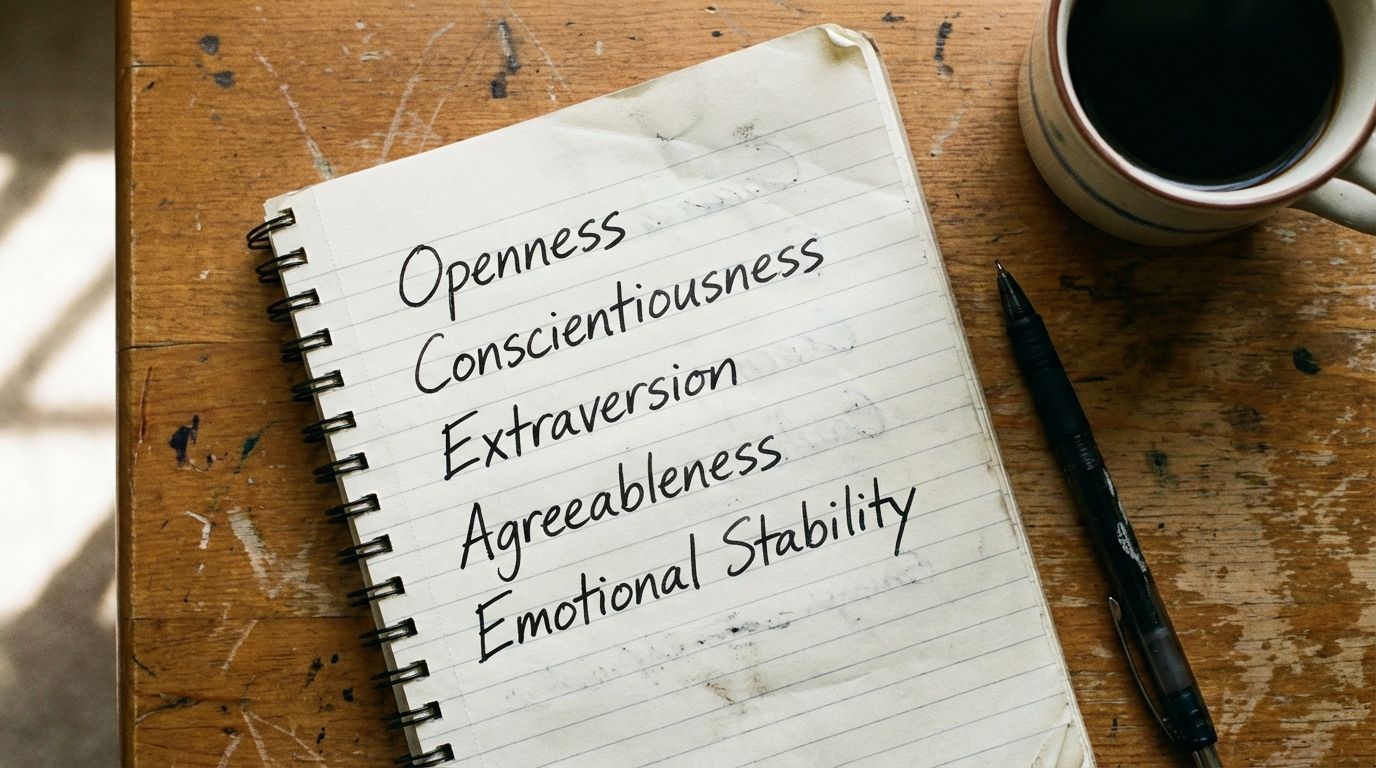
- Openness to Experience (The Explorer): If you love modding your games, exploring indie titles like Outer Wilds, or creating complex characters in RPGs, you likely score high here. These players crave novelty and immersion.
- Conscientiousness (The Optimizer): Do you love clearing every quest marker or maximizing your production lines in Satisfactory? High scorers prefer clear goals, rules, and structured gameplay.
- Extraversion (The Leader): These are your raid leaders and shot-callers. They thrive in multiplayer environments like Helldivers 2 or Call of Duty, where social interaction is the main mechanic.
- Agreeableness (The Teammate): High scorers gravitate toward cooperative roles—think Support classes in Overwatch or cozy multiplayer games like Among Us. Low scorers? They’re often the ones engaging in PvP or “griefing.”
- Emotional Stability (The Rock): Also known as low Neuroticism. Stable players stay calm during a 1 vs 5 clutch. Those with higher Neuroticism often play to escape stress, preferring low-stakes games or, conversely, raging at competitive losses.
According to Skillprint’s 2024 cognitive research, your traits don’t just predict what you play—they predict what you’re good at. For instance, high Openness is linked to better performance in puzzle games, while those lower on the scale often prefer the familiar odds of sports titles or iGaming platforms like Powerplay Casino.
What Are Common Gamer Archetypes?
Beyond the Big Five, researchers use models like BrainHex and Quantic Foundry’s 12 Motivations to categorize us. Here is where you might fit in:
| Archetype | Core Motivation | Favorite Games |
|---|---|---|
| The Mastermind | Strategy & Planning | Civilization VI, XCOM 2 |
| The Seeker | Discovery & Wonder | Elden Ring, Zelda: Tears of the Kingdom |
| The Achiever | Completion & Power | God of War, WoW (Grinding) |
| The Socializer | Community & Teamwork | Final Fantasy XIV, Destiny 2 |
Pro-Tip: Identifying your archetype can save you money. If you are a “Seeker,” stop buying linear shooters like Call of Duty just because your friends are playing them—you will likely get bored within a week. Instead, wait for the next big open-world RPG.
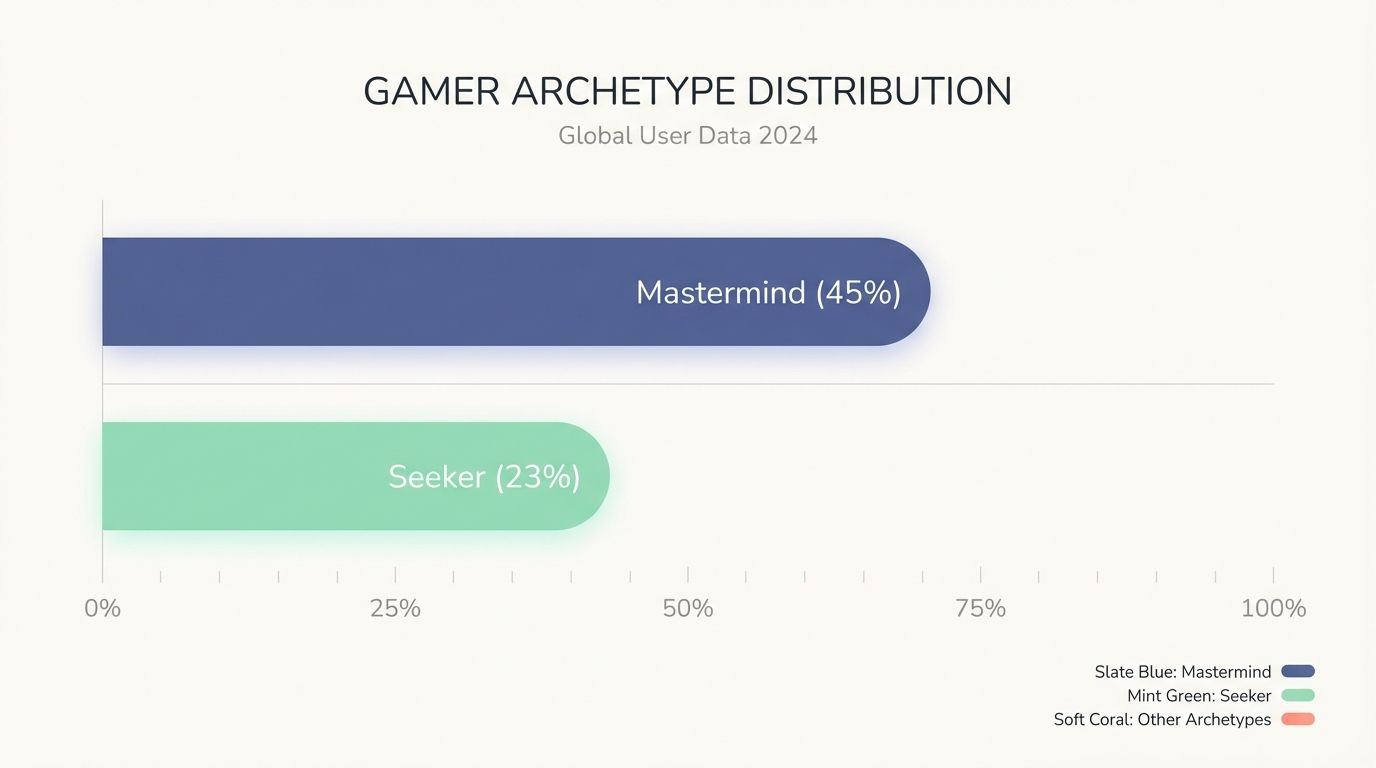
Interestingly, data from 2024 reviews suggests a shift. While Masterminds (strategic thinkers) used to make up nearly 45% of profiles in niche studies like those of French law students, broader US market data shows a decline in pure strategy preference. Meanwhile, Seekers remain steady at around 22-23%, driven by the massive popularity of open-world games. You can dive deeper into these nuances in the BrainHex model or check out a guide on different types of gamers.
Popular Personality Traits Among Gamers
It’s not just about what you play, but how you play. A “Mastermind” might play a shooter, but they’ll be the one setting up ambushes rather than running and gunning.
Who Are Masterminds (Strategic Thinkers)?
Masterminds view every game as a puzzle to be solved. They don’t just want to win; they want to outsmart the system. In 2024, Quantic Foundry noted that while this group is huge, the general gaming population is trending toward faster, “low-friction” action.
However, the core Mastermind remains dedicated. They rank high for Openness, always looking for new mechanics to exploit. Whether it’s drafting a perfect Magic: The Gathering deck or coordinating a flawless breach in Rainbow Six Siege, their fun comes from mental exertion.

“I’ve found that Masterminds are often the players who spend more time reading the wiki and patch notes than actually playing the game. If you have 20 browser tabs open researching build stats, this is you.”
What Defines Seekers (Explorers and Adventurers)?
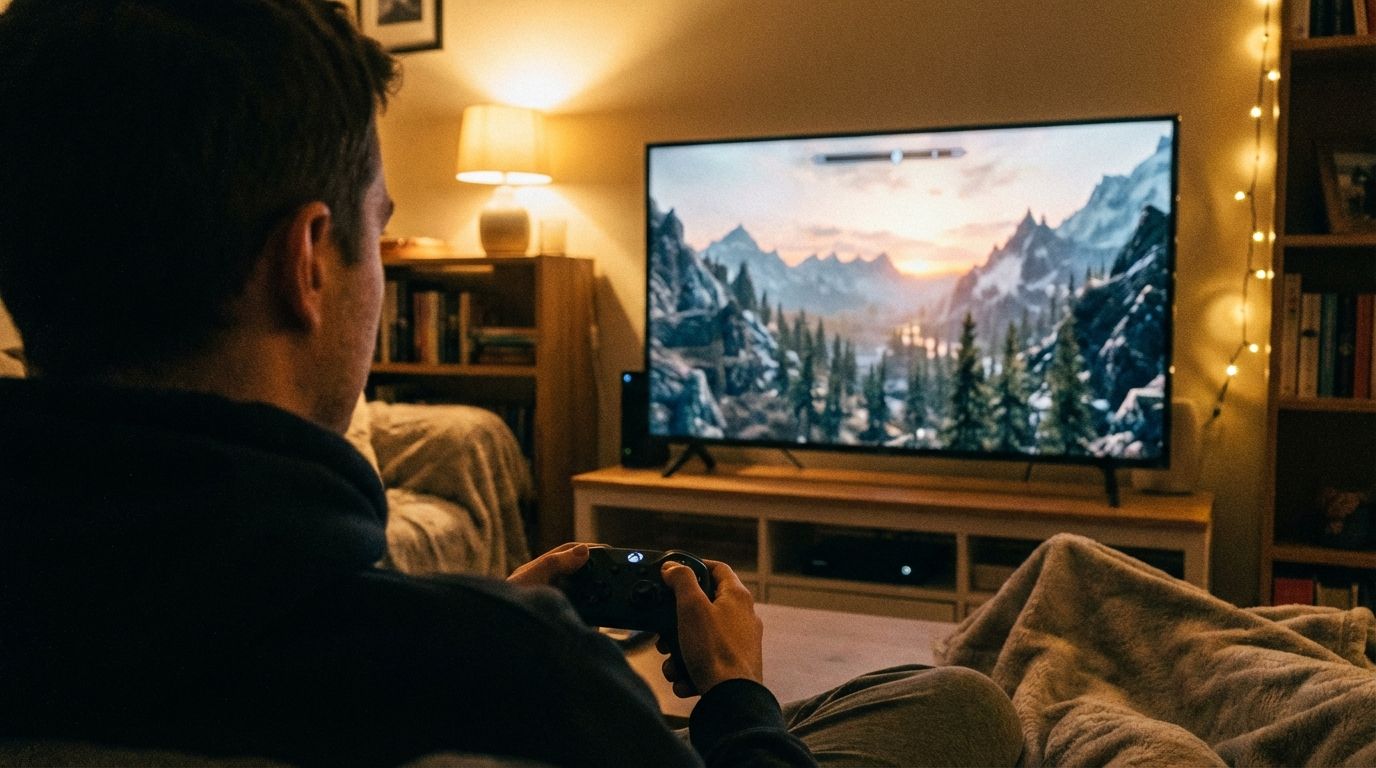
Seekers are the reason games like Skyrim and No Man’s Sky exist. Representing about 22.7% of gamers in older models, this group is defined by curiosity. They will ignore the main quest to see what’s on top of that distant mountain.
Psychologically, Seekers often score high in Openness and sometimes Neuroticism (using exploration as emotional regulation). Unlike “Conquerors” who want to dominate the map, Seekers just want to see it. They find joy in environmental storytelling—reading the diaries left behind in a fallout shelter rather than just looting the gun.
How Do Achievers (Goal-Oriented Players) Behave?
Achievers need a progress bar to feel alive. Making up roughly 10% of the population, they are the ones grinding for the “Platinum” trophy or hitting the level cap in an MMO. If a game has a leaderboard or a collection log, the Achiever is hooked.
Surveys using the HEXACO model link this behavior to high Conscientiousness (desire for order/completion) and Extraversion (desire to show off rewards). A common pitfall for Achievers is “optimization burnout”—they often optimize the fun out of a game by treating it like a checklist. If you find yourself playing a game you hate just to get an achievement, it’s time to take a break.
What Traits Do Socializers (Community-Focused Players) Have?
For Socializers, the game is just a chat room with graphics. They thrive on Agreeableness and seek connection. However, a 2025 “State of the Player” report highlighted a fascinating (and slightly worrying) trend: players in social genres like Battle Royales are becoming less agreeable and more power-focused.
Traditionally, Socializers flock to games like Among Us or MMOs where guilds matter. They are the glue that holds communities together. Research into internet gaming disorder even suggests that this social connection can be a protective factor against addiction—as long as the community remains toxic-free.
Personality Traits and Gaming Preferences
Can we predict your favorite genre just by looking at your personality test results? The data says yes, but it’s more nuanced than you might think.
How Do Extraversion and Introversion Affect Gaming?
This is the clearest divide in gaming psychology.
Extraverts treat gaming as a high-stimulation social event. They prefer:
- Fast-paced Shooters: Valorant, Apex Legends.
- Party Games: Mario Party, Jackbox.
- Why? They need the dopamine hit of real-time human interaction and competition.
Introverts use gaming as a battery recharger. They prefer:
- Deep RPGs: The Witcher 3, Persona 5.
- Simulation Games: The Sims, Animal Crossing.
- Why? These games offer control and solitude. A 2024 study reinforced that introverts are significantly more likely to prefer single-player modes to avoid the “social drain” of online voice chat.
How Does Openness to Experience Influence Game Choices?
Openness to experience is the strongest predictor of genre diversity. High scorers are the “variety gamers.” They are the ones playing a text-based adventure one day and a VR rhythm game the next. They value novelty over mastery.
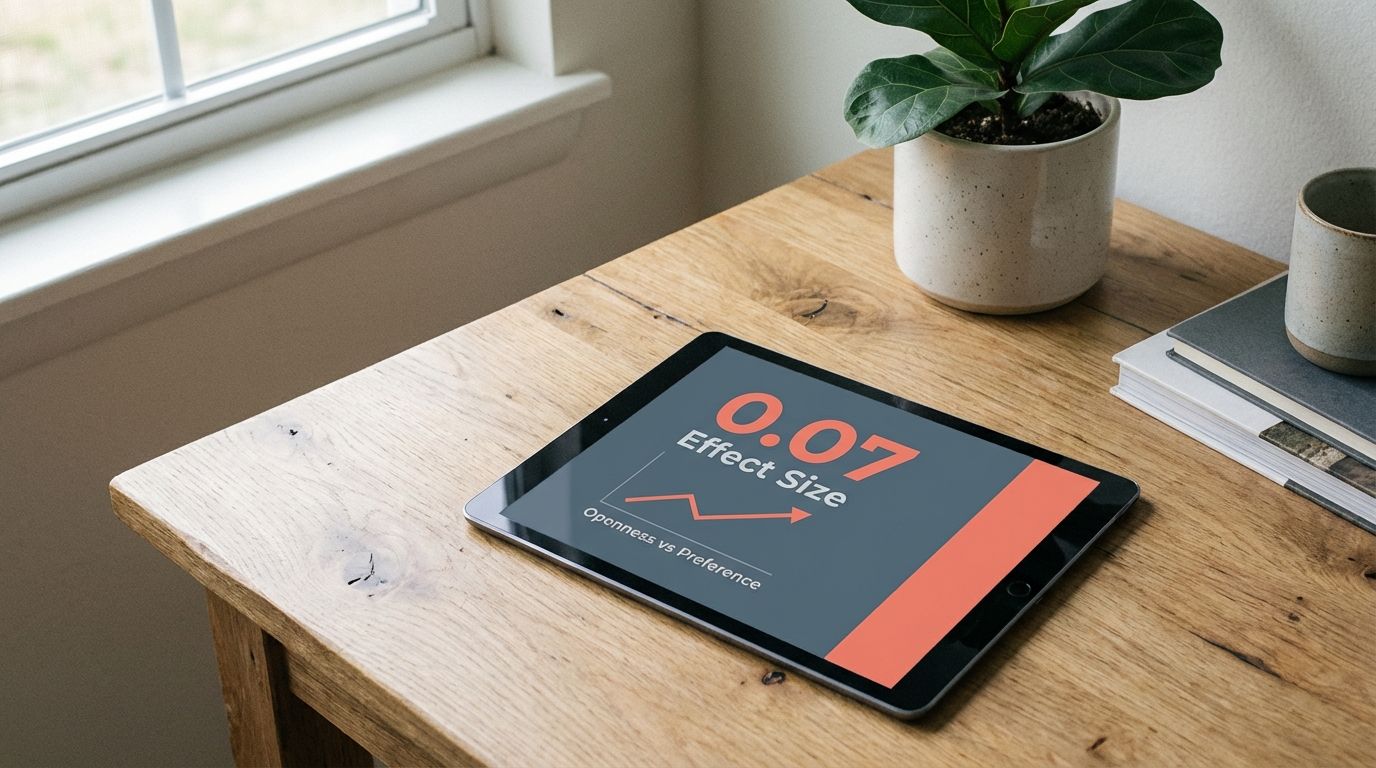
Low scorers in Openness tend to stick to what they know. They are often the players who buy the new FIFA or Madden every year. There is nothing wrong with that—they know what they like and they stick to it. Recent quantitative studies show the effect size here is small (around 0.07), meaning while the trend exists, plenty of creative people still enjoy a simple round of FIFA.
What Is the Impact of Neuroticism on Gaming Behavior?
Neuroticism, or emotional instability, is a major driver for why people play.
High Neuroticism players often use games for mood modification. They might play:
- Cozy Games: To soothe anxiety (e.g., Stardew Valley).
- High-Intensity Games: To vent frustration (e.g., Doom Eternal).
The Danger Zone: High Neuroticism is a known risk factor for “tilt” (getting angry at the game). If you score high here, avoid games with toxic ranked ladders like League of Legends. The data shows you are more likely to have a negative emotional experience compared to emotionally stable players.
The Least Common Gamer Personality Types
Not everyone is a “Hardcore Gamer.” In fact, some personality types are rarely found in the traditional gaming sphere—or so it seems.
How Do ESFJ Personality Types Engage with Gaming?
ESFJs (The Provider) are all about people and real-world harmony. You rarely see them grinding solo in a dark room. Instead, they are the demographic driving the mobile gaming boom.
While they report low frequency on “core” titles, ESFJs dominate the Casual market. They are playing Wordle, Candy Crush, or Pokémon GO—games that fit into a busy social life or can be played with family. For the ESFJ, gaming isn’t an identity; it’s just another way to connect with friends. If you are an ESFJ, you probably prefer games with clear rules and cooperation over abstract, open-ended sandboxes.
How Personality Influences Gaming Motives
Why do you pick up the controller? Is it to beat someone else, or to beat your own high score?
What Drives Competitive vs. Casual Gaming?
Competition is fueled by a mix of Extraversion (social dominance) and low Agreeableness (willingness to conflict). Competitive players view the game as a hierarchy to climb.
Casual play is driven by Openness (experiencing the art/story) and high Agreeableness (wanting a chill time). A casual player might quit a match if it gets too sweaty, not because they are “bad,” but because the stress outweighs the fun. Understanding this motive helps you choose the right lobby—don’t join a Ranked match if you’re in a “Casual” mood.
How Do Solo and Multiplayer Preferences Relate to Personality?
It ultimately comes down to social energy.
Multiplayer gamers (High Extraversion) see NPCs (non-player characters) as boring robots. They need the unpredictability of human opponents to feel engaged.
Solo gamers (Introversion/High Openness) view other players as immersion breakers. They want to get lost in a world, read the lore, and roleplay without a 12-year-old screaming in their ear. If you are an INTP or INFJ, you likely prefer the rich, controlled narrative of a solo campaign over the chaos of a battle royale.
How Will Gamer Personality Trends Evolve in 2026?
The future of gaming is personalized. We are moving away from “one size fits all” difficulty settings.
New tech from companies like Skillprint and GameTree is using AI to map your Big Five traits to specific game mechanics in real-time. Imagine a game that detects you’re getting frustrated (High Neuroticism reaction) and subtly adjusts the difficulty, or notices you love exploring (High Openness) and spawns more side quests.
By 2026, we expect games to ask you less about your hardware specs and more about your playstyle. Developers are waking up to the fact that a “Seeker” and an “Achiever” play the same game for totally different reasons, and the next generation of games will adapt to feed your specific psychological hunger.
People Also Ask
What are the Big Five personality traits found in gamers?
A massive 2024 meta-analysis shows that while we come from all walks of life, dedicated gamers often score high in Openness, driving us to explore vast digital worlds, while high Conscientiousness helps many of us manage playtime responsibly. We aren’t just one type; the data proves that successful players balance their creative curiosity with the discipline needed to master complex game mechanics.
Do certain video game genres attract specific personality types?
Recent 2023 research confirms that Extroverts tend to flock to sports titles for the social competition, while players with high Openness dominate the open-ended landscapes of RPGs. If you prefer the strict rules and logic of strategy games, studies suggest you likely score high in Conscientiousness, using your natural organizational skills to secure the win.
Can playing games change your personality over time?
While your core traits remain fairly stable, a landmark August 2024 study in Nature Human Behaviour proved that gaming causally improves mental well-being and life satisfaction during stressful times. Instead of rewriting your personality, regular play helps you level up specific cognitive stats like memory, attention, and problem-solving speed.
Why do researchers study gamer personalities using the Big Five model?
Scientists prefer this framework because it uses a precise sliding scale rather than binary labels, allowing them to accurately map complex player motivations like social achievement and immersion.
References
https://pmc.ncbi.nlm.nih.gov/articles/PMC8997197/
https://pmc.ncbi.nlm.nih.gov/articles/PMC10515229/
https://hal.science/hal-03746955v1/document
https://www.sciencedirect.com/science/article/abs/pii/S0191886920304803
https://www.truity.com/blog/profile-gamer-how-personality-affects-what-and-if-you-play (2023-09-25)
