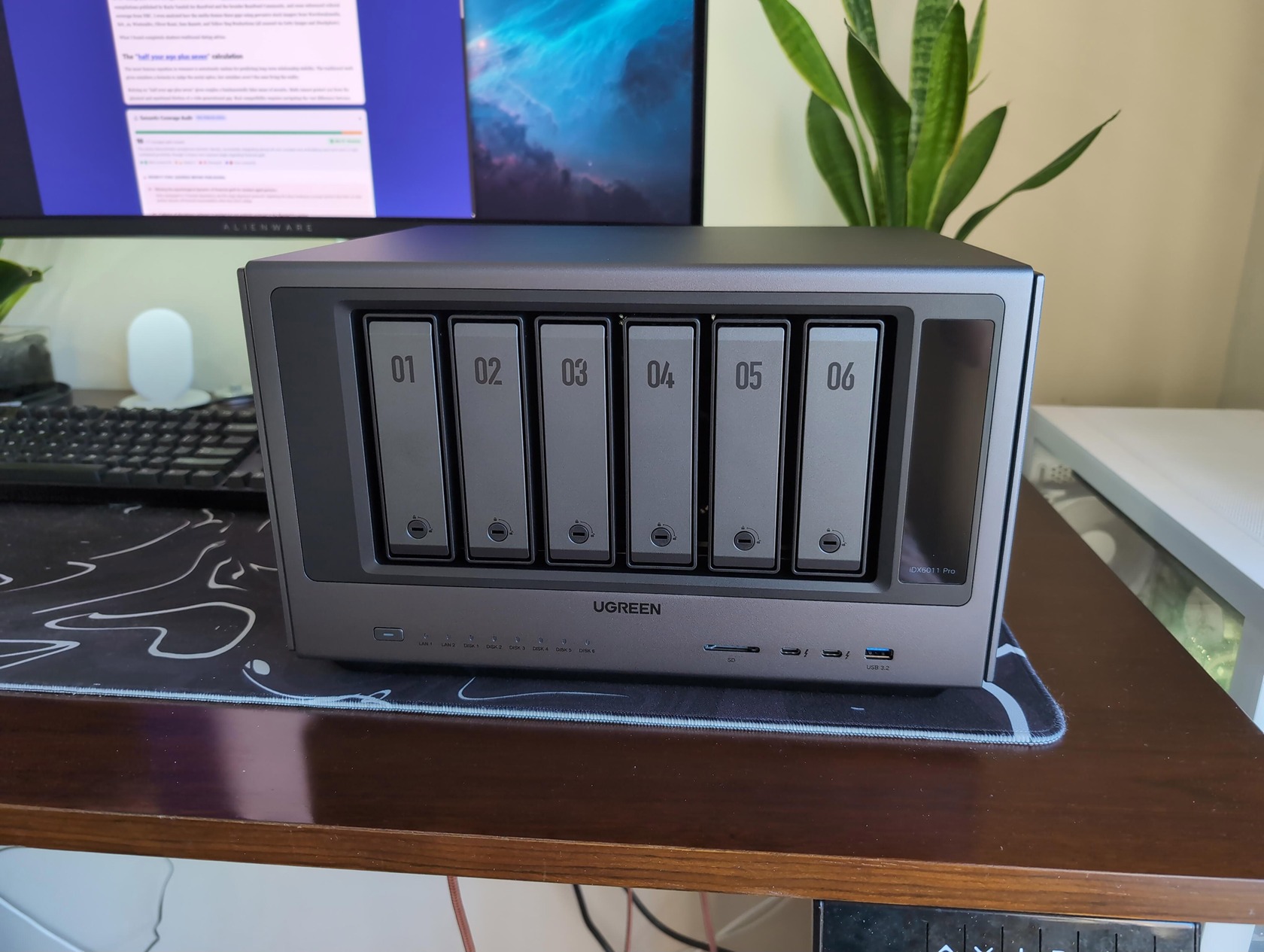
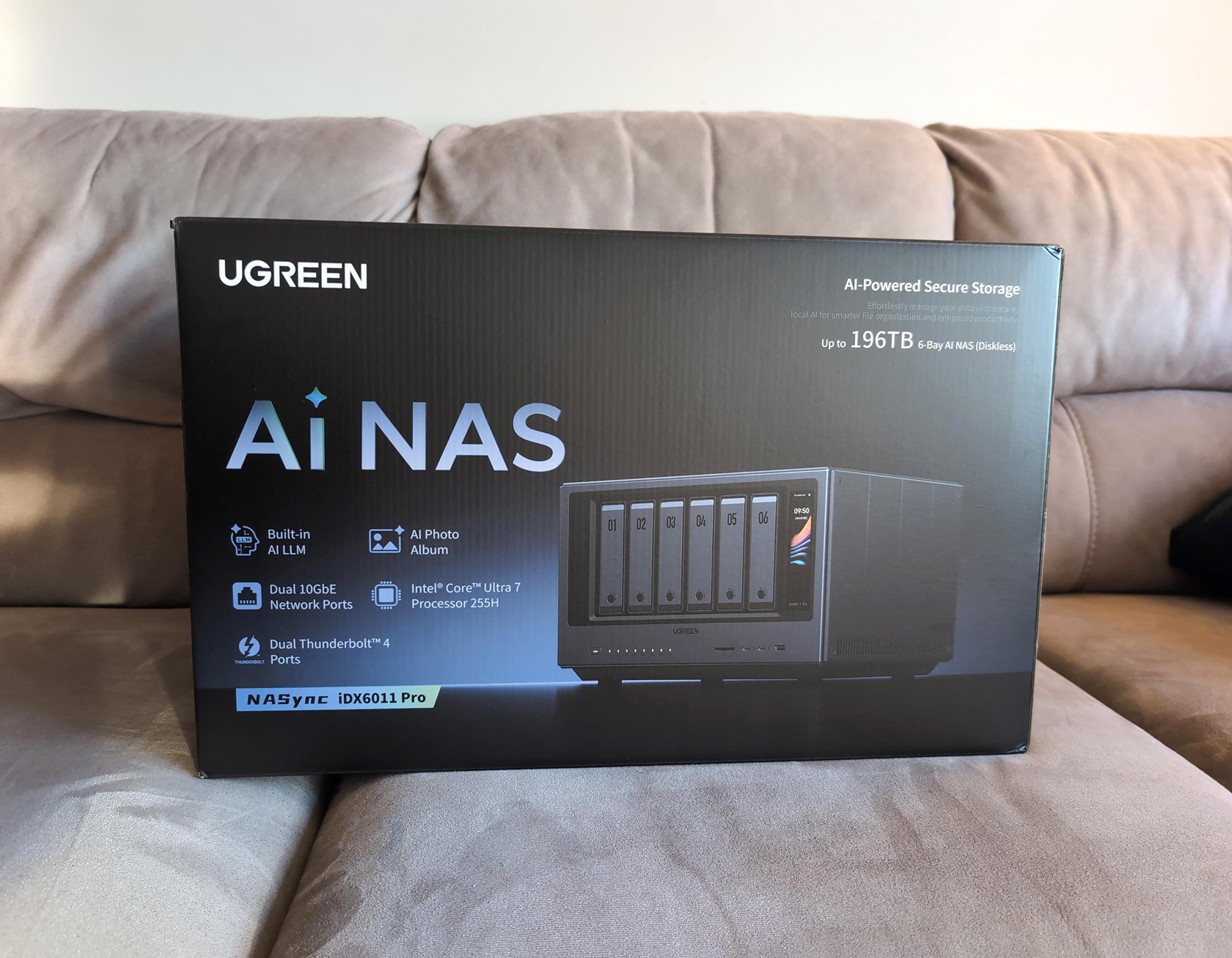
I recently secured an iDX6011 to review, and the specs on the UGREEN AI NAS feature introduction confirm an immediate truth: the UGREEN iDX NAS series renders traditional network-attached storage structurally archaic. If your goal is untangling unmanageable data silos without surrendering to monthly enterprise cloud fees, moving to localized edge compute is a strategic necessity. For any professional executing a Synology migration, the architectural depth of the UGOS Pro operating system represents a massive course correction.
A passive storage drive that simply holds bits until you manually retrieve them is functionally obsolete.
When UGREEN revealed their latest prototype at CES 2026, they made an aggressive claim against the current trajectory of cloud storage. Operating on the premise that a NAS should act as an active data partner rather than a passive dumping ground, the NASync iDX Series embeds intensive compute capabilities directly into the hardware layer. This shift acknowledges a stark reality for professionals and studios: sending proprietary data out to remote servers for indexing violates client privacy and bottlenecks creative workflows.
Table of Contents
How local AI replaces the digital junk drawer with a knowledge base
Most tech hardware manufacturers force artificial intelligence through external cloud servers, essentially renting you access to your own file organization. Cloud AI is a massive liability for content creators, legal professionals, and production studios managing sensitive data under tight non-disclosure agreements. Relying on remote servers means paying an ongoing privacy tax.
“Relying on remote servers means paying an ongoing privacy tax.”
UGREEN bypasses this entirely. By executing operations through an embedded Local AI Engine, the hardware completely isolates your data from opaque data pipelines. Every image scan, transcript, and text search happens squarely on your local processor.
The immediate result is a complete overhaul of file retrieval. Exact-match folder hunting is dead. By implementing Universal Search, UGREEN allows you to retrieve files using standard natural language. If you type “meeting notes on whiteboard” or “girl riding a bike,” the system parses documents, app data, and media simultaneously. This requires an entirely new metadata structure driven by Semantic Search, which pairs directly with OCR Text Recognition.
When a standard ingest process dumps raw media from a connected USB drive or camera SD Card into an archive, the AI Album instantly reads and tags embedded text, locations, and faces. You can type a dollar amount or a vendor name and pull up a specific scanned receipt instantly. Background routines like Similar Photo Recognition automatically clear out duplicate bursts to reclaim gigabytes of storage capacity without user intervention.
The UX expands furthest through the Uliya AI Chat interface. Uliya functions as an offline large language model, effectively upgrading your hardware from a hard drive into an interactive personal knowledge base.
You can instruct Uliya to read a folder of complex technical PDFs and output a bulleted summary. Using Voice Memos, you can upload a local audio recording to have the on-device engine transcribe the dialogue, translate the languages, and export the entire discussion into a structured mind map. While the system allows you to tunnel into external models like ChatGPT and Gemini if you want broader internet context, the core local functions remain entirely offline.
This active indexing fundamentally shifts user behavior, deploying AI File Organization to ensure a massive server dump never deteriorates into a digital junk drawer. Whether you are holding 133K movies, 6.85M songs, or 204.8M documents, the system categorizes the ingest automatically by date, file type, and localized content the minute it hits the disk.
Why the iDX NAS series from UGREEN requires workstation hardware
Consumer storage arrays typically run low-wattage ARM chips and single-digit RAM volumes. They are designed to sit quietly and catch backups. You cannot run an active LLM or live media rendering on an embedded mobile processor.
The iDX lineup demands edge-computing workstation specifications because local video transcription and semantic indexing require dense compute overhead. UGREEN centralized these tasks around Intel® Core™ Ultra processors backed by an internal AI Boost NPU. This specific hardware combination pushes 96 TOPS of raw computing power, generating a 33% CPU Mark increase and a massive 2.82X gain in AI Compute over standard architectures.
Memory bandwidth determines whether an intelligent system feels responsive or sluggish. Loading an offline large language model into memory requires immense capacity, which is exactly why UGREEN standardized deployments from 32GB up to 64GB of LPDDR5X memory. Configurations scaling to 64GB in a NAS are no longer enthusiast overkill; this capacity prevents system-halting page-file swaps when the processor is indexing thousands of high-resolution images in the background. The LPDDR5X standard enables 8400 MT/s transfer speeds for rapid caching.
Caching gets an additional tier of acceleration through dual M.2 NVMe SSD slots, pushing access speeds up to 64 GT/s. Combined with the massive memory pool, the SSD caching completely removes input lag while multitasking the UGREEN NAS app simultaneously across a smartphone, a workstation, and a tablet.
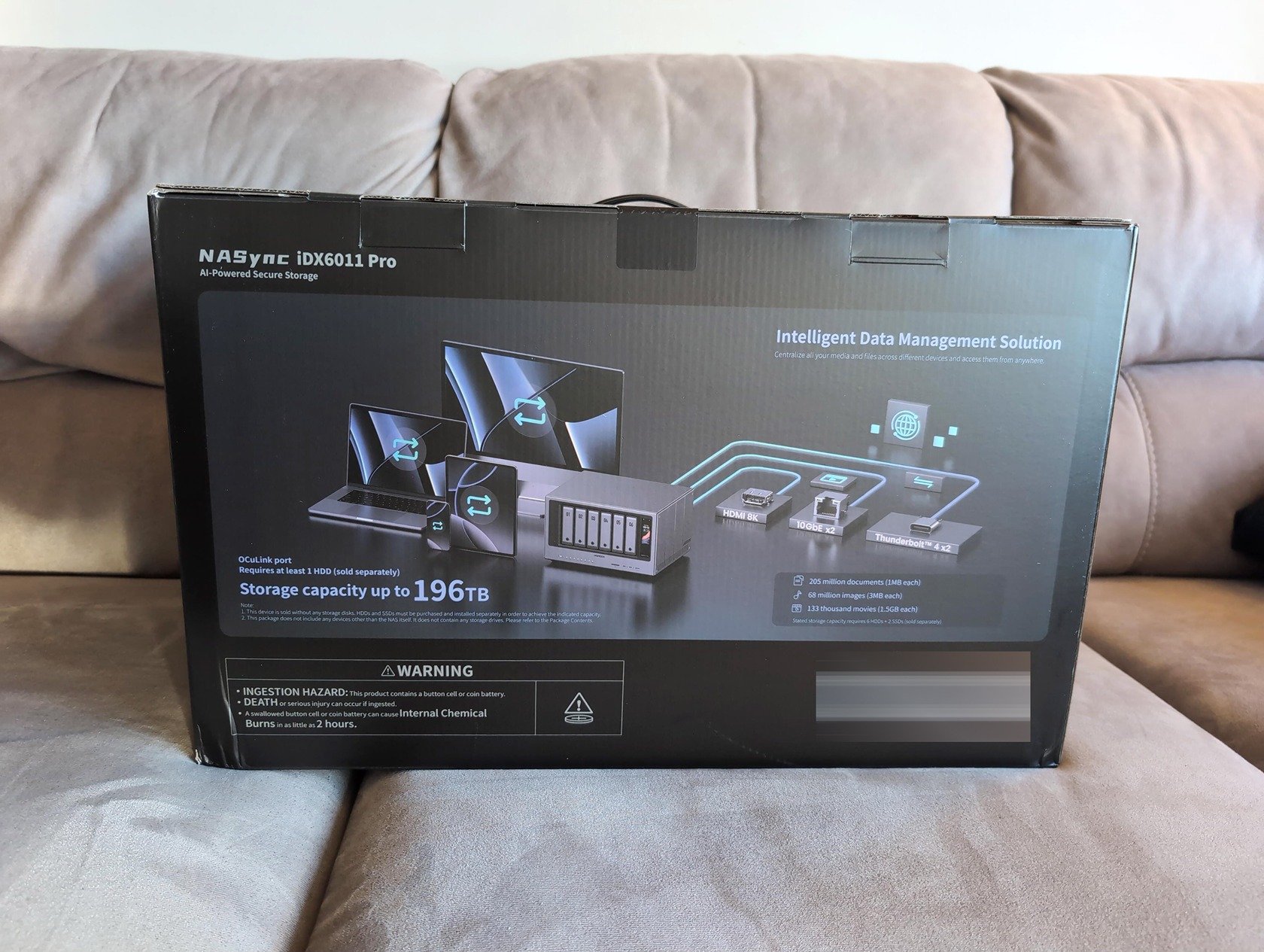
The network and I/O logic scales to match the internal processing. The chassis hosts dual high-bandwidth physical pipelines through Thunderbolt 4 and 10GbE LAN ports. The dual 10GbE network ports support link aggregation for 20Gbps sustained physical transfers, while the dual Thunderbolt 4 ports allow 40Gbps direct-attached connectivity. Video editors can plug a workstation directly into the NAS via Thunderbolt, edit raw 8K media straight off the array, and output the timeline directly to a monitor via the built-in HDMI 8K port, completely bypassing standard network bottlenecks.
Continuous index polling generates significant thermal loads. Traditional enclosures melt down under sustained hardware processing. The NASync unit houses these components inside a high-strength aluminum alloy casing treated with a matte finish. A magnetic dust mesh filter blocks intake debris, feeding air over a low-noise hydraulic fan that maintains a 29–34 dB acoustic signature, keeping the chassis cool directly on a studio desk.
iDX6011 vs. iDX6011 Pro: Which model fits your workflow?
Both models support massive multi-user expansion. You get up to 196TB of total scale across six SATA storage bays and two NVMe slots. Both run the Security Manager with pro-grade encryption protocols, active virus threat protection to catch malicious payloads, granular permission hierarchies, and multiple RAID levels to isolate corrupted sectors. Both feature a 3.7″ smart touch LCD display on the front plate to monitor CPU, NPU, RAM, and network usage in real time.
The decision criteria split strictly at the processor layer and external GPU expansion capability.
The NASync iDX6011 base model
The standard NASync iDX6011 relies on the 14-core Intel® Core™ Ultra 5 125H processor. Buyers can choose between a 32GB or 64GB memory footprint.
The base unit is the definitive recommendation for individual creators, prosumers, and standard small-office deployments. The Ultra 5 handles background OCR transcription, multi-user file sharing, and the full Uliya suite smoothly. If your core requirement is managing tens of millions of documents or backing up dense photo arrays with robust off-grid privacy, this model overdelivers.
The NASync iDX6011 Pro
The NASync iDX6011 Pro upgrades the CPU to the Intel® Core™ Ultra 7 255H (clocking 5.1 GHz across 16 cores and 16 threads) and pairs it with an integrated Arc™ GPU. It dictates 64GB of RAM as the hard baseline.
However, a mild processor frequency bump does not justify the Pro markup alone. The singular reason you buy the Pro over the standard variant is the inclusion of the rear OCuLink port.
This PCIe Gen4 x8 pipeline bridges the NAS directly to external graphics cards. Tethering via the OCuLink port enables massive external GPU-accelerated workloads native to the storage server itself. This specific I/O completely recalibrates the hardware from an intelligent NAS into a hybrid rendering node. If your studio runs localized 3D rendering pipelines or trains custom AI sub-models against massive private datasets, the Pro acts as a localized data-center rack. If you do not intend to connect an external GPU dock, buy the base model and save your budget for high-capacity NAS drives.
Pricing, release dates, and securing early Kickstarter availability
Premium networking silicon scales high, making aggressive early adoption windows highly relevant for IT budgets. Pre-orders on UGREEN’s store have already sold out, pushing the remaining early inventory strictly to the upcoming crowdfunding platform launch.
The campaign goes live on March 24 with the following Super Early Bird pricing structure:
- The 32GB iDX6011 starts at $999.
- The 64GB iDX6011 steps up to $1,199.
- The iDX6011 Pro commands $1,559.
To navigate the launch and secure the lowest tier, follow these exact fulfillment steps:
- Secure a $30 refundable deposit prior to launch on the UGREEN site using the exact email address you intend to use for the crowdfunding platform.
- Log into Kickstarter on March 24, match your reserved email, and select your specific model reward.
- Submit your final address information post-campaign to clear customs (which UGREEN covers).
Shipping begins strictly in May. Fulfillment centers dispatch inventory in batches sequentially aligned with completed payment orders, meaning early day-one backers skip the inevitable backorder delays.
If backing enterprise networking hardware via crowdfunding triggers typical hardware-vaporware concerns, the manufacturer’s operational history is the primary counterweight. Their previous NASync DXP Series broke platform records, pulling 13,285 backers and $6,678,664 in pledges to secure the Best of Kickstarter title as the highest-funded NAS product on the site.
They insulate the new iDX hardware with a three-year warranty, five years of committed security updates, and QA lifecycle testing proving 10,000 physical port insertions.
If you want comprehensive local media control without paying silicon valley tech giants to read your files, upgrading to embedded edge-compute storage solves the problem permanently. Claiming an early unit simply locks in the infrastructure before retail pricing takes effect.
Frequently Asked Questions
What’s the difference between the UGREEN iDX6011 and the iDX6011 Pro?
The base iDX6011 features an Intel Core Ultra 5 processor, while the Pro upgrades to an Ultra 7 and mandates 64GB of RAM. The singular reason to buy the Pro, however, is the rear OCuLink port. This connection lets you tether an external GPU dock to the NAS, transforming it into a localized hybrid rendering node for heavy 3D workflows or custom AI model training.
How does the UGREEN iDX process AI search features without exposing my private data?
The iDX series relies entirely on an embedded Local AI Engine backed by dedicated hardware NPUs. This completely isolates your data from opaque cloud pipelines, meaning every image scan, voice transcript, and natural language search executes strictly on-device. Your proprietary files remain entirely offline, eliminating the privacy tax and NDA liabilities associated with external cloud indexing.
Can I edit raw video directly off the iDX array?
Yes, you can completely bypass standard network bottlenecks using direct-attached hardware connectivity. The chassis includes dual Thunderbolt 4 ports capable of sustained 40Gbps transfers, allowing editors to scrub raw 8K media straight off the array. You can even output your editing timeline directly to a monitor monitor using the built-in 8K HDMI port.
Why does a storage drive need workstation specs like 64GB of LPDDR5X RAM?
A passive hard drive doesn’t, but the iDX series runs active edge-computing tasks like robust semantic indexing and media transcription. Loading offline large language models requires massive memory overhead to remain immediately responsive. Standardizing on 32GB to 64GB capacities prevents system-halting page-file swaps when the embedded AI is indexing millions of high-resolution files in the background.
What is Uliya AI Chat?
Uliya functions as a localized, offline large language model that acts as an interactive knowledge base for your stored data. You can command it to read through a folder of complex technical PDFs and generate a summary, or transcribe and translate massive audio recordings. The system executes these workflows natively on the hardware, though it permits tunneling out to external models like ChatGPT if you require broader internet context.
How much does the UGREEN iDX series cost and when does it release?
Super Early Bird pricing on Kickstarter starts at $999 for the 32GB base model, scaling to $1,559 for the Pro version. The crowdfunding campaign launches on March 24, requiring a $30 refundable deposit placed beforehand on UGREEN’s site to secure the lowest pricing tier. Hardware fulfillment begins strictly in May, with initial units dispatched in the exact order of completed payments.