Ever felt like the global economy is a puzzle with a few pieces missing? I’ve certainly been there. Even with a decent grasp of the basics, it’s easy to get lost in the sea of international trade flows and country GDPs.
That’s where a brilliant game called Tradle comes to the rescue. It’s a clever word-guessing game created by Boston-based programmer Alexander Simoes that makes learning about economics feel like an adventure.
Ready to boost your understanding of worldwide exports in a way that’s actually fun? Let’s explore the world of Tradle, one guess at a time.
Key Takeaways
Tradle is a daily guessing game where you identify a country based on a visualization of its main exports.
Developed by Alexander Simoes, the game uses real data from the Observatory of Economic Complexity (OEC) to create its puzzles.
Playing Tradle improves your knowledge of geography and economics by turning complex trade statistics into an engaging, interactive format.
The game is part of a larger trend of educational gaming, a market projected to be worth over $29 billion in 2025.
Table of Contents
What is Tradle?
Tradle is a fun daily game that makes learning about the world economy feel less like a chore and more like a challenge. It’s a word-guessing game, but instead of words, you’re guessing countries based on their exports.
The game was created by Alexander Simoes, who is the CTO of Datawheel, the company that develops and designs the Observatory of Economic Complexity (OEC). The OEC is a powerful data visualization platform that tracks global trade, and it’s the source for all the puzzles in Tradle. So when you play, you’re interacting with real-world economic data.

Inspired by the viral sensation Wordle, and its geography-based cousin Worldle, Tradle gives you six tries to figure out the mystery country. It’s a simple idea with a surprising amount of depth.
How Tradle Transforms Economics Learning into a Word-Guessing Game
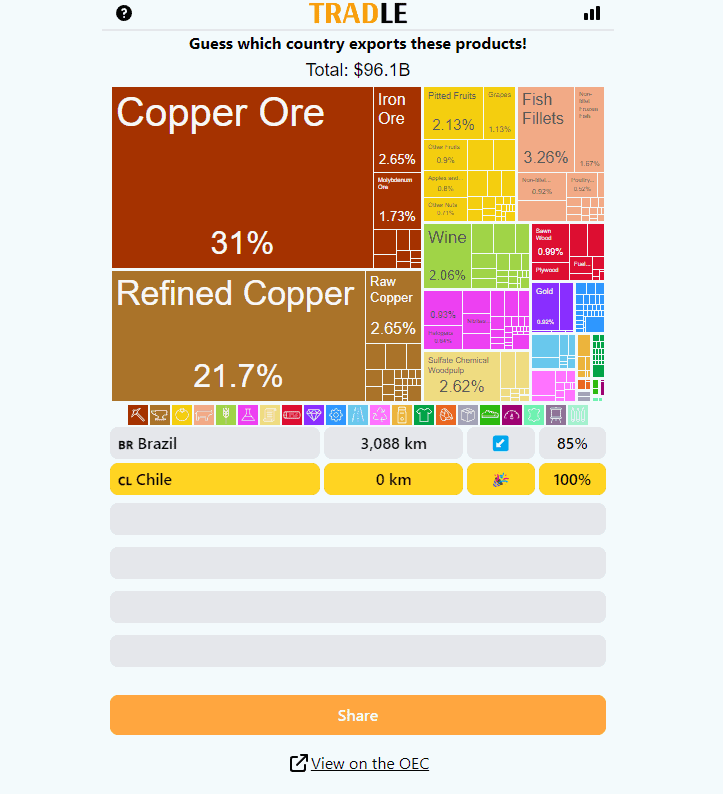
I find that Tradle turns abstract economic data into a tangible puzzle. The game starts by showing you a “treemap,” which is a visual breakdown of a country’s exports. Each colored rectangle represents a product, and the size of the rectangle shows how much it contributes to the country’s total exports.
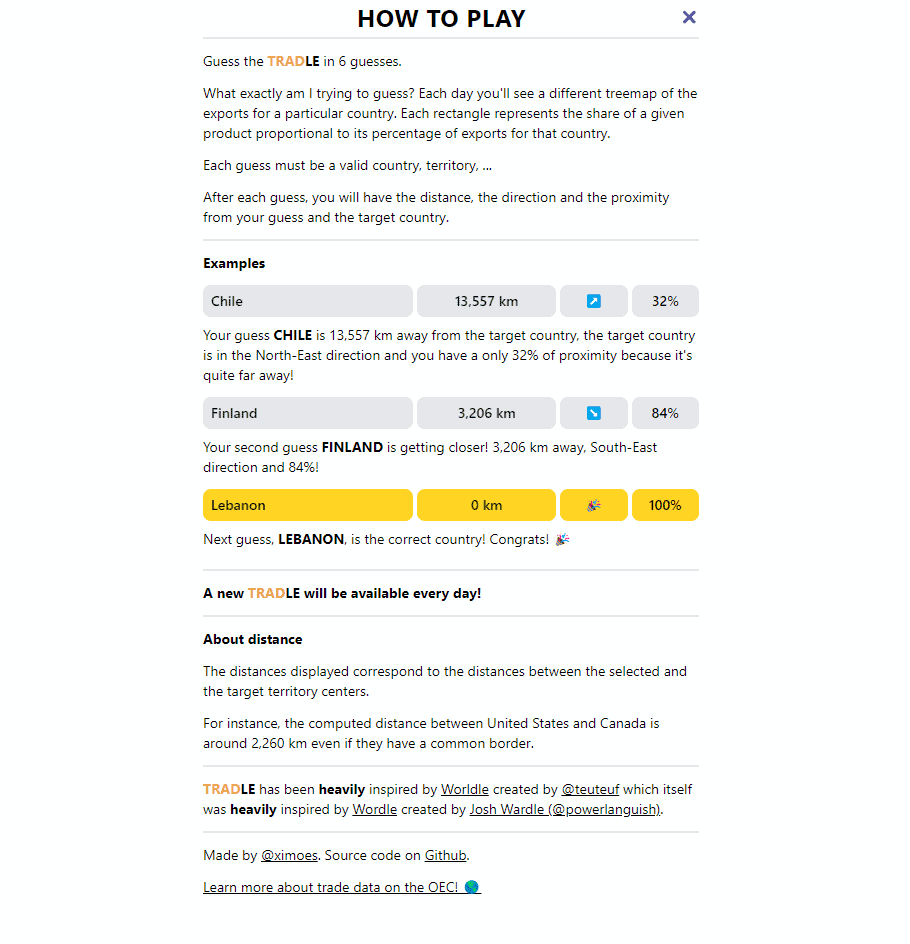
After each wrong guess, the game gives you three crucial hints: the distance your guess is from the correct country, the compass direction you need to move, and a proximity percentage. This turns every guess into a step-by-step geography lesson.
If you see a chart dominated by crude petroleum and cars, you might start thinking of major industrial nations. If it’s coffee and soybeans, your mind might go to South America. It’s all about pattern recognition.
This blend of economics and geography is what makes the game special. It follows in the footsteps of other popular “-dle” games but carves out its own niche. It’s not just about knowing country shapes like in Worldle; it’s about understanding what makes their economies tick.
The Impact of Tradle on Understanding of Global Exports
Tradle has a knack for shattering preconceptions about global exports. Before playing, I had a pretty standard idea of which countries sold what. But the game constantly surprises me.
For example, a puzzle might show that a country’s main export is “Non-fillet Frozen Fish.” This clue immediately makes you think geographically, pushing you to consider countries with significant coastlines and fishing industries, like Namibia. It connects a product directly to a place.
Playing the game makes abstract facts about global exports much more memorable. Everyone knows the U.S. imports a lot from China, but Tradle highlights the smaller, more specialized economies. It reveals the surprising diversity of products that drive international trade, turning boring statistics into an exciting discovery.
By making you an active participant, Tradle transforms learning. You’re not just reading numbers on a screen; you’re using them to solve a puzzle. This makes the information stick in a way that reading a textbook never could.
The Popularity of Tradle among Economics Enthusiasts
It’s clear I’m not the only one who enjoys this daily dose of economic trivia. Tradle has built a dedicated community of players who love the blend of learning and fun. It has become a popular habit for economics buffs, students, and geography lovers alike.
The game has garnered significant attention, averaging around 480,000 monthly views. This popularity stems from its ability to make complex data accessible and entertaining. It’s part of a massive trend in online word and puzzle games.
- The “Wordle Effect”: The original Wordle became a global phenomenon with over 2 million daily players at its peak in 2023. This success spawned countless variations, including Tradle.
- Broad Appeal: A 2023 report from Statista noted that about 23% of mobile gamers play word games, making it the fifth most popular genre. These games aren’t just for kids, as nearly 60% of players are between 25 and 54 years old.
- Engaged Communities: Players often discuss the daily puzzle on social media platforms like Reddit, sharing their scores and strategies, which helps new players discover the game.
Tradle taps into this existing audience by offering a unique, educational twist that rewards strategic thinking over simple guesswork.
How to Play Tradle
Getting started with Tradle is easy, but mastering it requires a bit of strategy. Here is my approach to tackling the daily puzzle.
- Analyze the Treemap: The game begins by showing you a country’s top exports. Don’t just look at the biggest product. Pay close attention to the mix of goods. A combination of machinery and pharmaceuticals suggests a very different economy than one based on agricultural products.
- Make an Educated First Guess: Based on the export profile, make your best guess. Think geographically. If fish is a major export, the country is likely near an ocean.
- Use the Hints Strategically: After a wrong guess, you get distance, direction, and proximity clues. Use an online map to visualize these hints. If your guess was 3,000 km off to the south-west, look for a country that fits the export profile in that new area.
- Learn from Your Mistakes: Every incorrect guess is a learning opportunity. You now know a country that *doesn’t* have that export profile, which is valuable information for future games.
- Check the OEC Link: After you solve the puzzle (or give up), Tradle provides a link to “View on the OEC.” I always click this. It takes you to a detailed profile of the country’s economy, providing a deeper context that makes the next day’s game even more interesting.
- Have Fun! The goal is to learn something new about our interconnected world. Enjoy the challenge and don’t worry about getting it right on the first try.
The Future of Educational Games like Tradle
Games like Tradle are more than just a passing trend; they represent the future of learning. The concept of “gamification” in education is growing at an incredible pace.
The numbers back this up. One market report estimates the global game-based learning market was valued at $29.46 billion in 2025 and projects it to grow to nearly $79 billion by 2030. That signals a huge shift in how we approach education.
Another analysis projects the gamification education market, a closely related sector, will grow from $1.55 billion in 2025 to over $18.6 billion by 2033, showing a compound annual growth rate of 36.4%.
The OEC team itself seems committed to this future. They have already expanded their offerings beyond Tradle to include other data-driven games like “Export Hold’em” and “Pick 5.” There are plans to incorporate more datasets and even AI capabilities into Tradle, which could provide deeper insights and more varied challenges.
As technology improves, I expect to see more tools that turn complex subjects into engaging and effective learning experiences. Tradle is a perfect example of this movement in action.