
Under Section 41(b)(1), qualified research expenses are the sum of two categories: in-house research expenses and contract research expenses, and if a cost isn’t set forth in Section 41(b), you can’t claim it, period. In software-team terms, the in-house bucket is what practitioners actually track: what your W-2 engineers are paid, the supplies the research consumes, and money paid for the right to use computers, which in 2026 mostly means your cloud bill. The fourth bucket is contract research, paid to non-employees, and it gets a haircut to 65% of what you actually spent.
That’s the whole formula. Two inputs. The list is closed, not illustrative: patent costs, overhead, consortium fees, and “miscellaneous engineering” all fail by default, no matter how research-adjacent they feel. And before a single dollar counts, the underlying activity has to pass the four-part qualified research test. Consider this the spec sheet. Everything below is implementation detail.
Key Takeaways
QREs come only from Section 41(b): in-house research expenses (wages, supplies, computer rental/lease) plus contract research, counted at 65% of what you pay outside contractors.
Wage QREs hinge on the Section 3401(a) W-2 definition and the 80% “substantially all” test, computed employee by employee as qualified hours over total hours; 1099 contractors live in the contract research math instead.
For tax years starting after Dec. 31, 2024, OBBBA ties QRE eligibility to Section 174A domestic R&E treatment, and claiming the gross credit means reducing domestic R&E deductions by the credit amount unless you elect the reduced credit under Section 280C(c).
Table of Contents
The definition, and the gate before it
Yes, the four-part qualified research test applies before any expense counts as a QRE. An expense only qualifies if the activity it paid for is qualified research under Section 41(d). Money spent on non-qualified activity doesn’t sneak into the credit no matter which ledger line it came from.
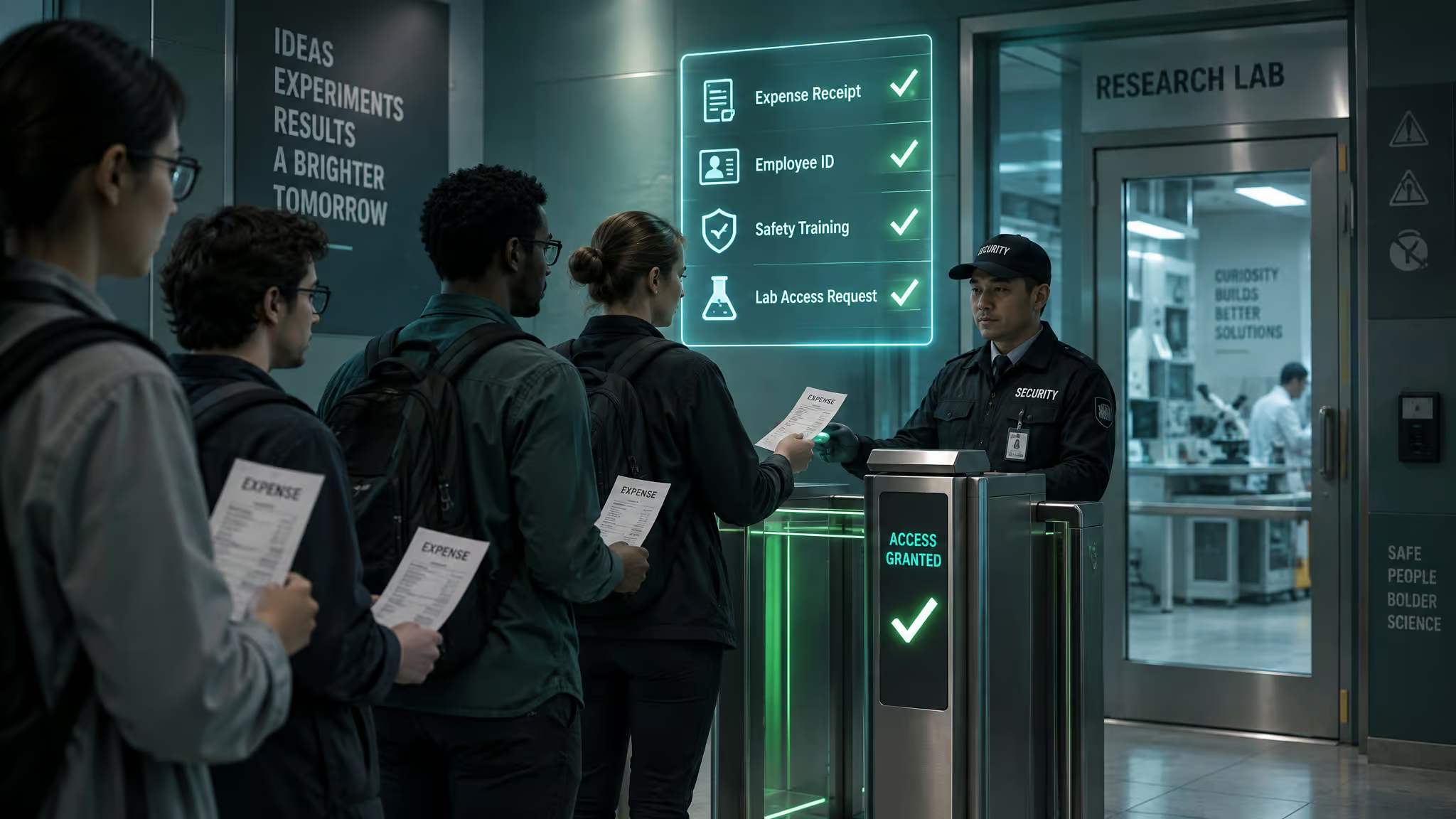
The two statutory categories sit in Section 41(b)(2) (in-house research expenses) and 41(b)(3) (contract research expenses). Practitioners mentally sort everything into four buckets: W-2 wages, supplies, contract expenditures, and computer rental/lease. That’s not a framework anyone invented, it’s just how people who file these credits actually think.
The four-part test, briefly:
- Section 174A eligibility. The expenditure must be for a trade or business, performed in the U.S., and experimental in the laboratory sense.
- Discovery of technological information. You’re hunting for information, not just shipping: something new or improved about a business component’s functionality, quality, reliability, or performance.
- Process of experimentation. You’re evaluating alternatives and working through uncertainty. Style, taste, cosmetic, and seasonal design choices are excluded; engineering uncertainty counts, aesthetics don’t.
- The business component test, applied with the shrinking-back rule. If the test fails at the whole-product level, you re-apply it to subsets of elements, then subsets of subsets, until something passes or you hit the most basic element and it fails. It’s genuinely a recursive function with a base case, and honestly kind of elegant that tax law works this way.
“Technological in nature” means hard sciences: physics, biology, chemistry, engineering, aimed at eliminating uncertainty. If your work isn’t grounded in one of those, it’s probably not this credit.
The statute also hands you an explicit no-fly list. Research after the beginning of commercial production is out, once it’s shipping, the clock stops. Adapting or reproducing an existing component is out; copying isn’t discovering. Efficiency surveys, routine data collection (no, dashboards and logging don’t count), and ordinary quality-control testing are out. Research conducted outside the U.S. is out, bluntly. And funded research is out, more on that below.
One more exclusion that surprises people: general and administrative costs aren’t QREs even when they support qualified research. Managerial oversight, clerical work, and normal business operations stay out. Helping the lab doesn’t make you the lab.
Quick history, delivered at the speed it deserves: Congress enacted the credit in 1981 to counter declining research spending, and the PATH Act of 2015 finally made Section 41 permanent, no more annual renewal drama. Eligibility also broadened well beyond biotech and pharma; the regulations opened the door for software companies, chemical manufacturers, medical labs, and food processors. If you’re solving technical problems, this credit is worth a look, which is roughly what everyone I’ve read on this says.
Wages: the first-line-management cutoff decides more than you’d think
Section 3401(a) W-2 box-one wages, including bonuses and stock option redemptions, qualify when paid to employees performing one of three qualified services. 1099 contractors and amounts not subject to withholding don’t. That’s the whole answer up front; the details are where claims survive or die.
What “wages” actually means
“Wages” for QRE purposes points at the withholding-law definition in Section 3401(a), not your gut feel. If it shows up on the W-2, it’s probably in. Bonuses and stock option redemptions count. Certain fringe benefits and non-taxed income don’t, because they’re never subject to withholding.
And 1099 contractors are simply in the wrong bucket. They’re not wage QREs at all; they belong in the contract research math at 65%. Wrong bucket, wrong math.
The three qualified-service types
Section 41(b)(2)(B) gives you exactly three:
- Engaging in qualified research. The person actually doing the thing, hands-on, like a scientist running lab experiments.
- Directly supervising. First-line management only. This is the cutoff that wrecks naive calculations: a VP of engineering who was herself a genuinely great researcher still can’t have her full salary claimed. Higher-level managers’ qualifying work is usually a minor fraction of their time, and the statute doesn’t care how technical their background is.
- Directly supporting. Services that support the doers and supervisors. Treas. Reg. 1.41-2(c)(3) gives the include/exclude list, and the examples are honestly kind of elegant in their proximity logic: the secretary typing lab reports, the lab worker cleaning equipment, the clerk compiling research data.
For software teams, build/devops support and data compilation are your equivalents. Close to the work counts; far from the work doesn’t.
The exclusion side is just as specific: payroll staff prepping scientists’ checks, accountants booking research spend, general janitorial, and officers supervising financial or personnel matters don’t qualify even if they sit inside a research department. And G&A services are excluded no matter where the people sit on the org chart. Relocating the org chart doesn’t change the answer.
The 80% rule, per person
Under Treas. Reg. 1.41-2(d)(2): if substantially all (at least 80%) of an employee’s services for the year are qualified services, all of that employee’s wages count. Below 80%, only the actual qualified-service portion counts, computed as qualified-service hours over total service hours, sick leave excluded. Employee by employee. A mixed team gets claimed person by person; it’s not a company-wide haircut.
Naming trap worth flagging: this “substantially all” test is a different rule than the process-of-experimentation “substantially all” test. Same words, different meanings, don’t cross-wire them.
Substance over titles
Eligibility turns entirely on what the employee actually does during a specific time period. The IRS looks at your calendar, not your LinkedIn. Degrees and technical qualifications are noted but not conclusive; a PhD on payroll isn’t automatic QRE wages. Conversely, an engineering supervisor performing design reviews or lending technical expertise can qualify through direct supervision or support, and a manufacturing staff engineer designing a new prototype is doing research regardless of what the title says.
A common failure pattern in practice: wholesale inclusion of engineering managers above first-line supervision. The tell, per people who do this work, is a VP’s full salary appearing in the QRE calculation. That number doesn’t survive a competent examiner.
Stock options: two clocks, one credit
Here’s the corner almost every QRE article skips, and it matters for option-heavy software teams.
Stock option spreads count as wages, per Apple Computer, Inc. v. Commissioner, 98 T.C. 232 (1992), acq., and Sun Microsystems, T.C. Memo 1995-69, acq. (The IRS actually agreed with taxpayers in both, which in tax litigation is about as common as a clean deploy on Friday.)
But two clocks are running here. The grant year’s work determines whether the work was a qualified service. The spread enters wages in the exercise year. Worked example: option granted in 1997, exercised in 2003.
You check what that employee did in 1997 to establish eligibility, then you count the spread in 2003. A spread can land as wage QREs years after the work happened, which is exactly the kind of temporal weirdness option-heavy teams should know about.
One boundary: the sources cover stock options only. Don’t generalize this to RSUs or other equity instruments.
Supplies: consumables, not capital, and the GL trap
A supply QRE, under Section 41(b)(2)(C), must be non-depreciable tangible property, not land or improvements to land, and not anything with a useful life over one year, directly used in qualified services. The depreciable-character test turns on useful life, regardless of how you actually depreciated the thing on your books.
Lockheed Martin Corp. v. United States (Ct. Cl. 2001) is the case that shaped how “supply” gets read: consumables, not capital.
The exclusion list, and one fun yes
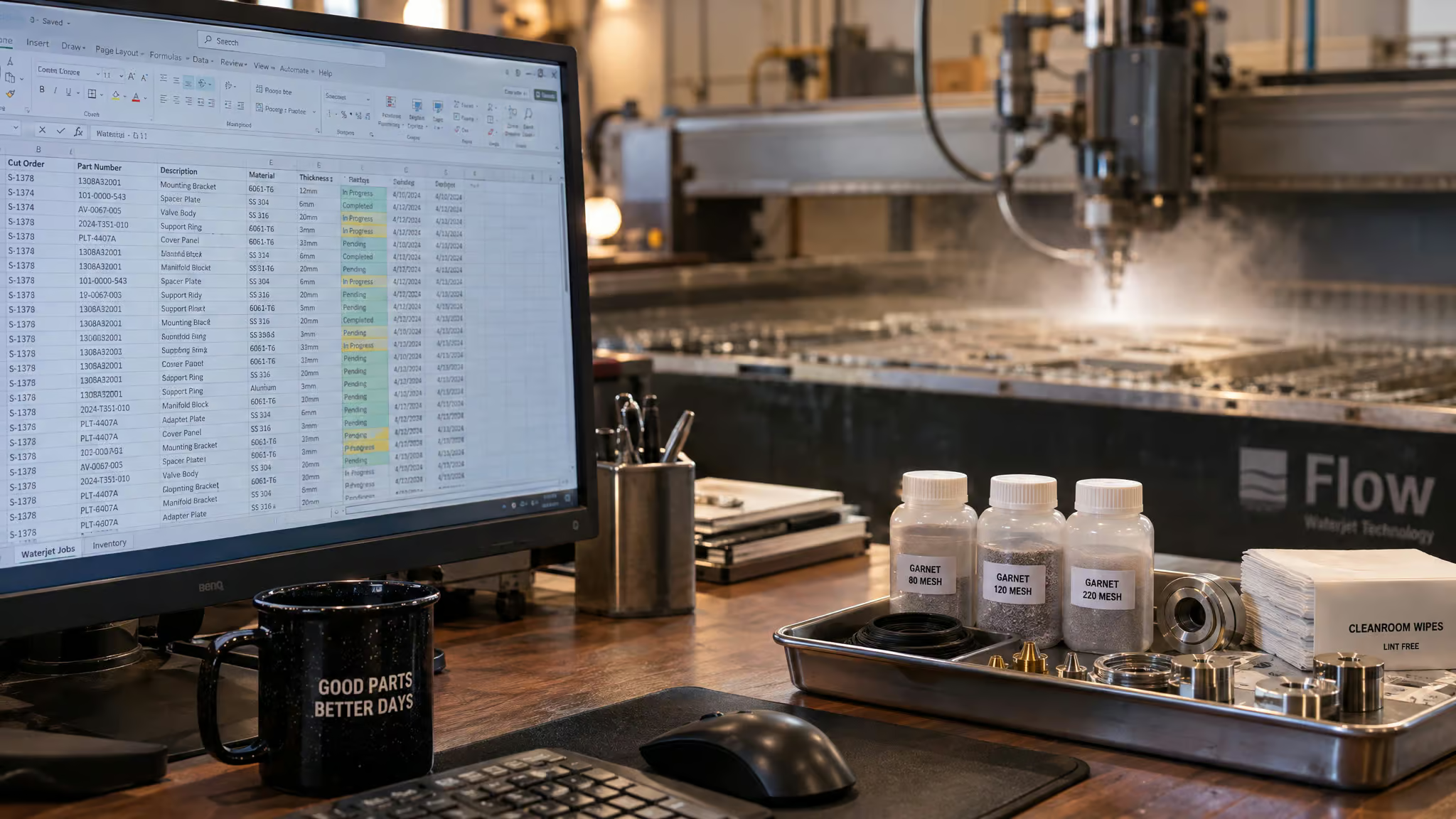
Mostly a list of no’s: travel, meals, entertainment, researchers’ phone bills, relocation, rentals, dues, royalties and licenses, overhead, general office materials. And one fun yes: certain “extraordinary utilities,” but only with bill-spike documentation. This exception is real in the wild. There’s a water jet cutting business whose extraordinary water expenses qualified as supplies, because the water bill went genuinely weird and the bills proved the spike.
Keep the bills. The spike is your evidence.
Also: G&A costs of self-constructed supplies get improperly claimed a lot, and prototype spend needs a depreciable-character check before it goes anywhere near the calculation. And your book labels don’t control. Renaming a line item isn’t a strategy; substance wins.
Boundary rulings worth knowing
- Software is intangible and can never be a supply. Obvious once you say it, but people keep trying.
- Building or testing facility construction is an improvement to land. No QRE. Mobile or wheeled facilities are a genuine gray area; bricks and foundation are out, wheels are… complicated.
- Prototype and first-run supplies qualify regardless of disposition. Sold, kept, scrapped, doesn’t matter. And repeated runs still count as “first run” while the product is still being changed and improved. But a second run with zero changes can’t qualify. The iteration is the point; a no-change rerun kills it.
The general-ledger trap
A typical setup error, and the one the IRS audit guide specifically flags: exporting the GL “supplies” account wholesale into the credit calculation. That account mixes depreciable property, office materials, and non-research spend, which is exactly why it’s not an answer. If a credit study’s supplies line got slashed in an exam, this is usually why: the number was pulled from a label instead of built from qualifying transactions.
Red flag: Supply QREs pulled straight from a GL account label mix in depreciable property, office materials, and non-research spend. Build the number from qualifying transactions instead.
The examiner heuristic is worth internalizing: supply QREs should be a small portion of total QREs. Big supply numbers signal capital or ineligible expenses riding along. If supplies dominate your QRE stack, something’s off. The GL label is a starting point, not an answer.
Cloud computing: your EC2 bill might literally be a tax credit
Yes. AWS and Azure costs can qualify, because the statute covers amounts paid for the right to use computers in qualified research, the same tax code that governs how software development costs are expensed or amortized. The original rental/lease language now mostly describes your cloud invoice. This is likely your largest non-wage spend as a software team, and it’s the bucket that most often goes unclaimed.
But draw the line commodity articles blur: you’re claiming rights to computing capacity, not software. An AWS bill can qualify while a CAD license on the same invoice run cannot, because purchased off-the-shelf software like Microsoft Office or CAD doesn’t fit any QRE bucket. Software is intangible; buying tools isn’t doing research.
Contract research and the 65% rule
Contract research expenses equal 65% of what you pay outside contractors for qualified research performed on your behalf, per Section 41(b)(3) and Treas. Reg. 1.41-2(e)(1). Show the math on a round number: a $50,000 contract devoted entirely to R&D yields only $32,500 in QREs. The IRS counts about two-thirds of what you pay outsiders, and how much of each contract survives that haircut depends partly on how it’s drafted, a point that becomes clearer once you understand how the Section 41 R&D credit applies to software development.

Why 65% exists at all
The haircut dates to the credit’s 1981 enactment and was deliberately designed to favor in-house research. That’s legislative archaeology with a strategic punchline for outsourcing-heavy teams: you structurally earn less credit per dollar than an in-house team does. In-house wage dollars count in full when the work qualifies; contract dollars max out at 65%. The statute was built that way. If anyone asks which category pays better, that’s the whole answer.
The three-part test
Treas. Reg. 1.41-2(e) sets three conditions:
- An agreement entered before performance. It’s usually written, though not required, a handshake can technically count, but get it in writing anyway.
- Research performed on your behalf. A right to the results suffices; exclusive rights aren’t required. You don’t need exclusivity, just a claim on the results.
- You bear the expense even if the research fails. Skin in the game is the test. Success-contingent payments are treated as buying a product, not funding research. Paying for a result isn’t paying for the attempt.
Practitioner shorthand bundles this as substantial rights plus the economic risk of the contractor’s development. Own the risk, own the credit.
Timing matters too: prepaid contract research isn’t credit-eligible until the services are performed, under Section 41(b)(3)(B). The credit follows the work, not the invoice. You can’t front-run the calendar.
Contract-type framework
- Hourly service contracts without specified research: only amounts paid for actual qualified research work count, still subject to 65%. Billable hours only count if the hours were research.
- Fixed-price research contracts: the entire amount goes through the 65% limit. Flat fee doesn’t dodge the haircut.
- Mixed-service contracts: two filters in sequence. First isolate the qualifying portion, then take 65% of only that.
And read the SOWs and work orders, not just the master agreement. That’s where the truth about what was actually scoped lives.
The domestic requirement
Contractors must be U.S.-based. Short, hard rule. The IRS guide’s example: overseas software developers in Asia paid hourly don’t qualify despite meeting the financial-risk condition. You can pass the money test and still fail the map test. The recurring software-team pattern is capturing cloud spend correctly while offshore contractor payments ride along in the same vendor list until someone actually reads the contracts, and the map matters even more once you hit the internal-use software R&D credit rules.
Funded research: the mirror-image rule
The funded research rules exist so two companies can’t claim the same expenditures. One expense, one credit.
What commodity articles state one-sidedly, and shouldn’t: the rule is mirror-image. Take the $100,000 lump-sum payment for a car design, payable only on completion. That success-contingent structure disqualifies the paying business. But the designing business’s own expenses can qualify. Same contract, opposite outcomes depending on which side you sit on.
This ties straight back to the three-part test’s economics: own the risk, own the credit. If someone else is paying and bearing the risk, someone else claims the credit. If you own the risk, the door is open even when you’re the one writing checks that only pay off on success.
What the IRS actually checks
The documentation that survives an exam is unglamorous: payroll records, job descriptions, performance reviews, calendars, and appointment books all count as good sources, plus W-2s, time-tracking records, questionnaires, meeting minutes, even oral testimony. And statistical sampling is legitimate when the employee pool is large and full coverage is impractical. Sampling is legit; the IRS guide says so.
The wage-audit playbook
The IRS Audit Technique Guide (June 2005, so pre-PATH Act and pre-OBBBA, read it for examiner framing rather than current law) is blunt about priorities: identifying employees whose wages are claimed is, in substance, the most important phase of auditing the research credit. Examiners focus first on employees whose descriptions suggest administrative, manufacturing, or marketing work, and use interviews to corroborate the records. Presenting this from the examiner’s side is the useful move: know where the scrutiny lands before it lands.
The contract-research audit procedure
Expect a request for all contracts with claimed contract research expense, listed by contract, plus the SOWs and work orders referenced in them. If the contracts aren’t produced and the taxpayer won’t represent in writing that none exist, a summons preserves the record for Appeals. Silence has procedural consequences. Dust off the attachments, not just the master agreement.
The contrarian thread here deserves plain words: courts have denied credits to companies doing legitimate R&D solely because they couldn’t tie expenses to qualified activities. Real research, lost credit, bad records. Substantiation, not innovation, is the deciding variable.
One reassurance while we’re here: pre-revenue startups can qualify. You need a realistic prospect of entering a technology trade or business, objective intent, and capability, plus a good faith intention to profit. Notably, the expectation doesn’t need to be reasonable in hindsight. No revenue yet doesn’t mean no credit.
Owners and partners: the flow-through silent failure
Yes, partners without W-2 wages can still claim wage QREs, using wages subject to self-employment tax: K-1 ordinary business income for partnerships filing Form 1065, or Schedule C net profit. S corp owners are already in the normal bucket, because S corps pay owners W-2 wages by design. Easy mode.
The caution: high-profit partners need a reasonable compensation analysis under Suitor v. Commissioner. The more you make, the more the number gets scrutinized.
And the classic silent failure, straight from practice: multiplying a $1-3 million distribution by a 50% qualified-time percentage to “yield” $1.5 million in QREs. Distributions aren’t wages no matter how you slice the percentage, and the number collapses under the first examiner question. This flow-through failure mode is one commodity articles almost never mention.
OBBBA, Section 174A, and the 280C(c) coupling
For tax years starting after Dec. 31, 2024, Section 41(d) requires expenditures to be treated as domestic R&E under Section 174A to qualify as QREs, and claiming the gross credit means reducing domestic R&E deductions by the credit amount, unless you elect the reduced credit under Section 280C(c). Full credit or full deduction; you’re picking one.

The new coupling
OBBBA, enacted July 4, 2025, created Section 174A, permanently allowing full expensing of domestic R&E for tax years starting after Dec. 31, 2024. Think of it as the current patch notes: domestic R&D is immediately deductible again, permanently, and the QRE definition now leans on those expensing rules. You can also capitalize and amortize over at least 60 months under 174A(c), or deduct ratably over 10 years via the Section 59(e) annual election. You have dials to turn.
If you capitalize and the credit exceeds the allowable deduction, the capital account gets reduced by the excess. The math balances somewhere.
Transition and retroactive options
The awkward middle chapter: TCJA required 5-year domestic and 15-year foreign amortization for taxable years beginning after Dec. 31, 2021, so 2022 through 2024 ran on capitalization. Post-OBBBA, remaining unamortized domestic R&E is deductible entirely in 2025 or ratably over 2025 and 2026. Pick your speed.
Small businesses, defined under Section 448(c) as averaging $31 million or less in annual gross receipts, could retroactively apply Section 174A to 2022 through 2024 via amended returns. That deadline was the earlier of July 6, 2026 or the applicable refund-claim deadline, which has now passed. The do-over came with fine print: retroactive 174A application also meant retroactively applying the 280C(c) rules.
The foreign side didn’t get the upgrade. Foreign R&E remains stuck at 15-year amortization under Section 174, and Section 174(d) blocks recovery of unamortized foreign basis on disposition and, for events after May 12, 2025, blocks reducing the amount realized either. Even selling the asset doesn’t free the trapped basis. The domestic-versus-foreign divergence may quietly drive research-location planning; the tax code is now voting on where your lab sits.
Software-specific good news: software development still qualifies as R&E under Section 174(c)(3) and 174A(d)(3). Notice 2023-63 was the interim guidance and Notice 2024-12 cleaned it up, a patch release in the best sense. Rev. Proc. 2000-50 Section 5 is effectively obsolete for software development costs; that 2000-era guidance is deprecated. Section 174A takes effect as an accounting-method change on a cut-off basis, a switch rather than a restatement of history.
The partnership mechanics came via Rev. Proc. 2025-28, released Aug. 28, 2025: BBA partnerships make the small business election on an AAR, with deductions pushed out to reviewed-year partners. Partnerships should also reassess 2025 tax distributions that were estimated on the old capitalization rules; if your distribution math assumed amortization, re-run it.
Election-modeling tradeoffs and state conformity
Immediate expensing is not automatically better. It can deepen a loss or create an NOL limited to 80% of taxable income. Capitalization elections, meanwhile, can raise the Section 163(j) business interest limitation, since amortization add-backs increase adjusted taxable income starting in 2025. An election over here moves a limit over there. And individuals must amortize R&E over 10 years for AMT purposes, which creates K-1 differences for flow-through owners; pass-through owners feel this directly.
The state map, as of the 2025 filing season: Illinois and New York have adopted Section 174A. Roughly one state in three. Florida and North Carolina among them, still conforms to TCJA Section 174. California conforms to pre-TCJA Section 174 with immediate deduction of both domestic and foreign R&E, which is actually the generous end of the map. Some states may change conformity before filing season, so verify before you file whether your federal elections even work at the state level.
The takeaway beat: the same wage bill can produce different credit outcomes depending on which Section 174A election you choose. The sources are clear that expensing can backfire; don’t flip the switch without modeling the side effects. If you want the deeper dive on the deductibility side, I’ve got a separate piece on whether software development is tax deductible at all, and the internal use software R&D credit rules get stricter still.
So your credit survives
Loop back to the definition: Section 41(b)(1) defines qualified research expenses as in-house research expenses plus contract research expenses, and nothing outside Section 41(b) counts. The four buckets are a closed statutory list. The four-part test is the gate everything passes first. And what decides whether the credit survives an exam isn’t the quality of your science; it’s contract structure, per-employee hours tracking, and documentation.
For 2025 and later filers, treat QRE identification and Section 174A election modeling as one exercise, not two. The same wage bill produces different outcomes depending on the election.
The checklist mental model is the one to keep: does the activity pass the four-part test first? Then route each dollar to wages, supplies, cloud, or contract research, each with its own percentage and documentation rule. Wage dollars in full when the work qualifies, contract dollars at 65% max, supplies small and clean, cloud bills as computer-use rights. Do that routing deliberately, and the credit has a fighting chance of being more than a study binder.
Standard disclaimer in voice: this is technical explanation of how the rules fit together, not tax advice for your specific return.
People Also ask
What are the categories of qualified research expenses under Section 41(b)?
Section 41(b)(1) defines QREs as the sum of two statutory categories: in-house research expenses under 41(b)(2) and contract research expenses under 41(b)(3). In practice, practitioners sort everything into four buckets: W-2 wages, supplies, computer rental/lease (which today mostly means cloud bills), and contract research. The list is closed, not illustrative — if a cost isn’t set forth in Section 41(b), it can’t be claimed, period.
Which employee wages qualify for the R&D tax credit and which do not?
Wages qualify when paid to employees performing one of three qualified services: engaging in qualified research, directly supervising it (first-line management only), or directly supporting it. Wages must meet the Section 3401(a) withholding definition — W-2 box-one wages, including bonuses and stock option redemptions. Certain fringe benefits and non-taxed income don’t count because they’re never subject to withholding, and 1099 contractor payments belong in the contract research bucket instead.