
Every kid who types “how to hack” into a search bar is actually asking about a real job. The version of hacking that pays a salary is called ethical hacking, and the people who do it, ethical hackers, or penetration testers, get legally paid to probe systems for weaknesses, write up what they find, and recommend fixes. The difference between that and the illegal kind isn’t technique. It’s permission. Same curiosity, same skill set; one career path comes with a handshake, the other comes with consequences.
And here’s the part that surprised me when I went digging: the on-ramp for kids already exists, and it’s been built with actual care. CISA, CYBER.ORG, the Air Force Association, SANS, the list is long, but the point is simple: there’s a genuinely good stack of free, age-segmented resources here, running from password games in elementary school up to Capture the Flag competitions in high school. One documented example that sold me: a girl with zero coding experience played through CyberStart America, moved on to AP Computer Science A, and landed a summer internship at the New Jersey Cyber Security Office. No paid bootcamp.
No family connections. A free browser game as the entry point.
So if your kid (or you, kid-reader, hi) wants to know how a kid actually becomes a hacker, the honest answer is: start with how computers, coding, and networks actually work, practice in the sanctioned sandboxes that exist for exactly this purpose, and learn the permission rule early. This article is the roadmap.
Key Takeaways
Ethical hacking is legal probing of systems with permission, and the career behind it, ethical hacker or penetration tester, is a real, well-defined job, not a movie trope.
The legal rule is simple: no touching, testing, or logging into systems you don’t own or aren’t explicitly authorized to access, and sanctioned arenas like CTFs, CyberPatriot, and Cyber Quests exist so beginners never need a gray area.
A realistic free path runs from CISA and CYBER.ORG materials in elementary school through Codecademy Python and Hacker Highschool in the teen years, then CyberPatriot, CyberStart America, and potentially CompTIA certifications before graduation.
Table of Contents
What ethical hacking actually means for kids
Ethical hacking is the legal probing of computer systems to find weaknesses, done with the owner’s permission. That’s the whole distinction. The technique might look identical to what a malicious hacker does; what separates the two is authorization. The job title behind it is penetration tester, and it’s a concrete, paid position, not the white-hat-hero trope from a heist movie.
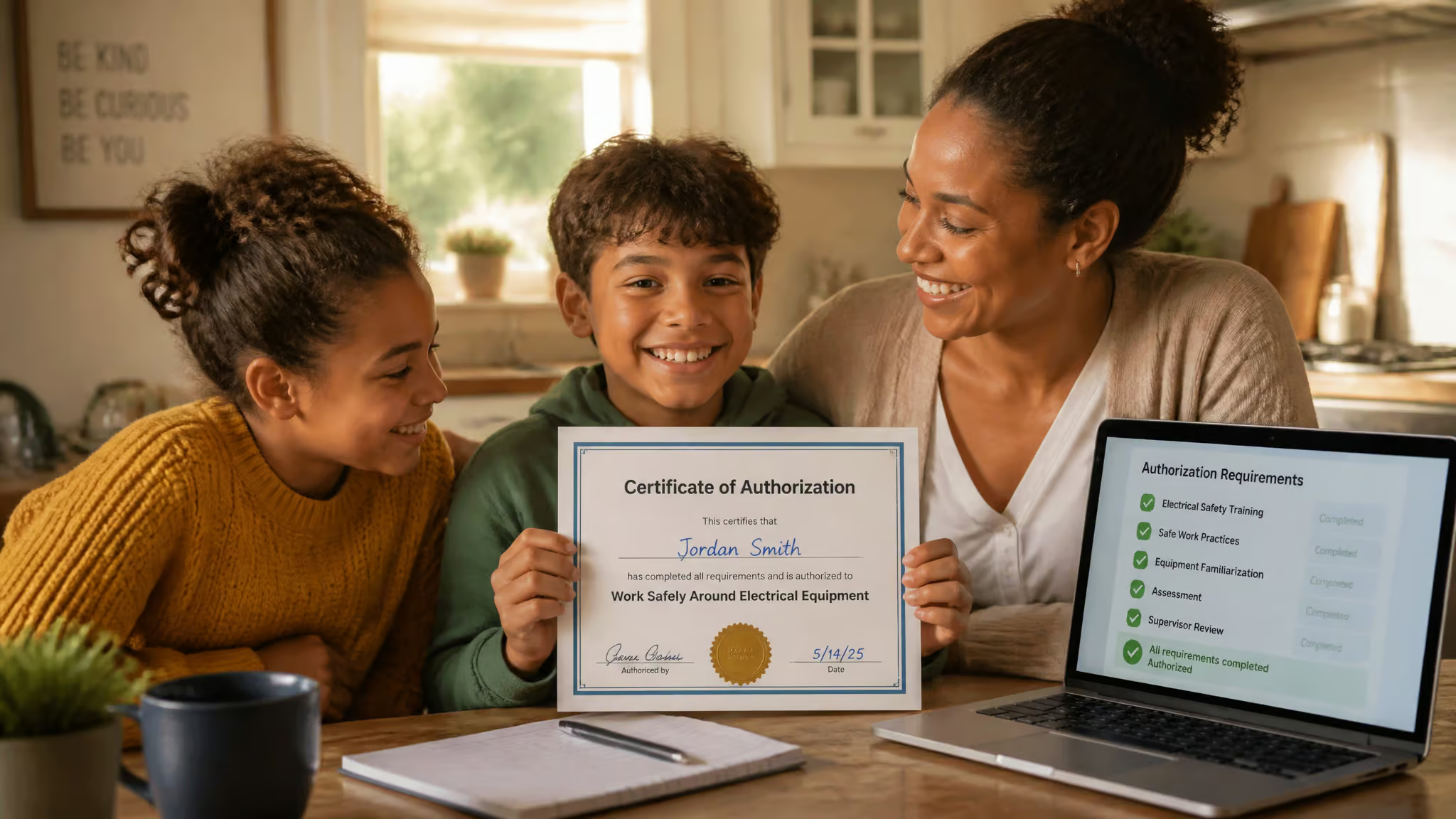
One thing worth saying early, because it gets lost: “hacking” isn’t the only job in this field, and some kids who love security won’t love pentesting. The menu is wider than that, security analysts watch networks for trouble, security engineers build the defenses, and digital forensics analysts investigate crimes after the fact, which is honestly the CSI branch of the field.
Digital forensics analysts investigate crimes after the fact, which is honestly the CSI branch of the field. Information security managers run strategy, and security software developers write the tools everyone else uses. If a kid likes puzzles and systems but the “breaking in” part doesn’t grab them, there’s still a seat at the table.
As for prerequisites, they’re less cinematic than the movies suggest and more learnable than parents fear: critical thinking, digital literacy, risk assessment, privacy awareness, solid passwords and multi-factor authentication, technical aptitude, and, this one surprises everyone, communication. Pentesters spend a real chunk of their job writing reports and explaining findings to non-technical people. It’s not all terminal windows.
The legal boundaries young hackers must know
No, being a hacker is not illegal. Hacking is legitimate exactly when you have permission to test the system, and that single condition is the entire legal framework a young hacker needs to internalize before touching anything.
The golden rule: if you don’t own a system or lack explicit authorization to access it, don’t touch it, test it, or log into it. Yes, that includes school accounts. Yes, it includes a sibling’s device, even as a “joke.” Yes, it includes networks over public WiFi.
And here’s the mistake I see beginners make over and over: a kid learns one genuinely cool trick, tries it on a system they don’t own, and has no idea they just crossed a line. The trick itself wasn’t the problem. The target was. (Standard caveat, stated plainly: this is permission-based ethics, not legal advice.)
Red flag: If a practice environment isn’t explicitly offered to you, it’s not your lab — school accounts, family devices, and public WiFi all count as off-limits.
The reframe that makes this easier to live with: the security world deliberately built sanctioned arenas so no beginner ever needs a gray area. Capture the Flag competitions exist so you can attack systems legally. CyberPatriot hands teams virtual operating systems to secure. Cyber Quests gives you sample vulnerable web servers to analyze.
These aren’t loopholes; they’re designed features of the ecosystem. If a practice environment isn’t explicitly offered to you, it’s not your lab.
Start here: learn the basics by age
The ecosystem is already age-segmented, which turns this from a resource dump into an actual roadmap. One honest pattern first: motivated kids who jump straight to “advanced hacking tools” or raw tutorials tend to quit within weeks, usually when they hit networking basics they skipped. Kids who start with structured games and graded curricula persist. Boring truth, but it’s the truth.
K-5: games, comics, and one great cootie catcher
The elementary tier is free, mostly without signup walls, which, honestly, is rare enough to call out.
- CISA’s Chatting with Kids about Being Online, a free parent-facing starter booklet, the low-effort first download
- CYBER.ORG’s The Adventures of Pascal and Python, a comic strip series teaching internet safety, and yes, that name is a delight
- The Creating a Password Tip Card, one page, no login, a first-sitting activity
- The Cyber Safety Series videos, a CYBER.ORG and CISA collab covering common online threats and how to dodge them; think threat modeling for a fifth grader
- CISA’s downloadable K-5 school-visit presentation, ready-made for career day
Then there’s KnowBe4’s Children’s Interactive Cybersecurity Activity Kit, which is slightly absurd in the best way: a password zapper game, a Roblox game, spot-the-phish challenges, and a clickbait cootie catcher. A cootie catcher, for clickbait. I have no notes.
The kit also includes Security Cat’s Activity Book, a security-themed coloring book that comes in 12 language variants, a small detail that makes it genuinely accessible for multilingual households. PBS CyberChase (games at pbskids.org/cyberchase) and StopBullying.gov round out the tier.
Grades 3-8: self-paced, certificate-driven
CYBER.ORG’s Keys to Cybersecurity is the star here: self-paced activities kids can drive themselves (parents will appreciate that), targeting grades 3-8, with a certificate for each completed Key. That little dopamine loop is clever motivation design, and I mean that as a compliment.
Also in this band: the FBI’s Safe Online Surfing program at sos.fbi.gov, the least intimidating FBI URL you’ll ever type, with games for grades 3-8 and certificates for top-performing schools. The PBS NOVA Labs Cybersecurity lab at pbs.org/wgbh/nova/labs/lab/cyber is free, gamified, and the kind of thing a curious kid will burn an whole afternoon on. And the Australian government’s Cybersmart Challenge (esafety.gov.au/kids-quiz) is a good reminder that the good stuff isn’t all US-made.
Teens: the real curriculum starts
This is where “hacking” becomes a legitimate course of study. Hacker Highschool, a free self-paced curriculum from ISECOM (the Institute for Security and Open Methodologies), targets ages 12-20 and covers topics like Attack Analysis and Defensive Hacking. It’s the place where the “how to become a white hat hacker” question finally gets a straight answer, and the framing is offense-informed defense, not mayhem.
Codecademy covers the coding foundation with free interactive courses in Python, Ruby, PHP, computer science, and data science. Cybrary is the step up once a kid knows they’re serious. All courses are free to view; a paid Pro tier adds career pathways. The catalog runs from Introduction to IT and Cybersecurity up to Offensive Penetration Testing.
Honest caveat: Cybrary isn’t built for K-12. It assumes an IT baseline, so treat it as a teen and young-adult platform.
For parents pushing their district: the K-12 Computer Science Framework (a five-organization collaboration involving ACM, Code.org, and CSTA, among others) provides guidelines for weaving CS and cybersecurity through every grade band. It’s background ammo, not homework. And for the hands-on tier, KiwiCo and Creation Crate subscription boxes suit roughly age ten and up, the physical-tinker bridge between PBS games and real coding.
Learn Python: the gateway skill
The first language a 12-year-old should learn is Python. Not a hacking tool, not Kali Linux, not a “tutorial how to hack” video. Python, because the competitions and challenges that lead anywhere teach it: CyberStart America teaches Python directly through code-breaking challenges, and CYBER.ORG runs free multi-day capture-the-flag events scored by category and difficulty, one reason ethical hacking is a great career choice. Competition forensics and code breaking presuppose exactly those fundamentals, and a free interactive platform like Codecademy is enough to pick the language up.
The honest sequencing: a kid doesn’t start with hacking tools at all. They start with Python and networking basics, and the hacking part grows out of that soil, the same path behind most guides on how to become a white hat hacker online, which lean on online courses, virtual labs, and remote bug bounty work rather than formal schooling. Coding isn’t required for every cyber specialty, but it gives a head start regardless, you can’t script your way out of a problem you can’t read.
For the how: Codecademy’s free interactive editor is the natural fit, letting a kid write and run Python in the browser with zero setup. CyberStart’s in-game instruction is the other entry, with the advantage of being wrapped in puzzles. And if twelve feels a bit early for a full language, KiwiCo and Creation Crate boxes bridge the gap with hands-on builds first.
Practice safely: kid-friendly CTFs and competitions
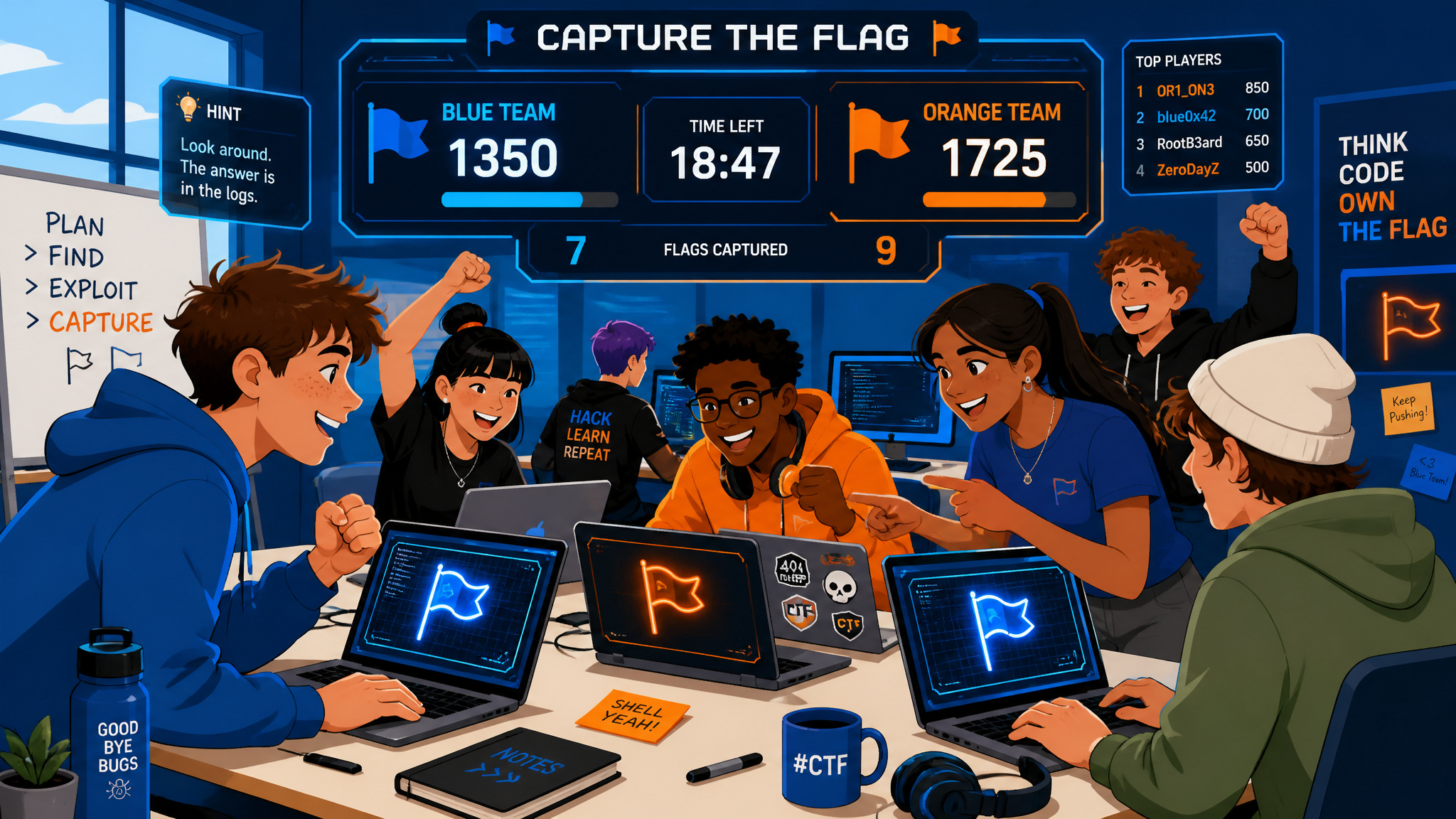
Capture the Flag, or CTF, is the most fun part of this entire world: competitive puzzle hacking with rules. The most popular format is attack-and-defend, you attack opponents’ systems while defending your own. It’s basically team PvP for nerds, and I mean that affectionately. Def Con’s CTF is the scene’s famous one, the world-championship vibes, but it’s context, not a kid’s entry point. The kid’s entry points look like this:
Cyber Quests
Run by the US Cyber Challenge and funded by CIS with a talent-pipeline goal, the country scouting its next generation through puzzles, which is cool. Each quest hands you an artifact to analyze plus quiz questions, and the artifacts are the good stuff: potentially a vulnerable sample web server to dig through for flaws, or forensic images, or packet captures. Real analysis practice in a sandbox. Honest caveat: difficulty varies, and most quests skew high school and college, so younger kids should expect to bounce off some of it. Registration lives at uscc.cyberquests.org.
CyberPatriot
The Air Force Association’s National Youth Cyber Defense Competition, and the flagship of the whole youth-cyber scene. Teams run 2-6 students with an adult coach required, and no, you don’t need a school: homeschool groups, scout troops, 4-H chapters, Boys and Girls Clubs, and church groups all count. Kids find and fix vulnerabilities in virtual operating systems during six-hour online rounds. For scale: 6,750 teams registered as of 2020 reporting, with registration that year having closed October 15 and rounds running November through February, check current dates rather than assuming the same schedule.
The recruiting hook is that no prior knowledge is required. Coaches get training materials and practice virtual machines, so the adult in charge doesn’t need to be a pentester, which removes the biggest “we can’t do this” excuse. And CyberPatriot’s Director of Program Engagement, Rebecca Dalton, has described the pattern the program sees: students arrive unsure of themselves and leave with real confidence and a new passion. That’s the emotional payoff, not just the technical one.
CyberStart America
Free, game-based, built for high school students, no experience needed, skills are taught in-game through embedded videos. You learn password cracking (yes, openly, it’s sandboxed and legal), forensics, Python, and code breaking inside a game. The headline detail: high scorers auto-qualify for the National Cyber Scholarship program, which means actual college scholarships earned from a browser game. It’s SANS-sponsored and began as girls-only Girls Go CyberStart before broadening to all high schoolers, a nice origin note for families with daughters. Play in the 2020 season began November 15; check the current site for this season’s dates rather than treating that as an annual constant.
CYBER.ORG CTFs and the National Cyber League
CYBER.ORG runs free multi-day CTF competitions, anywhere from a few days to a week, playable from class or home. Topics cover encryption, hacking, and security, and scoring is broken out by category and difficulty. Their stated belief is that fixing the cyber workforce shortage starts in K-12, which is exactly why all this free material exists in the first place.
The National Cyber League is the next rung: a competition platform that simulates real-world threats in a safe environment. Good fit for self-driven older teens. And for teens eyeing university CTF teams: some accept high schoolers, and one out-of-the-blue email to the local CS department costs nothing to send.
Camps, workshops, and conferences: the in-person layer
Screen learning only goes so far. The in-person layer exists, spans every budget, and includes university-run options like NYU’s pre-college cyber summer program. The cost contrast here is worth being honest about.
Summer camps
The big three, all held on college campuses nationwide: GenCyber, AFA CyberCamps, and iD Tech. GenCyber is the one to lead with because it’s free to all student and teacher participants, jointly funded by the NSA and the National Science Foundation, two acronyms parents trust, and summer camps are usually the expensive part of a kid’s interests. AFA CyberCamps are the off-season companion to CyberPatriot, so families already in that ecosystem have a summer option. iD Tech is the paid one; prices vary, so check current pricing rather than trusting a number in an old article.
TechGirlz
For girls in grades 5-8, TechGirlz runs free, volunteer-run TechShopz workshops and TechCampz camps, virtual or in person, with seven cybersecurity workshops on the menu including Cybersecurity Basics, How Computers Talk, Intro to Encryption, and cyber-stalking prevention. The stat that makes parents sit up: 82% of attendees came away with a more positive view of a tech career. Free, volunteer-run, and it nudges responsible online behavior on the side, two-for-one.
Conferences by age
The comparison nobody publishes for a kid audience, so here it is. DEF CON, in Las Vegas every summer, has no age requirement but an adult atmosphere, parents should come along. It’s also home to the lock-picking and social-engineering villages, which are the part kids would lose their minds over. Black Hat runs the week before DEF CON, also in Vegas, with full training classes and briefings, but it’s 18+ only, file it under “later, when they’re grown.”
Shmoocon in Washington DC is three days and all ages welcome, with speed talks and hands-on training: genuinely a good first con for a teen. And BSides events are held across the country, typically free or low-cost, with actual costs varying by city. All of this shifts year to year, so check each con’s current policies before booking anything.
University and local programs
Two universities worth a look: NYU and the University of Maryland both run pre-college cyber summer programs, and time on a campus doubles as a scouting trip for the college search anyway. Two birds. The broader actionable move: just email the local university’s CS department. Cold emails feel scary, but departments genuinely answer these. And if there’s no program at your school at all, the Air Force, NSF, and NSA all back schools and organizations running cyber programs, so parents and teachers pushing to start one have federal support behind the idea.
Certifications with real age rules
Yes, teenagers can earn cybersecurity certifications while still in school. CompTIA has no formal age requirement for its exams, it recommends candidates be at least 13, and the recommended path is a clean, stackable ladder: A+, then Network+, then Security+, then CySA+ or PenTest+.
Now the counterintuitive part, and the detail I refuse to bury: Microsoft certifications are available at any age, and the youngest recorded Microsoft Certified Professional passer was five years old. Five. A kindergartner with a cert. That’s a documented record, not an expectation, but it does put “too young” in perspective. Cisco, by contrast, prohibits minors under 13 from taking its exams and requires parental consent for ages 13-17, with CCNA as the widely recognized entry point and CCNP Security as the next rung after it.
Proof the teen timeline is real, from the original source author, not me: they passed CompTIA A+ at 16 and had an entry-level network engineer job offer at 17. One cert, one real door opened before graduation. So what comes after high school itself? For a full academic roadmap, see how to become ethical hacker after 12th.
Certs earned in high school may also translate into college credits, real time and money saved, though transfer policies vary by school, and teens often prep more easily than busy adults with jobs and mortgages. Early-mover advantage, stated honestly and without job-placement promises. One flag: vendor age policies can change, so check the current rules before promising a kid anything.
Field note: Vendor age policies shift — CompTIA recommends 13+, Cisco requires parental consent for 13-17 — so always verify current rules before committing.
For parents: build the pipeline, don’t police it
The most supportive parental move isn’t surveillance. It’s enrollment in coached structure. CyberPatriot’s adult-coach requirement makes supervision a design feature of the program rather than a rule you impose, which is an elegant bit of engineering when you think about it. The composite worry is real, though: many parents hear “hacker” and shut the curiosity down instead of channeling it, and that’s how you lose a kid who might have been your household’s future security engineer.
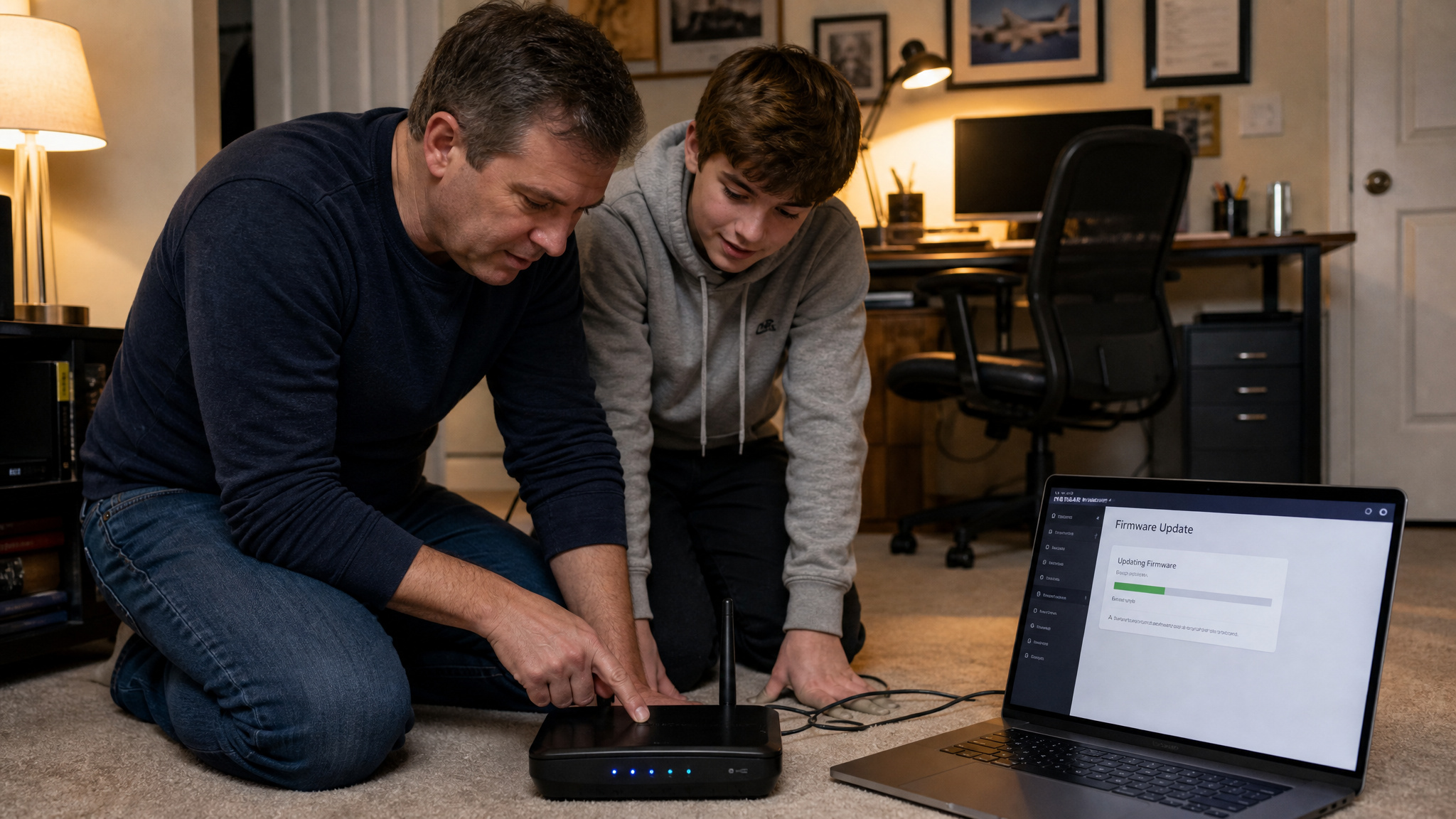
The practical checklist, condensed and conversational: keep communication open, set clear boundaries on screen time, educate yourself (CISA publishes a booklet for exactly this, Chatting with Kids about Being Online), use parental-control tools where they help, lead by example with strong passwords and cautious sharing, and secure your home WiFi, router settings, encryption, firmware updates. That last one is secretly the most geek-satisfying item on the list. Hardening your own router alongside your kid is a legitimately good Saturday afternoon, and it teaches more than any lecture.
The threat landscape, calmly
No doom spiral, just the actual risks. The big number: 46% of US teens say they’ve been cyberbullied, that’s the risk kids actually meet first, and it’s why StopBullying.gov belongs in the bookmarks. Beyond that: predators posing as peers, phishing, fake profiles, and oversharing that can lead to identity theft. Framing matters here: this is why the security habit matters, not stranger-danger panic.
The critical-thinking exercise
Hand your kid a fake story and walk through verifying the sources together. Frame it as a game, because it basically is one, skeptical source-checking is a core security skill wearing a game costume. And the real-world beat that makes it land: during virtual school, kids were using improperly secured videoconferencing software. The threat wasn’t hypothetical; it was on the class schedule.
Where the path leads
An early start compounds into real careers: penetration tester, security analyst, security engineer, digital forensics analyst, and the rest of the menu from earlier in this article. The sequencing argument is the fun one: a kid who starts fundamentals around age ten can realistically hold Security+ before they’re old enough to drive. CISA, for its part, frames cybersecurity education as something that can start in kindergarten, precisely because habits learned young stick and security thinking becomes your default instead of something patched in later. Skill-tree logic, applied to a brain.
And the through-line one last time, because it’s the whole game: hacking is legitimate when you have permission. Every resource in this article, the CTFs, the virtual operating systems, the sample web servers, the comic strips about a dog named Pascal, exists to give kids a sanctioned place to be exactly as curious as they want to be. Point them at the sandbox, teach them the rule, and let them break things that were built to be broken.
Frequently Asked Questions
Who is the youngest hacker?
The youngest documented certification record belongs to a five-year-old who passed a Microsoft Certified Professional exam — Microsoft certifications are available at any age. That’s a documented record, not a typical benchmark. For the more common path, CompTIA recommends candidates be at least 13, and motivated kids who start fundamentals around age ten can realistically earn Security+ before driving age.
How can I become a hacker?
Start with how computers, coding, and networks actually work — Python is the recommended first language — then practice in sanctioned sandboxes like Capture the Flag competitions, CyberPatriot, and Cyber Quests. The one rule to internalize early: only touch, test, or log into systems you own or have explicit permission to access. Structured games and graded curricula beat jumping straight to ‘advanced hacking tools,’ which is where motivated beginners tend to quit within weeks.
Can a 12 year old do coding?
Yes, and twelve is actually the right age to start: Python is the recommended first language because the competitions and challenges that lead anywhere teach it. Codecademy’s free interactive editor lets a kid write and run Python in the browser with zero setup, and CyberStart teaches Python through code-breaking puzzles. If a full language feels early, KiwiCo and Creation Crate subscription boxes bridge the gap with hands-on builds for roughly age ten and up.
What coding should a 12 year old learn first to get into ethical hacking?
Python — not a hacking tool, not Kali Linux, not a tutorial video. The competitions and challenges that lead anywhere teach Python, and competition forensics and code breaking presuppose those fundamentals. Learn it through Codecademy’s free interactive editor or CyberStart’s in-game puzzles, and layer networking basics alongside it so the hacking part grows out of real understanding.
Are there capture the flag competitions and cyber challenges suitable for teenagers?
Yes — several are built specifically for young beginners. Cyber Quests offers vulnerable sample web servers, forensic images, and packet captures to analyze; CyberPatriot has teams of 2-6 students secure virtual operating systems in six-hour online rounds with an adult coach required; and CyberStart America is a free browser game where high scorers auto-qualify for the National Cyber Scholarship program. CYBER.ORG also runs free multi-day CTFs, and the National Cyber League suits self-driven older teens.