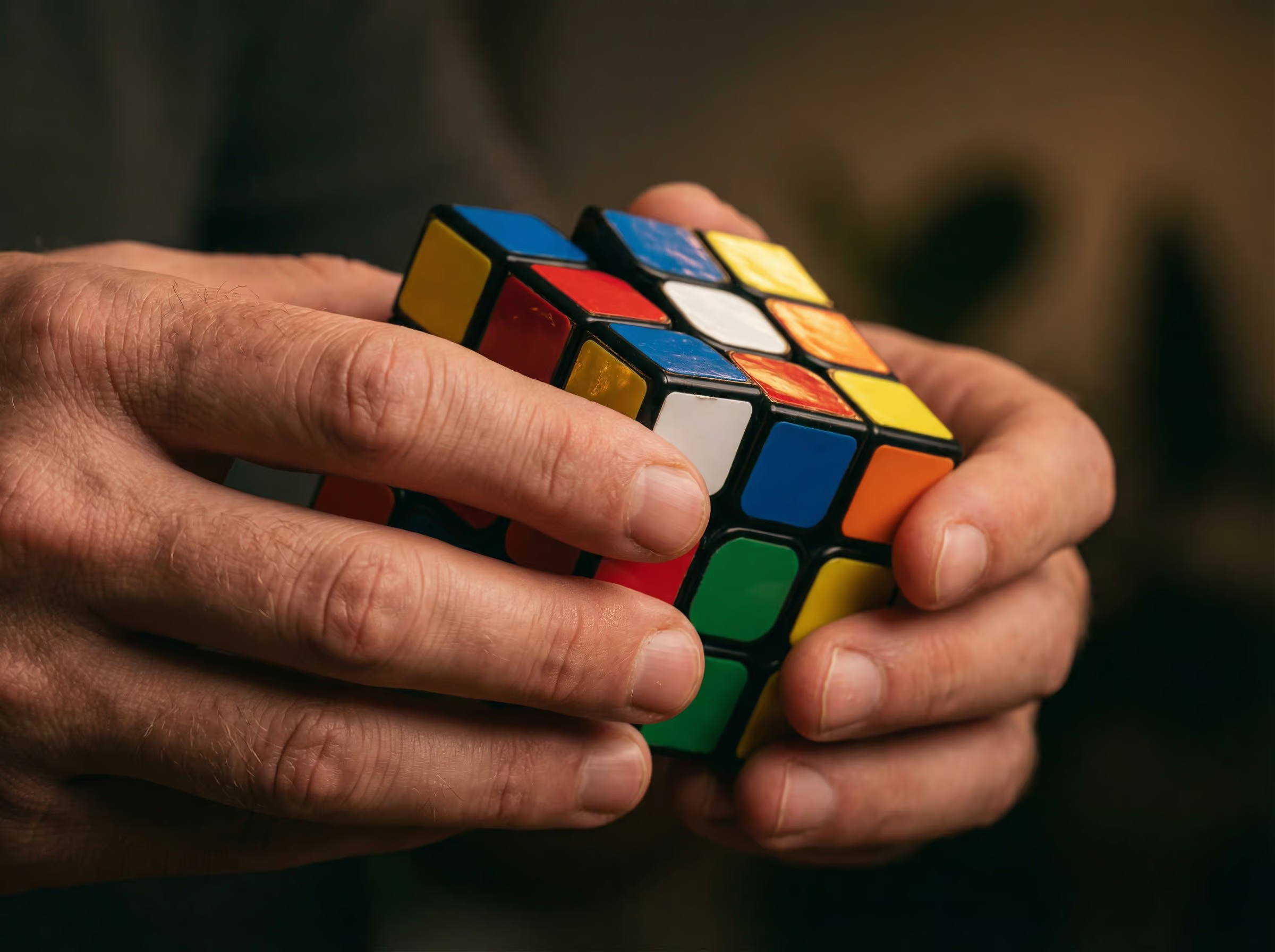
I’ve often been asked, “How many people can solve a Rubik’s Cube?“ It feels like some exclusive club, maybe for math prodigies or people with superhuman brains. But I’m here to tell you that the reality is far more exciting and accessible.
You might have seen the popular statistic that around 5.8% of people have solved the cube. That number came from a YouGov poll way back in 2014, and in my experience, the cubing world has exploded since then. With millions learning from online tutorials, I believe the real number in 2025 is likely closer to 8-10% of the population, and it’s growing every day.
Solving the cube isn’t a measure of genius. It’s a learnable skill, and you can absolutely be one of them.
Key Takeaways
Growing Numbers: ~8-10% of people worldwide can solve a 3×3 Rubik’s Cube in 2025—up from 5.8% in 2014—thanks to online tutorials and communities.
No Genius Required: It’s a learnable skill using algorithms, not random luck or superhuman IQ; everyone from kids to pros uses structured methods.
Myth of Impossibility: 43 quintillion configurations seem daunting, but fixed centers and 20 movable pieces (edges/corners) make it systematically solvable.
Accessibility Boom: Free YouTube guides (e.g., J Perm’s 35M-view tutorial), apps, and 140K+ WCA competitors have made cubing mainstream.
Practice Pays Off: Beginners hit sub-2-minute solves in months; world records like 3.05 seconds show dedication unlocks elite speed.
Table of Contents
Why Do People Think Only a Few Can Solve a Rubik’s Cube?

The Rubik’s Cube looks impossibly hard for one very big reason. A standard 3×3 cube has over 43 quintillion possible arrangements. That’s 43 with 18 zeroes after it: 43,252,003,274,489,856,000 to be exact!
Trying to find the one correct solution by randomly twisting is statistically impossible. But here’s the secret, no one solves it by chance.
When Hungarian architecture professor Ern? Rubik created the cube in 1974, he wasn’t trying to make a brain-buster. He wanted a physical tool to teach his students about 3D spatial relationships. It was a teaching aid, not an IQ test.
Every single person who solves it, from me to a world champion, uses a method. These methods rely on sequences of moves called algorithms to solve the cube in predictable stages.
So, What Percentage of People Can Actually Solve It?
As I mentioned, the old 5.8% figure is likely an underestimate today. The internet changed everything. The rise of “speedcubing,” the competitive sport of solving puzzles as fast as possible, has inspired a new generation.
This growth is powered by huge global communities. The World Cube Association (WCA), the official governing body for the sport, now has over 140,000 registered competitors across the globe. Meanwhile, YouTube creators like J Perm provide free tutorials to millions of subscribers.
Within that group of solvers, an even smaller fraction can solve it fast. While less than 1% of the population might solve it in under a minute, this is a very achievable goal.
Based on discussions in communities like the r/Cubers subreddit, many dedicated beginners find they can get their time under two minutes within just a few months of practice.
How the Cube Works (and Why That Makes It Solvable)
A 3x3x3 Rubik’s Cube is made of 26 physical pieces, which I call “cubies,” connected to a central core. The key is that these pieces are not all the same.
- Centers: The 6 center pieces each have one color and are fixed in place. The white center is always opposite the yellow one, green is always opposite blue, and red is always opposite orange. They are your map.
- Edges: The 12 edge pieces sit between the centers and have two colors each.
- Corners: The 8 corner pieces have three colors each.
This structure is the secret to its solvability. You aren’t just moving 54 colored stickers around. You are moving 20 specific pieces (8 corners and 12 edges) back to their correct homes—much like taking apart a Rubik’s Cube and putting it back together step by step, but using clever algorithms instead of your hands.
A big improvement in modern puzzles also helps. Speed cubes from brands like GAN or MoYu often contain tiny magnets that help the layers click cleanly into place. This makes turning smoother and practice far less frustrating than with the stiff cubes from the 1980s.
Practice Makes Perfect: How to Get Better at Solving
If you want to join the club, the path is simple: learn a method and practice it. But “practice” means learning efficiently.
The first “insider” tip I always give is to learn Cube Notation before you watch a single tutorial. It’s the simple language of algorithms (like R for right-side clockwise, or U’ for top-side counter-clockwise). Every guide uses it, and knowing it first will save you a ton of confusion.
Here are some of the best resources I recommend to my friends:
- YouTube Channels: Creators like J Perm have amazing, easy-to-follow tutorials. His “Learn How to Solve a Rubik’s Cube in 10 Minutes” video has over 35 million views for a reason, it’s a fantastic starting point.
- Online Simulators: Websites like Grubiks or CubeDB.io let you practice on a virtual cube. They can even analyze a scramble and show you how to solve it step-by-step.
- Timer Apps: Once you know the steps, a timer makes practice fun. csTimer is a popular web-based option, and mobile apps like Twisty Timer are great for tracking your progress on the go.
Once you get the hang of it, you can even look for local competitions sanctioned by the World Cube Association (WCA). They are friendly, welcoming events for solvers of all skill levels.
Tips and Tricks for Aspiring Cube Masters
Nearly every solver starts with the beginner “Layer-by-Layer” method. It breaks the puzzle into simple goals: solve the top cross, then the corners, then solve the second layer of a Rubik’s Cube, and finally the last layer.
Once you master that, you can move to faster methods. The most popular one used by champions is CFOP. This table shows how it compares to the beginner’s method.
| Method | Algorithms to Learn | Potential Solve Time |
|---|---|---|
| Beginner’s Method | ~7-10 | 1-3 minutes |
| CFOP Method | 78+ | Under 20 seconds |
The four steps in CFOP are:
- C – Cross: Building a cross on the bottom layer.
- F – F2L (First Two Layers): Solving the first two layers at the same time. This is the hardest step to master.
- O – OLL (Orientation of the Last Layer): Getting all the last layer pieces facing the right way (57 possible algorithms).
- P – PLL (Permutation of the Last Layer): Arranging the last layer pieces into their final spots (21 possible algorithms).
While CFOP is dominant, it’s not the only choice. The Roux method is another popular advanced system that some people find more intuitive, as it focuses on building blocks and has fewer algorithms to memorize.
Famous Rubik’s Cube Solvers and World Records
The world of speedcubing is incredible, and the records are always falling.
For a while, the community was captivated by the rivalry between American cuber Max Park and Australian legend Feliks Zemdegs, featured in the 2020 Netflix documentary “The Speed Cubers.” Max held the world record with an amazing 3.13-second solve.
As of late 2025, the official 3×3 single solve world record is a breathtaking 3.05 seconds, set by 7-year-old Xuanyi Geng from China in April 2025. He broke the previous record of 3.08 seconds set just two months earlier by his fellow countryman, Yiheng Wang.
These top-tier solvers practice for hours a day. They have memorized hundreds of algorithms and can recognize patterns in a fraction of a second. They show what is possible with dedication.
So, How Many People Can Solve a Rubik’s Cube?
So, how many people can solve a Rubik’s Cube? While the exact percentage is hard to pin down, the number is far larger than it used to be and it’s growing every single day.
The cube is not an IQ test. It’s a puzzle about process and patience.
That incredible “aha!” moment when you see all six sides finally solved is something I believe everyone can and should experience. With the right guide and a little bit of practice, you can definitely do it.

It depends on what method you use. For example, the method I use rely on getting one complete face, then all the opposite face corners in the correct position. This only involves 4 or 5 distinct move patterns, depending on individual cube placement. Once at that stage it is 1 repeatable move that only moves 3 squares. So I just need to decide where those 3 aquares need to be and repeat the same move.