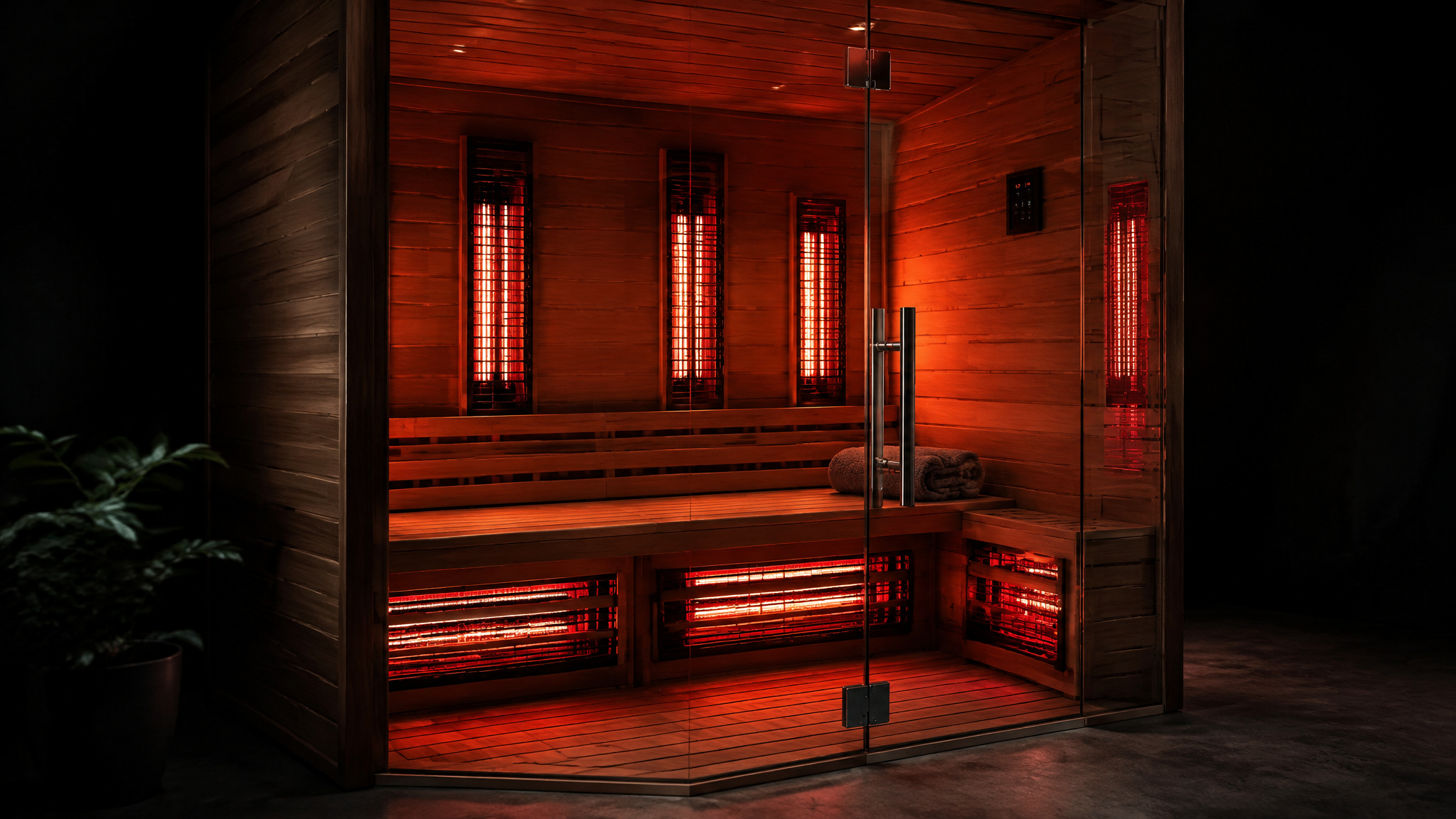
I’ve owned a SaunaCloud custom infrared sauna for a while now, though I still enjoy a traditional steam room too. Sitting inside my cedar cabin, watching the panels warm up, I finally decided to pop the figurative access panel off the hardware for GeekExtreme and look at what the emitters are doing. Infrared saunas have escaped the specialty clinic: you’ll spot them in gym locker rooms, glowing pop-up tents on wellness influencer stories, and zip-up sauna blankets shelved right beside face masks at Sephora. Nearly every pitch promises deep cellular detox and effortless heart health.
Strip away the spa brochure language, though, and you’re left with a straightforward hardware question: is an infrared sauna different thermal technology, or just a glorified heat lamp with better branding? The physical heating mechanism inside the panels is real, and clever in how it bypasses the room air. The wellness marketing bolted onto that physics is another story entirely.
Key Takeaways
Infrared sauna panels emit invisible radiant light (centered around a 10-micron far-infrared wavelength) that warms your skin directly, keeping cabin air at 104 to 140 degrees Fahrenheit compared to 158 to 194 degrees Fahrenheit in traditional saunas.
The landmark 2018 Källström meta-analysis of nine heart-failure trials found improved ejection fraction and reduced BNP, but every trial used a conventional hot-air sauna rather than an infrared cabin.
Portable 1,050 to 1,300W infrared units draw about 0.5 to 0.65 kWh per 30-minute session (under 20 cents on a 120V outlet), while full-size cabins require a dedicated 120V or 240V circuit rated for 15 to 40 amps.
Table of Contents
How infrared sauna heaters heat your body
Infrared heat works by emitting invisible wavelengths of radiant light from heater panels that your skin and tissue absorb directly, warming your body without heating the room air first. It feels like sunlight warming your skin on a cool day, without the harmful UV rays, and any soft red glow you see is just the heater element working (like a stovetop coil glowing before it’s fully hot) rather than the invisible infrared light itself. Traditional saunas have to superheat the ambient air and wooden surfaces to 158 to 194 degrees Fahrenheit so they can transfer heat back into you, whereas an infrared cabin stays breathable at 104 to 140 degrees Fahrenheit while you sweat using roughly 10-micron far-infrared waves.
- Direct radiant transfer: Panels project thermal energy straight into tissue, feeling like sunlight warming your skin on a cool day without the harmful ultraviolet (UV) rays.
- Cooler cabin air: Because the room air isn’t the delivery vehicle, the cabin stays breathable while you sweat.
- Invisible working light: The actual infrared output sits entirely outside the visible spectrum.
When I look at the panels in my cabin, that soft red glow on the heater element is just metal running hot, like an electric stovetop coil glowing before it hits full temperature. First-time users often judge a heater by the brightness or color of that red glow, not realizing the light doing the heating can’t be seen at all.
What far-infrared means
Far-infrared is a position on the electromagnetic spectrum rather than a higher quality grade, and full-spectrum sauna systems are a legitimate multi-band hardware configuration rather than a clinically proven upgrade over far-infrared alone. The infrared spectrum splits into three bands based on distance from visible light:
- Near-infrared: The shortest wavelength, backed by randomized controlled trials and clinical use for wound healing and skin treatment.
- Mid-infrared: The middle band packaged into multi-emitter cabins.
- Far-infrared: Waves sitting at roughly a 10-micron wavelength, absorbed at the skin as radiant heat and used in most home saunas and heated Pilates or yoga studios.
Brands love treating “far” or “full-spectrum” like luxury trim levels on a graphics card, when they just describe which emitters are wired into the wall. According to Pavan Tankha at Cleveland Clinic, far-infrared wavelengths can penetrate up to 1.5 inches into the skin, which suggests the energy may reach immune cells and deeper structures instead of merely warming the outer epidermis.

Why infrared cabins run cooler, and why the thermometer misleads
Infrared saunas run at 104 to 140 degrees Fahrenheit versus 158 to 194 degrees Fahrenheit for traditional saunas because radiant panels heat the user’s skin directly instead of using hot room air as the heat transfer medium. While a traditional stove must push ambient air temperature near 200 degrees Fahrenheit in some setups so convection can warm your body, infrared heater elements run at 120 to 140 degrees Fahrenheit and beam energy straight across the cabin.
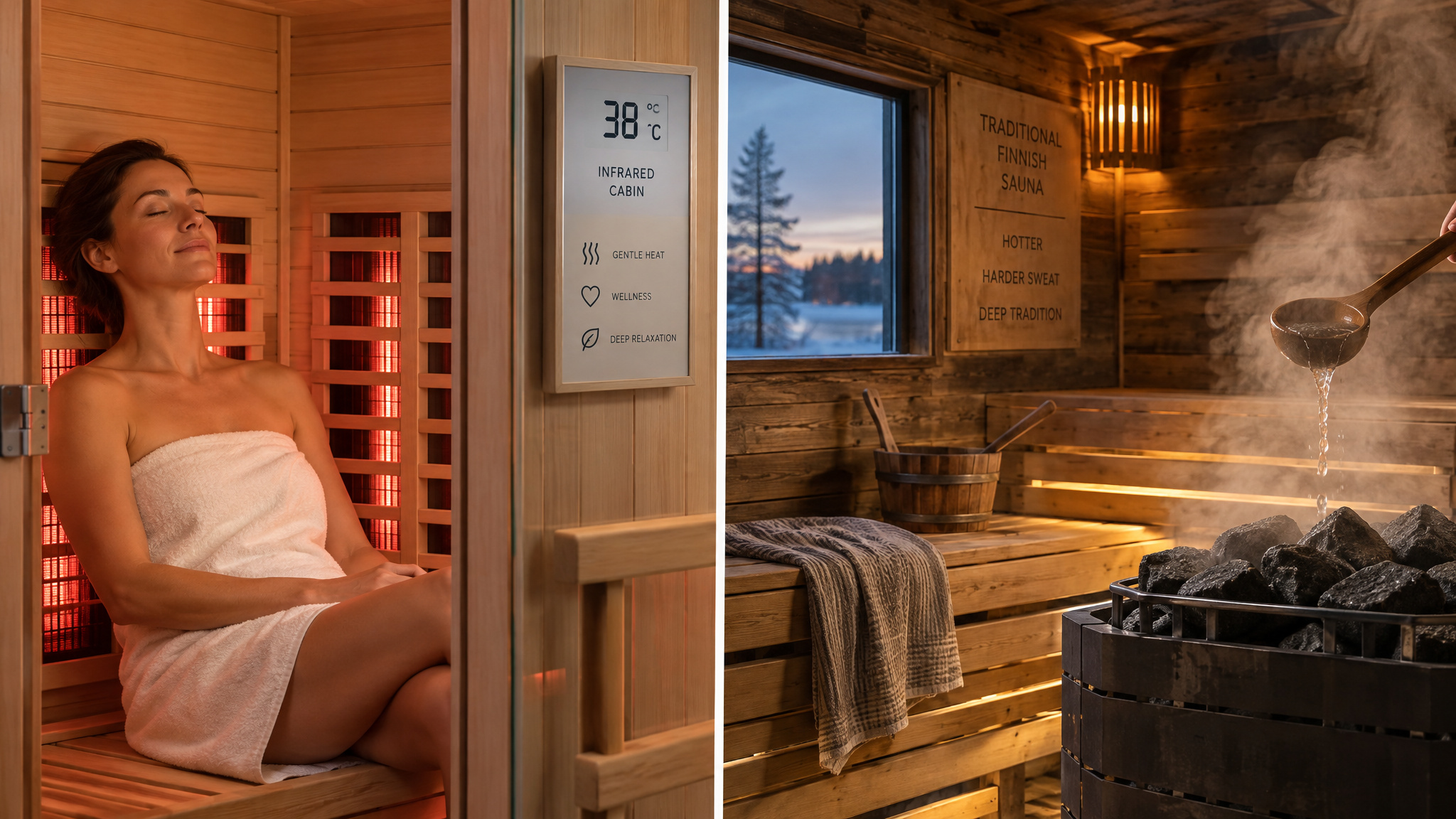
| Feature | Infrared Sauna | Traditional Sauna |
|---|---|---|
| Operating Temperature | 104 to 140 degrees Fahrenheit | 158 to 194 degrees Fahrenheit (up to 200 degrees Fahrenheit) |
| Heating Method | Direct infrared radiation | Heated air and surfaces |
| Primary Target | Warms the body directly | Warms the room air first |
Infrared and traditional saunas are different machines, and they don’t share the same clinical research record.
That hardware difference creates a classic perceptual trap inside the cabin. When I step into my SaunaCloud cabin, the wall thermometer measures the unheated room air, not the radiant heat striking my skin. People crossing over from Finnish steam rooms glance at a gauge reading 125 degrees Fahrenheit and assume the heater is underperforming, right up until they’re drenched in sweat ten minutes later. Keeping the air temperature lower is actually the main usability perk of the format. You aren’t gasping in 190-degree-Fahrenheit air, which makes sessions gentler on the lungs and tolerable for people who find conventional sauna heat suffocating.
Heater design: why two cabins with the same spec feel different
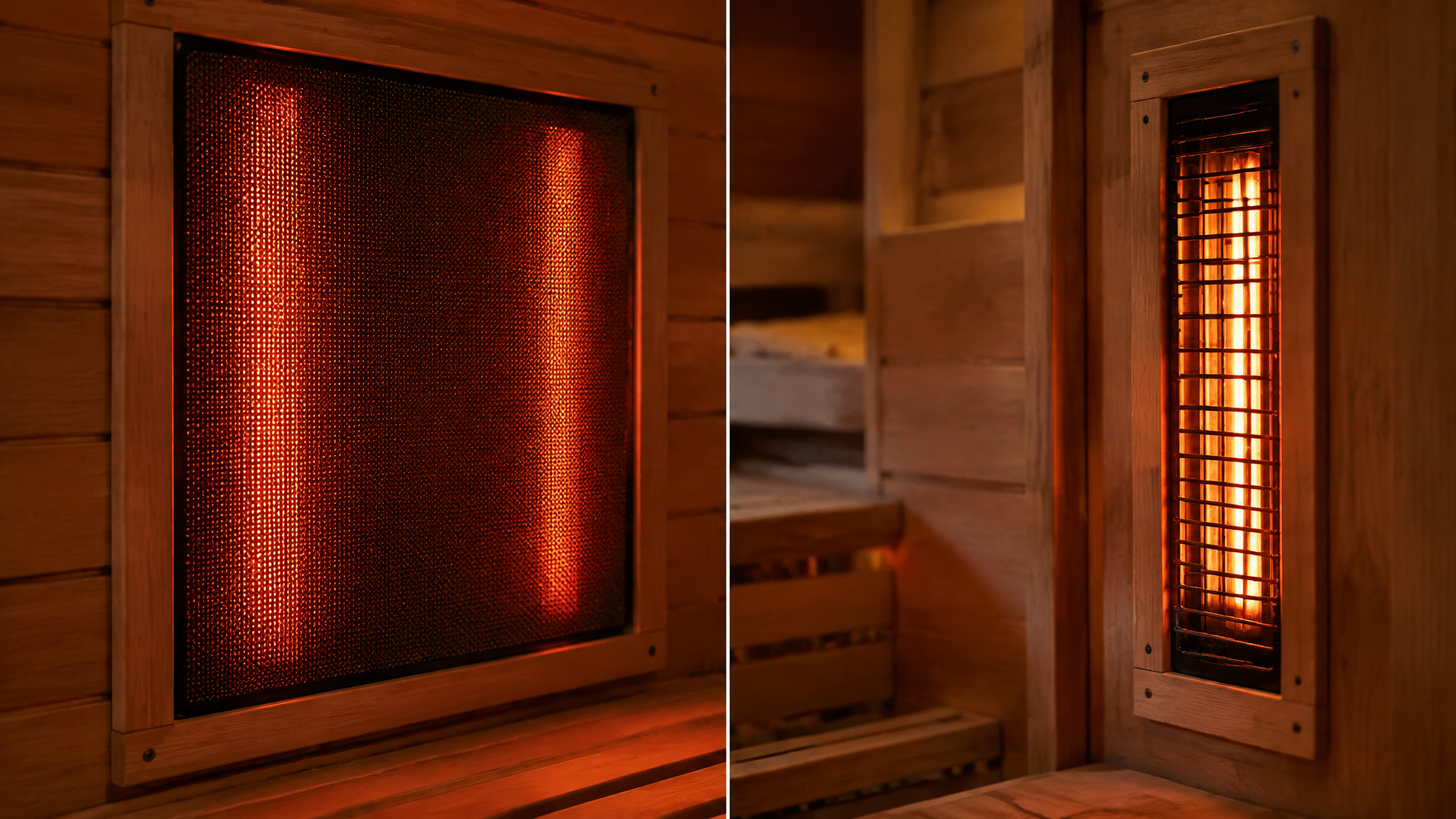
Two cabins with the same max-temperature spec feel different because wavelength output, heater surface area, and EMF levels vary widely across the market and can’t be judged from a product photo. That comes from SaunaCloud founder Christopher Kiggins, whose company has built low-EMF VantaWave heaters and hand-built cedar cabins since 2014, with more than 3,000 installations in homes and clinics.
Body-zone heat distribution in tested cabins
In Fortune‘s hands-on testing (by Christina Snyder, published January 23, 2026, and updated October 12, 2026), testers scored cabins on heat-up lag, temperature fluctuation, body-zone heat distribution, and heater placement alongside bench comfort, back support, realistic capacity, ease of entry, timers, and mid-session controls. In that testing, the Sunlighten Solo Portable pooled warmth at the feet while tester Rachel could barely feel it near her torso, whereas the full-spectrum Sun Home Luminar hit 130 degrees Fahrenheit in about 10 minutes and 140 degrees Fahrenheit in another 10 minutes with even coverage.
A DIY garage build pushes the limits
Stock infrared cabins top out around 140 to 150 degrees Fahrenheit. To push past that, creator @DeMossJr bolted a Patio Boss patio heater into a two-person, six-panel low-EMF DIY Sonic kit (4 feet by 4 feet by 6 feet 3 inches on a standard garage outlet). The modded cabin hit roughly 150 to 160 degrees Fahrenheit at 500W, 180 degrees Fahrenheit at 1,000W, and over 200 degrees Fahrenheit at 1,500W with only minor label crinkling.
Because the stock ceiling sensor trips at about 65 degrees Celsius with a one-hour auto-off, @DeMossJr relocated the sensor into the ceiling with cardboard shielding strictly as a personal experiment rather than a recommendation. He advises GFCI protection and an electrician amperage check, and notes that his family drinks Saps electrolyte drinks entering and exiting.
A 130-year history of radiant-heat therapy
Radiant-heat cabinets date back over 130 years, proving that light-based heating hardware is durable, though longevity alone doesn’t validate modern wellness claims. After William Herschel discovered infrared radiation in 1800 using a prism experiment, John Harvey Kellogg invented the incandescent electric light bath in 1891, showed it at the 1893 Chicago World’s Fair, and patented the Radiant Heat Bath in 1896 (US558394), installing units for King Edward VII and Kaiser Wilhelm II. Japan revived the concept in the 1970s as Waon Therapy, and hospital neonatal beds still rely on infrared heating elements.
What happens in your body during a session
An infrared sauna session triggers measurable vasodilation, increased skin blood flow, sweating, and an elevated heart rate similar to light-to-moderate exercise. Steven Novella noted in Science-Based Medicine in 2021 that these cardiovascular shifts last only during the session and for about 30 minutes afterward, and may reflect dehydration lowering blood volume like a diuretic. Dr. Anna B. Shannahan at Northwestern Medicine says sessions should complement rather than replace exercise, preferring shorter, more frequent bouts. Other heat-and-light research hints at different mechanisms too.
Robert Griffin at the Rockefeller Cancer Institute and University of Arkansas Medical School notes that 1 to 2 degrees Fahrenheit of whole-body heating can boost immunity like a fever, while targeted radiofrequency or ultrasound heat improves tumor long-term survival rates by up to 20 percent. Randomized controlled trials also show red and near-infrared light grows hair (FDA-approved), speeds wound healing, and improves cold sores (David Ozog, Henry Ford Health). Finally, infrared sessions paired with cognitive behavioral therapy produced a statistically significant drop in depression symptoms, possibly by cooling elevated body temperature through sweat (Ashley Mason, UCSF).
Which machine did the studies use?
Yes, infrared saunas show limited evidence for specific conditions, when you separate small infrared trials from the landmark heart-failure studies that actually tested conventional saunas. Infrared marketing routinely borrows cardiovascular claims from conventional hot-air cabins, even though Tommi Källström’s 2018 meta-analysis in Clinical Cardiology covered nine heart-failure trials (five weekly sessions for two to four weeks) that found reduced BNP (a blood marker of heart strain) and improved ejection fraction using conventional saunas exclusively, never testing an infrared unit.
When you isolate actual infrared hardware, the clinical record shrinks. Richard Beever’s 2009 review in Canadian Family Physician found limited moderate evidence for normalizing blood pressure and treating congestive heart failure, fair evidence against cholesterol reduction, weak evidence for obesity, and fair evidence for chronic pain from a single study, noting the trials were small, short, used unvalidated symptom scales, and came from the same core research group. Citing Jari Laukkanen’s 2018 review in Mayo Clinic Proceedings, Mayo Clinic summarizes the evidence across high blood pressure, heart failure, dementia and Alzheimer’s, headache, type 2 diabetes, and arthritis as “some proof of possible benefit,” noting heavily hedged possible improvements in left ventricular function and arterial flexibility, no reported harmful effects, and the caveat that some studies used regular saunas (reported in National Geographic on October 2, 2026).
Benefit claims, graded claim by claim
So let’s grade the common marketing pitches against the physiology and the study rigor, and see which claims survive.
Relaxation and recovery
A 2019 survey by Joy Hussain (reported via The Conversation) found most people sauna to relax, with 5 to 15 sessions per month correlating with higher reported well-being (correlation, not causation); vasodilation also increases blood flow to deliver oxygen and nutrients to sore muscles.
Pain and stiffness
Infrared heat eases muscle and joint stiffness (especially in rheumatoid arthritis) like a hot shower. Beever’s 2009 review found fair evidence from one study, while anecdotes like Michigan Pilates instructor Brooke Alexandra (owner of Reforming Foundations Pilates and Wellness, who paired infrared saunas with gentle Pilates for Lyme disease symptoms and reported better mobility, sleep, energy, focus, and joint relief) lack long-term data, and real-world studio thermal dose remains imprecise.
The detox claim
Neither infrared nor traditional sauna sweat removes meaningful toxins from the body because sweat composition is roughly 97 percent water, while true detoxification happens 24/7 in the liver and kidneys (per the NCCIH). Heavy sweating actually cuts urine output, potentially reducing toxin excretion, and the viral claim that infrared sweat is 20 percent toxins versus 3 percent in traditional sweat is unverified marketing that contradicts medical consensus.
The pseudoscience record
Claims that infrared saunas treat autism, cancer, or COVID-19 are documented pseudoscience. Fire departments in Texas and Indiana purchased saunas believing they would prevent cancer and flush out pollutants, naturopaths advised sauna use for cancer and autism, and wellness clinics claimed radiation and heavy-metal removal. Gwyneth Paltrow’s post-COVID sauna recommendation drew NHS criticism, and the FTC warned practitioners about false COVID-19 claims.
Safety, risks, and a session protocol grounded in the studies
Even with cooler cabin air than a conventional sauna, direct radiant heating still puts real thermal stress on your body. Getting the benefits without overheating comes down to knowing the medical contraindications, drinking water, and sticking to the brief session lengths actually tested in clinical trials.
Known risks including toasted skin syndrome
Yes, infrared saunas are generally safe for most healthy adults when used properly, though sessions carry known risks of dehydration, dizziness, overheating, and, per a 2018 systematic review, heat exhaustion and heat stroke. Drinking alcohol around a session compounds the risks of abnormal heart rhythm and dehydration.
Chronic infrared exposure can also trigger erythema ab igne (“toasted skin syndrome“), a net-like rash described by Dr. Shannahan that is uncommon among sauna users, often goes unnoticed until a clinician spots it, and typically fades within a few months of removing the heat source. Because infrared radiation isn’t UV light and doesn’t damage skin DNA like UV, no strong evidence links it to cancer.
Session length and frequency
Typical studied protocols run 15 to 30 minutes, two to four times weekly (Cleveland Clinic advises staying under 30 minutes, three to four times a week, with beginners starting around five minutes). Most trials tested a 15-minute duration rather than an exact thermal dose, and during a session only drinking water and watching the clock are grounded in evidence. People with heart conditions, high blood pressure, or pregnancy should consult a doctor before stepping in, and anyone who’s had a recent heart attack should skip sauna use entirely.
What Fortune’s 2026 testing shows about formats and felt heat
Portable infrared saunas are worth it for home users who need a 120V plug-in format, provided you accept uneven body-zone heating or cramped seating and avoid ultra-cheap tents that fail within three to six months. While a $900 SAUNABOX Pulse Pro or $2,999 Sunlighten Solo Portable runs on a household outlet without the 240V wiring of a permanent cabin, budget portables frequently fail at the three-to-six-month mark at the zippers and included folding chair, making repeated replacements pricier than buying one durable unit. All product prices and test specs below reflect Fortune’s hands-on testing published January 23, 2026, and updated October 12, 2026.
Sun Home Luminar Outdoor 5-Person
Fortune’s Best Overall pick (4.5/5, $14,499) is a five-person full-spectrum cabin rated to 170 degrees Fahrenheit on a dedicated 240V 30A circuit (six-year heater warranty, one-year other). Tester Rachel clocked heat-up at 130 degrees Fahrenheit in about 10 minutes and 140 degrees Fahrenheit in another 10 minutes, scoring controls, seating, and UI 5/5 and praising the group music handoff, nine LED modes, and Celsius/Fahrenheit keypad toggle for quick 10-to-15-minute morning sessions, with price, footprint, and 240V wiring as the main hurdles.
Sunlighten Solo Portable
Named Best Portable (4/5, $2,999), this one-person floor pod runs on 120V at roughly 1,260W with a 150-degree-Fahrenheit max, separate upper and lower zone controls, and a seven-year heater, three-year controller, and one-year fabric warranty. Tester Rachel (5 feet 5 inches) scored seating 3/5, controls 4.5/5, and aesthetics 4/5, noting slow heat-up, a cramped footwell, and warmth pooling at her feet while near her torso she could barely tell it was working.
Plunge Sauna
Fortune’s Best Outdoor pick (4/5, $12,990) is a two-to-three-person wood-clad cabin using a traditional HUUM heater on a 240V dedicated circuit with a two-year warranty and a max temperature cited between 170 and 195 degrees Fahrenheit. Tester Ellie sat at about 150 degrees Fahrenheit with a solid sweat, scoring seating 4/5, aesthetics 5/5, controls 5/5, and overall 4/5; she loved the intuitive dial controls but noted slow heat-up, basic lighting, and a tight fit for users over six feet tall.
HigherDOSE Infrared Sauna Blanket
Evidence doesn’t establish that infrared sauna blankets work as well as full cabin sessions, so cabin and traditional sauna study results don’t transfer, and buyers should check U.S. Consumer Product Safety Commission (CPSC) recall notices by model and serial number. Fortune’s Best Blanket pick (4/5, $699; 100 to 120V, 350 to 420W, 175-degree-Fahrenheit max, one-year warranty) earned 4/5 for seating, 5/5 for look, and 5/5 overall from tester Josh (5 feet 10 inches), who liked its steady level-based heat, easy wipe-down shell, and compact storage, though it lacks an inner liner, audio, or light therapy.
SAUNABOX Pulse Pro
Fortune’s Best Affordable pick ($900) is a one-person tent-style unit with an internal heater box (110V, 1,600W, 140-degree-Fahrenheit max, one-to-two-year warranty). Tester Rachel scored seating 2/5, aesthetics 4/5, and overall 3/5, describing the interior fit as comfortable but condensed.
Owning one: electricity, energy, and where to use it
Bringing an infrared unit home means matching the heater’s power draw and footprint to your available wiring and floor space.
Electrical requirements for an infrared sauna
Infrared saunas require a dedicated 120V or 240V circuit rated for 15 to 40 amps, plugged straight into a wall outlet with no shared loads or extension cords. While large multi-person cabins need dedicated amperage, floor space, ventilation clearance, and often an electrician, smaller plug-in units sip power because radiant panels heat you instead of the room: a portable 1,050 to 1,300W infrared unit uses about 0.5 to 0.65 kWh per 30-minute session, costing under 20 cents on a 120V outlet.
By contrast, Nordic Sauna’s heating-method data shows traditional electric stoves need 30 to 60 minutes to heat air and stones via thermostat control, wood-burning Finnish saunas need a chimney while providing off-grid heat and steam from water tossed on rocks, and some newer hybrid cabins pair electric stoves with infrared panels.
Home sauna vs spa sessions
Buying a home unit trades upfront hardware cost for zero-commute consistency, whereas spa visits let you sample different cabin styles and bigger rooms without wiring a circuit. Relaxation and muscle recovery remain the best-supported reasons to own one, and any weight dropped during a session is purely water weight that returns as soon as you rehydrate.
Frequently Asked Questions
how does infrared heat work?
Infrared panels emit invisible wavelengths of radiant light—usually centered around a 10-micron far-infrared band—that travel straight across the cabin and absorb directly into your skin. According to Pavan Tankha at Cleveland Clinic, far-infrared energy can penetrate up to 1.5 inches into tissue rather than just warming the surface. It feels a lot like stepping into direct sunlight on a cool day, minus the harmful UV rays.
why do infrared saunas heat your body and not the air?
Because radiant energy transfers directly into solid tissue without needing ambient room air as a middleman. The heater elements themselves run around 120 to 140 degrees Fahrenheit and beam light straight at you, leaving the surrounding cabin air at a breathable 104 to 140 degrees Fahrenheit. In my SaunaCloud cabin, the wall thermometer only reads that unheated air, which tricks newcomers right up until they are drenched in sweat ten minutes later.
is far-infrared better than full-spectrum in a sauna?
Neither is a clinically proven upgrade over the other; those terms just describe which positions on the electromagnetic spectrum the wall emitters cover. Far-infrared (around 10 microns) provides the deep radiant heat used in most home cabins, while full-spectrum setups add near-infrared—which has randomized controlled trial backing for wound healing and skin treatment—alongside mid-infrared emitters. Brands love pitching these bands like luxury trim levels on a graphics card, when they really just tell you what hardware is wired into the cabin.
Are infrared saunas safe, and what are the risks of dehydration, overheating, and toasted skin syndrome?
Infrared saunas are generally safe for healthy adults, though sessions still carry real risks of dehydration, dizziness, overheating, heat exhaustion, and heat stroke. Chronic exposure can also cause erythema ab igne, or toasted skin syndrome—an uncommon net-like rash described by Dr. Anna B. Shannahan that usually fades within a few months of stopping the heat exposure. You should never drink alcohol around a session, anyone with a recent heart attack should avoid saunas completely, and people who are pregnant or managing heart conditions or high blood pressure should clear sessions with a doctor first.
how long should you stay in an infrared sauna and how often?
Clinical protocols typically run 15 to 30 minutes, two to four times a week, with most trials testing a 15-minute session. Cleveland Clinic recommends capping sessions under 30 minutes three to four times weekly and starting around five minutes if you are a beginner. While you are inside, the only habits actually backed by evidence are drinking water and keeping an eye on the clock.
