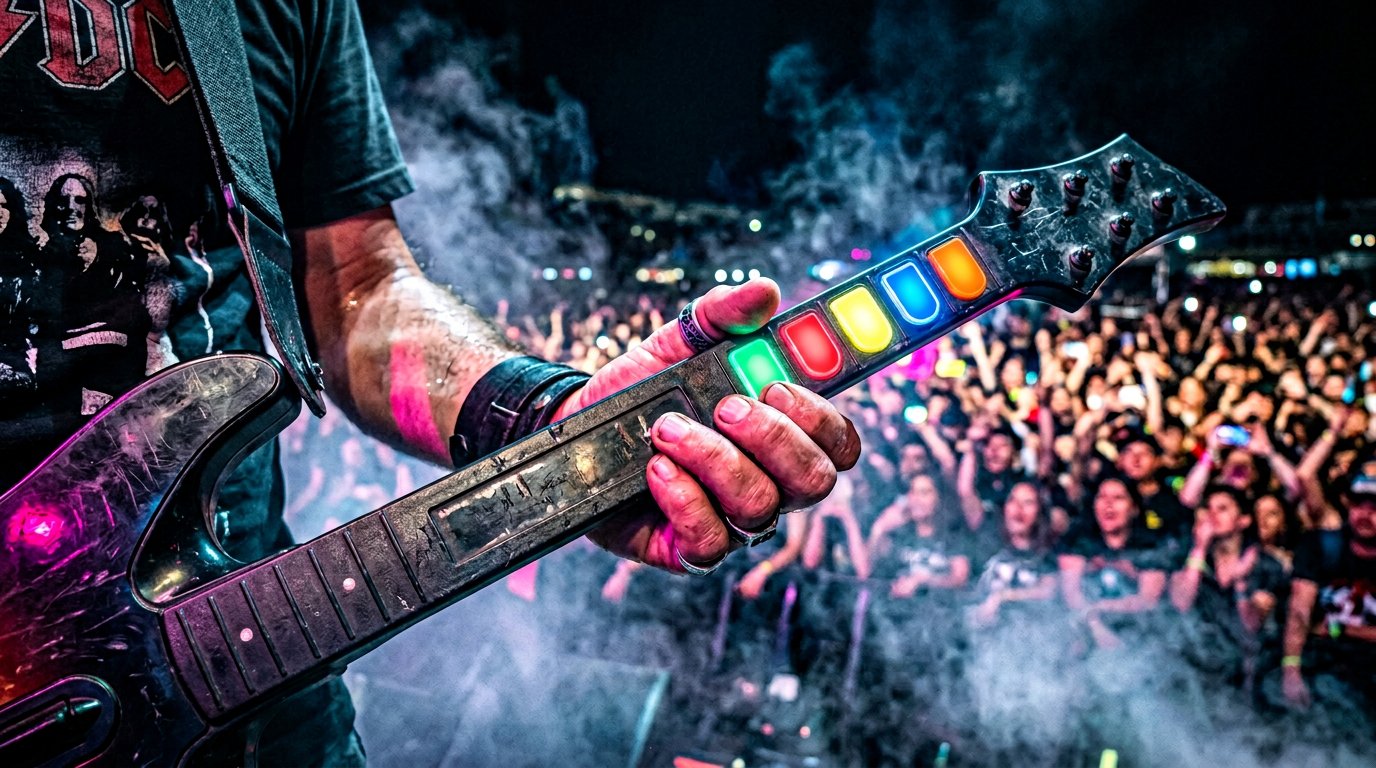
I met my girlfriend—now my wife—at a house party where she was absolutely obsessed with tracking high scores on Guitar Hero. Unpacking the complete history of Guitar Hero requires looking past that peak era of pop culture to see a landscape entirely disrupted by this weird piece of plastic and its fiercest rivals like Rock Band. To understand how this strange rhythm action game conquered living rooms and eventually crashed overnight, you have to examine the brutal economics of hardware startups.
The franchise generated over $2 billion and sold 25 million video game units, fundamentally altering human interaction at social gatherings. Yet, the initial pitch was objectively terrible. The game did not succeed because its creators had a flawless master plan. It succeeded because they were failing so consistently at their original, “smarter” goals that they had absolutely nothing left to lose.
Table of Contents
Failing upward: The desperate origins of rhythm action
Eran Egozy and Alex Rigopulos did not set out to build gaming consoles. As graduate students at the MIT Media Lab working under professor Tod Machover, their goal was to engineer software that bypassed the need for traditional musical facility, providing accessible gameplay to non-musicians. Their first commercial product, The Axe, allowed users to manipulate music via a joystick. It sold exactly ten copies.
The transition to the PlayStation ecosystem was similarly rocky. Harmonix built critical darlings like Frequency and Amplitude, but they were commercial duds. Sony found that while post-play intent to purchase was exceptionally high, pre-play interest was the lowest they had ever recorded. To keep the lights on, Harmonix built AntiGrav—a camera-based hoverboard game which became their lowest-reviewed title ever, but mathematically funded the studio’s survival by selling four times better than their best music title.
Simultaneously, the Huang brothers at RedOctane were surviving a dot-com bust by pivoting from an online game rental service to manufacturing aftermarket dance pads for Konami’s Dance Dance Revolution. They later published the arcade port In The Groove. When Konami refused to bring home versions of their own games natively to the US, RedOctane realized they needed to become a developer to survive. They approached Harmonix with an idea that combined two historically uncommercial genres: rhythm action and peripheral-based gameplay.
Rationally, the board should have killed the pitch. The project faced three distinct barriers: 1. The hardware required a massive manufacturing pipeline. 2. Neither indie company possessed the capital to fund widespread distribution. 3. North American consumers had historically completely rejected titles mapped to a proprietary guitar controller.
They greenlit the game specifically because it felt like the passion project they were born to make.
Designing the rockstar illusion for living room parties
Frequency mapped beats to a rapidly moving, abstract interface. To make this new hardware gamble work, Harmonix had to completely redesign the user experience around the rockstar illusion. You were no longer a generic spaceship blasting beats; you were an avatar on a stage. The early visual identity, anchored by a logo designed by street artist Shepard Fairy, gave the software a distinct punk-rock authenticity.
Rhythm processing and audio engine design led by figures like Harmonix audio director Kasson Crooker turned basic button clicks into visceral power chords. Unlike the steep learning curve required when plugging a real Fender into a guitar amp, the game engineered an immediate flow state that allowed anyone to feel like a genuine guitar hero. It traded the physical calluses of a real stringed instrument for pure dopamine. This accessibility transformed it from a solitary video game into a powerful sociological tool. It became the ultimate icebreaker, permanently fusing communal performance with mid-2000s party culture.
“It traded the physical calluses of a real stringed instrument for pure dopamine.”
The retail footprint nightmare
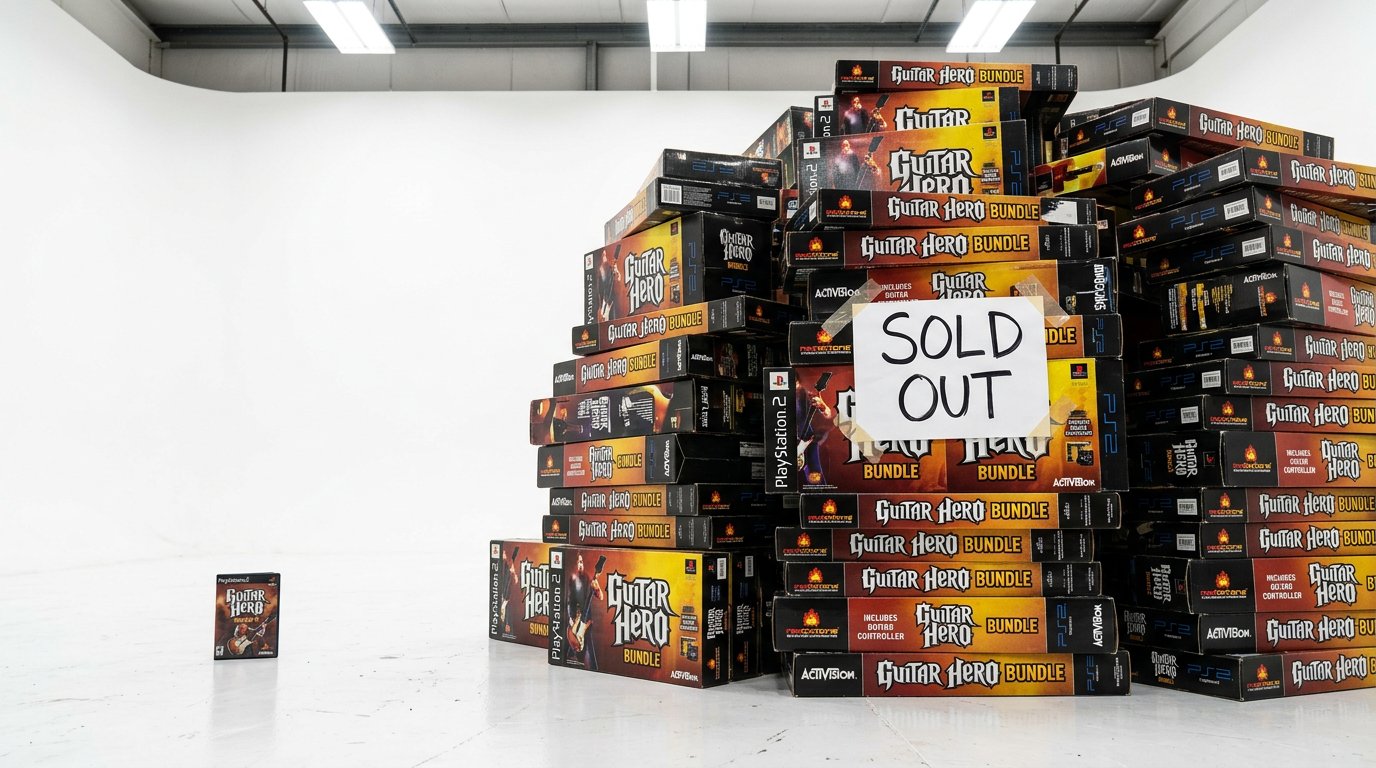
The logistical friction of shipping this product is largely ignored in retrospective analyses. A standard video game ships in a cheap, uniform DVD case. A game bundled with a scale replica guitar requires massive, oddly shaped boxes.
This created a severe bottleneck regarding retail footprint and inventory capital. Best Buy and GameStop loathe oversized boxes because they generate less revenue per square inch of coveted shelf space. RedOctane had almost no leverage to demand this real estate. This wasn’t just a niche product for people into geeky hobbies; it was an unproven physical product demanding extreme shelf space without the upfront capital to guarantee high-volume production. RedOctane quite literally bet the farm on the initial manufacturing run.
Disrupting music monetization and outearning MTV
Once the hardware penetrated living rooms, the ripple effects completely destabilized traditional music distribution. The mechanics of the game forced players to actively engage with the isolated stems of a track rather than passively listening to the radio.
The inclusion of a song in the setlist translated to immediate, measurable spikes in real-world consumption. An appearance in the game could boost individual digital song downloads by 843 percent. When Dragonforce’s “Through the Fire and Flames” was featured in the third installment, the band saw a 126 percent increase in physical CD sales.
Legacy acts quickly realized the leverage of the platform. The synergy between software sales and music monetization peaked when Guitar Hero: Aerosmith generated more revenue for the band than any of their actual studio albums. For a brief window, Activision possessed a more powerful promotional tool than MTV or terrestrial radio. Bands actively sought out the publisher for placement, wanting their own tracks—whether an obscure indie cut or a stadium anthem like AC/DC frontman Brian Johnson belting Back In Black—digitized into colored highway notes.
How corporate greed killed the Guitar Hero franchise
The sheer scale of the hardware’s success inevitably attracted corporate acquisition, which proved to be the genre’s death knell. Harmonix and RedOctane, the two indie entities that managed to forge this billion-dollar synergy, were quickly acquired, split up, and turned into enemies.
Viacom purchased Harmonix, backing them to build the full-band simulator Rock Band. Activision bought RedOctane, retained the central IP, and handed future development duties over to the studio Neversoft (best known for the Tony Hawk’s Pro Skater series). This corporate split fractured the foundational alliance. RedOctane possessed the hardware logistics expertise, while Harmonix held the core rhythm processing capability. Separated, they became bitter rivals fighting for finite living room space.
Between the factions of Activision and Viacom, an aggressive hardware arms race began. The market was completely dismantled by oversaturation and forced annual releases. Consumers were expected to buy multiple $100+ plastic instrument bundles each year just to keep up with fragmented tracklists.
The burnout was rapid. By 2010, the consumer base evaporated, and Activision shut down RedOctane entirely. Harmonix backed away from the genre by 2012, eventually attempting a modest revival years later with Rock Band 4, but the cultural moment had definitively passed.
Unplugging the plastic guitars for good
The financial collapse of the genre was a textbook case of corporate execution failing to respect market bandwidth. A passionate development team solved a complex physics and audio synchronization problem, accidentally conquered pop culture, and then watched executives choke the life out of the user base by monetizing every conceivable inch of the IP.
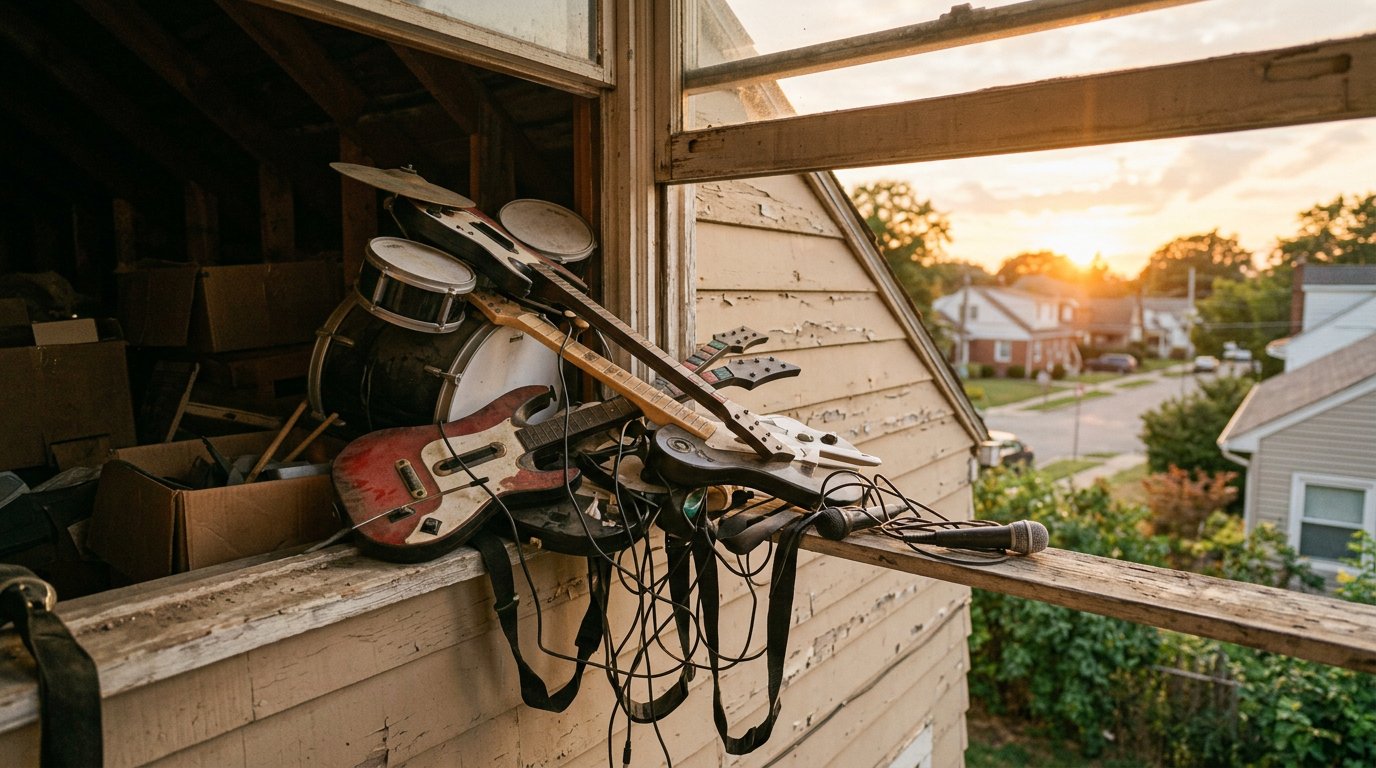
Yet, the sociological crater it left behind remains. The hardware is sitting in attics and thrift stores now, but the bonds forged over those plastic frets endure. My wife and I, alongside millions of others, owe personal relationships to that brief anomaly in game development. The industry may have killed the franchise by demanding too many sequels, but for a few years, a group of MIT engineers successfully democratized the exact feeling of standing on a stage and bringing the house down.
Frequently Asked Questions
Why did they stop making Guitar Hero games?
The franchise was choked to death by corporate greed and rapid market oversaturation. After Activision and Viacom split the original development team, a hardware arms race began that forced consumers to buy multiple expensive plastic instrument bundles every single year. Players quickly burned out from the endless flood of sequels, and the consumer base completely evaporated by 2010.
What’s the difference between the studios behind Guitar Hero and Rock Band?
The original Guitar Hero was a collaboration: Harmonix handled the rhythm processing software, while RedOctane built the plastic hardware. When corporate buyouts happened, Viacom bought Harmonix to make Rock Band, while Activision bought RedOctane to continue Guitar Hero. This fractured their foundational software-hardware alliance and turned the two indie creators into bitter corporate rivals.
How much money did bands actually make from Guitar Hero?
Bands made a staggering amount of money, to the point that the game temporarily out-earned traditional music channels like MTV. An appearance in the game forced players to engage directly with track stems, which could boost digital downloads for a song by over 800 percent. The peak of this monetization came when Aerosmith generated more revenue from Guitar Hero: Aerosmith than they did from any of their actual studio albums.
Why were Guitar Hero boxes such a nightmare for retail stores?
Unlike traditional video games that ship in uniform DVD cases, Guitar Hero required massive, oddly shaped boxes to house the scale replica instruments. Retailers like Best Buy and GameStop loathed stocking them because the large boxes generated significantly less revenue per square inch of coveted shelf space. RedOctane had zero leverage to demand this real estate, so they had to literally bet their entire company on the initial unproven production run.
How did Harmonix fund the development of the original game?
Ironically, the defining rhythm game of a generation was bankrolled by a critically panned hoverboard title. Harmonix’s early music concepts like Frequency were commercial duds, so they built an experimental camera-based game called AntiGrav just to keep the lights on. It was their lowest-reviewed game ever, but it sold well enough to mathematically fund their gamble on plastic guitars.
Can I still buy brand new Guitar Hero hardware today?
No, the massive manufacturing pipelines required to build the bulky plastic instruments were shut down after the rhythm game bubble burst. Harmonix attempted a modest revival with Rock Band 4 years later, but the cultural obsession had definitively passed. Today, if you want to play, you have to scour thrift stores, eBay, or dusty attics to find surviving controllers.