
Ever feel like air travel is just a series of lines, waits, and cramped seats? You are not alone. But if you look past the queues, the technology powering our skies is getting a massive upgrade. We are talking about green tech like electric aircraft and smart tools powered by artificial intelligence that are quietly rewriting the rules of flight.
This guide will show you exactly what is coming to passenger comfort, fuel efficiency, and urban air mobility options such as air taxis. I will walk you through the specific tech that is about to make your next trip faster, cleaner, and honestly, a lot cooler.
Key Takeaways
Biometric Adoption: By 2026, 82% of airlines plan to use biometric boarding. This means your face becomes your boarding pass at major hubs like Frankfurt and JFK (SITA data).
Real-World Air Taxis: Joby Aviation is set to launch commercial flights in Dubai by early 2026. Their aircraft flies at 200 mph and is quiet enough to blend into city noise.
Climate Action: A partnership between Google Research and American Airlines used AI to reduce contrails by 54%. This proves software can cut climate impact before new engines even arrive.
Connectivity Upgrades: United Airlines is rolling out Starlink Wi-Fi across its fleet. By early 2026, over 25% of their planes will offer high-speed, low-latency internet for free.
Electric Fleets: Heart Aerospace plans flight tests for its ES-30 hybrid-electric plane in 2026. Air Canada has already ordered 30 of these regional hoppers to serve shorter routes.
Table of Contents
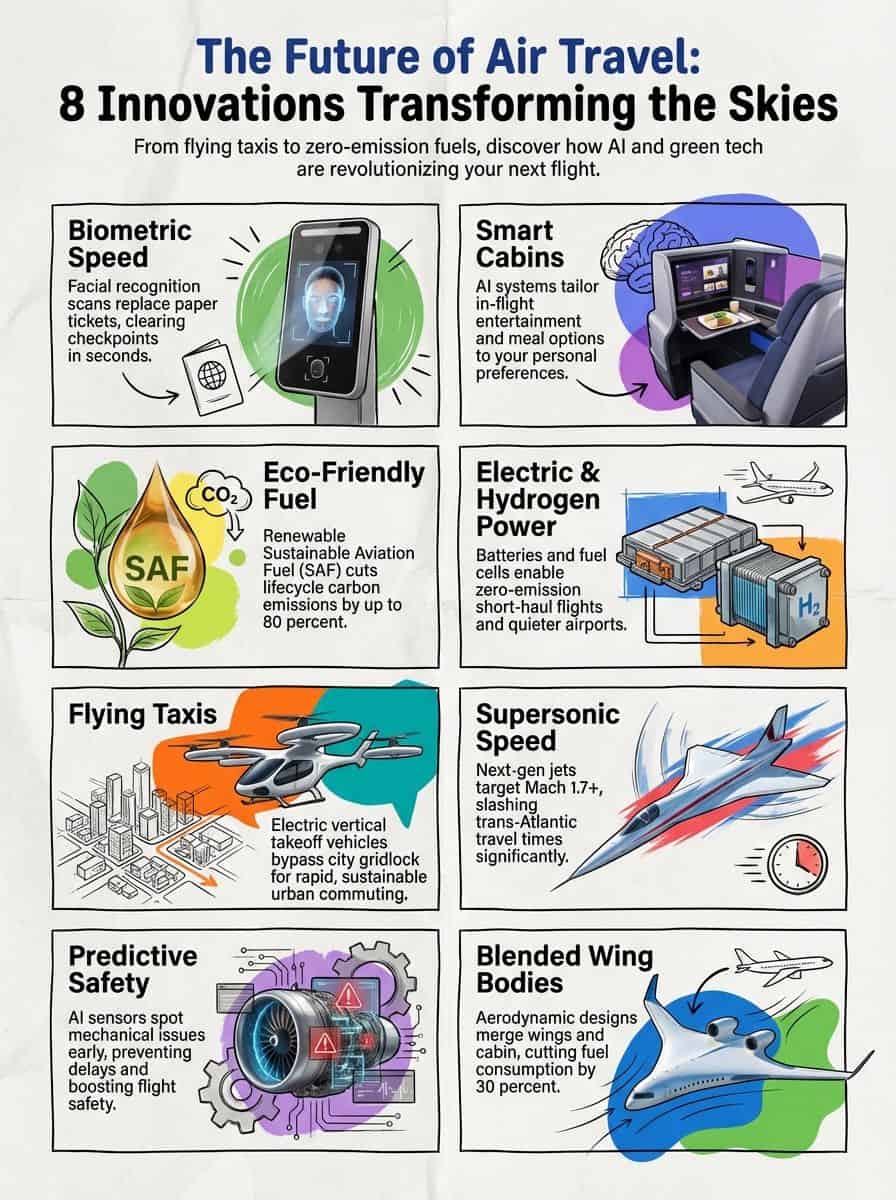
Passenger Experience Innovations
Waiting at New York’s JFK or Frankfurt is about to feel less like a chore. The days of fumbling for paper tickets are ending thanks to facial recognition and faster security checkpoints. But the real upgrades are happening inside the terminal and the cabin.
How can travel be personalized for each passenger?
Airlines are finally using data to do more than just send you receipts. Delta Air Lines has deployed a mind-bending technology called Parallel Reality at Detroit Metropolitan Airport (DTW).
It allows up to 100 passengers to look at the same digital screen at the same time. Yet each person sees only their unique flight info. You scan your boarding pass or face. The screen directs pixels specifically to your eyes. It feels like magic, but it is just high-end optics.
On the connectivity front, the old “slow and expensive” Wi-Fi model is dead. United Airlines is equipping its fleet with Starlink. This brings low-earth orbit satellite speed to your seat.
You can stream 4K video or game online without buffering. Targeted promotions and loyalty rewards from programs like Miles & More or Flying Blue are becoming smarter too. They now push offers based on your real-time location in the airport.
What makes airport processes more seamless?
Once the airline knows what you need, the airport has to get you there fast. The TSA PreCheck Touchless ID program is expanding rapidly. If you opt in, you do not even show your ID at security.
You just look at a camera. The system matches your live scan to your photo on file. I tried this recently at Hartsfield-Jackson Atlanta and cleared the checkpoint in under ten seconds.
Baggage handling is also getting a tech injection. Smart baggage systems now use RFID tags to track suitcases in real time. You can see exactly when your bag hits the carousel on your airline app.
Autonomous vehicles are starting to haul luggage behind the scenes. This reduces the human error that leads to lost bags. Airports like Singapore Changi and Incheon are leading the way with robots that guide confused travelers to their gates.
How do virtual and augmented reality improve in-flight comfort?
VR and AR are transforming in-flight entertainment. Lufthansa has tested VR headsets that transport passengers to relaxing landscapes or offer 3D movies. It creates a private theater experience in economy class.
For those who get anxious flying, virtual destination tours can provide a distraction. Interactive safety demos are also replacing the boring manual cards.
Advanced LED mood lighting is now standard on newer jets like the Airbus A350. It simulates sunset and sunrise to help your body adjust to new time zones.
Real-time language translation tools on in-flight tablets are breaking down barriers. You can chat with crew members in your native tongue. These features make long-haul flights on hybrid-electric aircraft or hydrogen-powered planes much more bearable.
Sustainable Aviation Technologies
The aviation industry has a massive carbon problem. Solar panels and wind turbines on the ground help. But the real fix requires new propulsion tech in the sky. Energy sources like sustainable aviation fuels and hydrogen are making zero-emission aircraft a reality.
What are electric and hybrid-electric aircraft?
Electric aircraft use batteries to spin motors. It is simple, quiet, and clean. The challenge is energy density. Batteries are heavy.
MagniX is the name to know here. Their Magni350 and Magni650 electric engines are targeting FAA certification in mid-2025. These motors power planes like the eBeaver and allow for zero-emission flights on short routes.
Hybrid-electric airliners are the bridge to the future. They mix jet engines with electric props. The Heart Aerospace ES-30 is a prime example.
This regional plane carries 30 passengers and uses battery power for short hops of 200 km. It switches to hybrid mode for longer trips up to 800 km. Flight tests are scheduled for 2026. Air Canada and Saab are backing this project heavily.
“Battery range anxiety is real for pilots. But hybrids like the ES-30 solve this by carrying a backup generator for safety.”
According to magneticenginestands.co, maintenance for these new engines requires completely new tools. Mechanics will need to be part electrician and part aerospace engineer.
How do hydrogen-powered planes work?
Hydrogen offers way more power per pound than batteries. Hydrogen-powered planes use fuel cells to convert gas into electricity. The only exhaust is water vapor.
Here is how the energy density stacks up against traditional options:
| Fuel Type | Energy Density (MJ/kg) | Pros | Cons |
|---|---|---|---|
| Jet Fuel (Kerosene) | ~43 | Proven infrastructure | High carbon emissions |
| Liquid Hydrogen | ~120 | Zero carbon, high energy | Huge volume storage needed |
| Li-ion Battery | ~0.9 | Simple, clean | extremely heavy |
Companies like ZeroAvia are flight testing hydrogen-electric engines right now. They retrofitted a 19-seat Dornier 228 and flew it successfully.
The industry needs better storage tanks and stricter safety rules before this goes mainstream. But for regional flights, hydrogen is the most promising path to true zero emissions.
What is Sustainable Aviation Fuel (SAF)?
Sustainable Aviation Fuel (SAF) is the immediate fix. It is made from waste oil, farm scraps, or even captured CO2. It cuts lifecycle carbon emissions by up to 80%.
The best part is that it works in today’s engines. No modifications needed. Airlines like United and KLM are already using it.
The problem is supply. As of 2024, SAF still accounts for less than 0.5% of global jet fuel. It is expensive to make. Governments are pushing mandates to increase production, but it will take years to replace fossil fuels entirely.
Advanced Air Mobility
Cars on the ground are stuck in traffic. The solution is to move up. Urban air taxis and electric vertical takeoff fliers are turning gridlock into a 3D problem. If you hate sitting on the 405 or the M25, keep reading.
What are urban air taxis and how will they change travel?
Urban air taxis are basically flying Ubers. These electric vertical takeoff and landing vehicles (eVTOLs) lift off like helicopters but fly like planes.
Joby Aviation is leading the pack. They are targeting commercial launch in Dubai by late 2025 or early 2026. Their aircraft carries a pilot and four passengers at speeds up to 200 mph.
Archer Aviation is another major player. Their “Midnight” aircraft is built for short, rapid back-to-back flights of 20-50 miles. It is designed to replace hour-long car commutes with 10-minute flights.
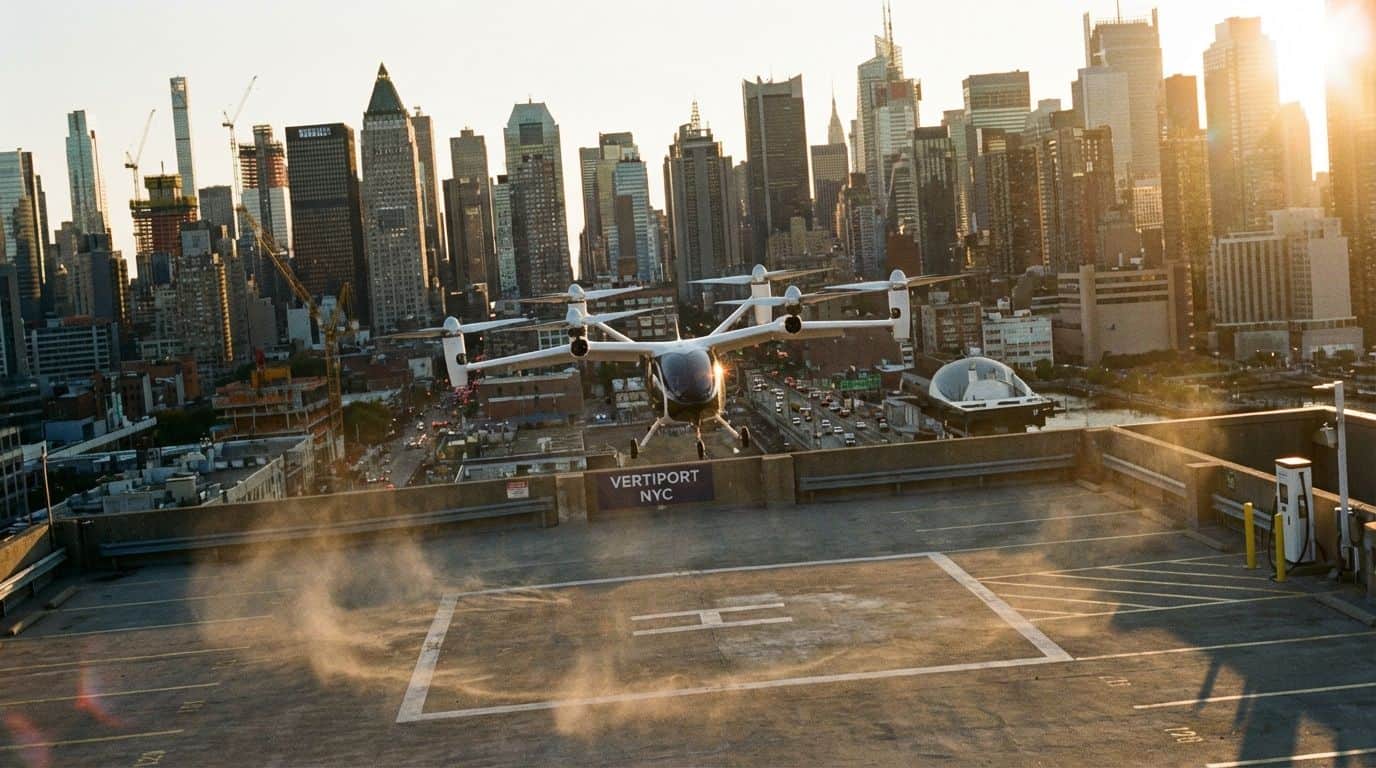
- Noise Levels: Joby’s aircraft registers around 45 decibels during cruise. That is quieter than a normal conversation.
- Infrastructure: Cities are planning “vertiports” on top of parking garages and existing helipads.
- Cost: Initial prices will be high. But the goal is to match Uber Black pricing within a few years.
The U.S. Department of Transportation is finalizing rules for advanced air mobility systems. Integration with public transport is key. Imagine taking a train to the city edge and then an air taxi to downtown.
How fast are supersonic and hypersonic planes?
If you have a need for speed, supersonic is coming back. Boom Supersonic is building the Overture. It aims to fly at Mach 1.7. Their XB-1 demonstrator already completed successful test flights in 2025.
NASA is tackling the noise problem with the X-59 QueSST. This experimental plane flew in October 2025. Its unique shape turns the loud sonic boom into a quiet “sonic thump.”
If that works, regulators might finally allow supersonic flights over land. That would cut a flight from Los Angeles to New York in half.
Hypersonic planes are even wilder. Companies like Hermeus want to hit Mach 4. That is over 3,000 mph. You could fly from New York to London in 90 minutes. It sounds like sci-fi, but the engines are being tested today.
What are autonomous passenger drones?
Autonomous drones remove the pilot from the equation. Ehang in China has already certified its EH216-S for passenger flights. They obtained a production certificate in 2024.
These drones are smaller and designed for short city hops. You get in, select a destination on a screen, and the machine does the rest.
Boeing’s Wisk Aero is taking a similar path in the US. They are skipping piloted versions entirely and going straight for self-flying sustainable urban air mobility. It is a bold bet on artificial intelligence in aviation.
Artificial Intelligence in Aviation
Smart computers now spot problems before they cause delays. Air traffic gets smoother with machine learning tools. This tech keeps you safe and on time.
How does predictive maintenance improve flight safety?
Mechanics used to fix things when they broke. Now, AI tells them what will break. GE Aerospace uses AI to analyze data from thousands of engine sensors.
They can detect subtle vibrations or heat changes that a human would miss. This predictive maintenance allows airlines to swap out a part overnight instead of canceling your flight the next morning.
It works for smaller craft too. Startups are using AI to monitor battery health in electric air taxis. This ensures zero-emission aircraft are just as safe as traditional jets.
What is AI-powered flight management?
AI-powered flight management saves fuel by finding the perfect path. Google Research partnered with American Airlines to tackle contrails.
Contrails trap heat in the atmosphere. Google’s AI analyzed satellite data and weather models to predict where contrails would form. Pilots then adjusted their altitude slightly to avoid those zones.
“The result was a 54% reduction in contrails. This proves we can cut climate impact just by flying smarter.”
Deep learning also helps with air traffic management. Systems like swisstopo in Europe are testing AI to manage drone traffic alongside airliners. It is essential for safety as the skies get crowded.
How can AI enable autonomous airport operations?
Airports are turning into giant robots. SITA reports that 48% of airlines are looking at robotic helpers for baggage and cleaning.
In Japan, robots like the Panasonic HOSPI assist with clearing tables and guiding passengers. AI cameras monitor crowds to predict bottlenecks at security.
China is leading the charge here. New terminals in Beijing use AI to control lighting and airflow based on how many people are in the room. It saves massive amounts of energy.
Biometric boarding is the most visible part of this. But behind the wall, AI is sorting bags, scheduling crews, and even predicting the weather to minimize delays.
Biometric and Contactless Technologies
Scanning your face is faster than scanning a boarding pass. Airports are rolling out iris readers and smart gates to speed up the flow.
How does biometric boarding speed up check-in?
Biometric boarding uses high-resolution cameras to verify your identity. At gates in Frankfurt and Munich, you just walk through. The gate opens automatically.
In the US, Delta Digital ID allows you to drop your bag and go through security without showing a physical ID. You need a passport and a TSA PreCheck membership to use it.
Adoption is skyrocketing. SITA data shows that 82% of airlines will have this tech in place by 2026. Travelers love it because it removes the “where is my passport?” panic.
What are touchless security screening methods?
Security is getting less invasive. New CT scanners at checkpoints allow you to keep laptops and liquids in your bag. They create a 3D image that agents can rotate on screen.
Evolv Technology uses AI sensors to scan people as they walk at a normal pace. It can detect weapons without a metal detector arch. You do not even have to break stride.
Mobile driver’s licenses are also gaining ground. States like Arizona, Maryland, and Georgia allow you to use your ID on your iPhone at TSA checkpoints. It is secure and completely contactless.
New Aircraft Designs
We have been flying in tubes with wings for 60 years. It is time for a change. Designers are testing shapes that slash fuel use and cut noise.
What is a blended wing body aircraft?
A blended wing body looks like a giant flying wedge. The fuselage and wings merge into one smooth shape. This generates lift from the entire body.
JetZero is the company making waves here. They claim their Z-5 design cuts fuel consumption by 50% compared to traditional tubes. They are building a full-scale demonstrator expected to fly by 2027.
The USAF is interested for tankers, but airlines are watching closely. The wide interior allows for new cabin layouts. Imagine aisles that are roomy enough to actually walk through.
How are cabins redesigned for noise reduction?
Electric motors are quiet, but wind noise is still a thing. Active noise control works like your noise-canceling headphones. It emits sound waves to cancel out the drone of the flight.
Hybrid Air Vehicles is taking a different approach with the Airlander 10. This helium-filled airship uses buoyant lift. It flies slowly and quietly.
The Airlander 10 is set for its first flight in 2026. It offers a totally different experience with floor-to-ceiling windows and very low noise levels. It is perfect for short, scenic routes where speed is not the priority.
How Will the Future of Flight Transform by 2026?
The next few years are going to be busy. You will see biometric boarding become the standard at major hubs. Fast, free Wi-Fi from Starlink will make being offline a choice, not a requirement.
Joby Aviation and Archer will begin real-world flights, proving that air taxis are more than just hype. Sustainable fuel usage will inch up, and contrail avoidance AI will start making a dent in our climate impact.
Pack your curiosity. The skies are getting cleaner, smarter, and a whole lot more interesting.
People Also Ask
What are zero-emission aircraft, and how do they change air travel?
Zero-emission aircraft rely on hydrogen fuel cells or battery-electric power to fly without releasing carbon. European giant Airbus is actively testing its ZEROe hydrogen concepts, while US-based Beta Technologies is proving that electric cargo flights are viable today. These designs promise a quiet, clean future where the only thing planes leave behind is water vapor.
How does urban air mobility (UAM) fit into city life?
Urban Air Mobility (UAM) uses electric Vertical Takeoff and Landing (eVTOL) vehicles to bypass gridlock, with leaders like Joby Aviation planning to launch air taxi services in US cities like New York and Los Angeles by 2026.
What role will AI play in future flight safety and passenger experience?
AI enhances safety through predictive maintenance, where US-based GE Aerospace uses algorithms to analyze engine data and predict repairs before a failure occurs. This tech can reduce unplanned downtime by up to 20%, ensuring flights stay on schedule. On the fun side, these systems personalize your in-flight entertainment to recommend movies you will actually enjoy.
Is there an example of green tech changing aviation right now?
The Airlander 10 remains a standout, using helium lift and an aerodynamic shape to cut emissions by 90% compared to traditional jets. Spanish carrier Air Nostrum has already ordered 20 of these hybrid airships, anticipating passenger flights that offer incredible views and a minimal carbon footprint.
References
- https://dl.acm.org/doi/10.1145/3721478
- https://www.researchgate.net/publication/397897419_A_Review_of_Emerging_Airport_Technologies_from_a_Passenger-Centric_Perspective (2025-11-26)
- https://www.researchgate.net/publication/393639102_Enrichment_of_Passenger_In-Flight_Experience_using_Virtual_Reality_Technology (2025-07-29)
- https://www.researchgate.net/publication/395595559_Towards_Sustainable_Aviation_A_Review_of_Electric_Aircraft_Concepts_and_Developments (2025-09-19)
- https://www.sciencedirect.com/science/article/pii/S0360319924043295
- https://advanced.onlinelibrary.wiley.com/doi/full/10.1002/aesr.202500223
- https://www.sciencedirect.com/science/article/pii/S0301479724039306
- https://afdc.energy.gov/fuels/sustainable-aviation-fuel
- https://aerospaceamerica.aiaa.org/features/will-advanced-air-mobility-really-change-the-way-we-travel/
- https://www.alg-global.com/blog/aviation/future-supersonic-and-hypersonic-commercial-flights (2025-05-27)
- https://www.sciencedirect.com/science/article/pii/S0968090X21003788
- https://www.researchgate.net/publication/383921179_Predictive_Maintenance_in_Aviation_using_Artificial_Intelligence (2025-11-25)
- https://www.sciencedirect.com/science/article/pii/S2666764924000626
- https://unitingaviation.com/news/security-facilitation/from-check-in-to-boarding-how-biometrics-is-reshaping-air-travel/ (2025-07-17)
- https://www.sciencedirect.com/science/article/pii/S2667096821000422
- https://www.globalrescue.com/common/blog/detail/technology-future-air-travel-security/
- https://www.engineering.com/blended-wing-body-aircraft-the-future-of-air-transport/ (2023-10-31)
- https://www.sciencedirect.com/science/article/pii/S2666691X2500096X
- https://www.researchgate.net/publication/398410923_Rethinking_the_aircraft_design_process_using_a_cabin-centric_development_approach
- https://www.eplaneai.com/news/how-ai-and-global-connectivity-are-shaping-air-travel-in-2026 (2025-12-18)