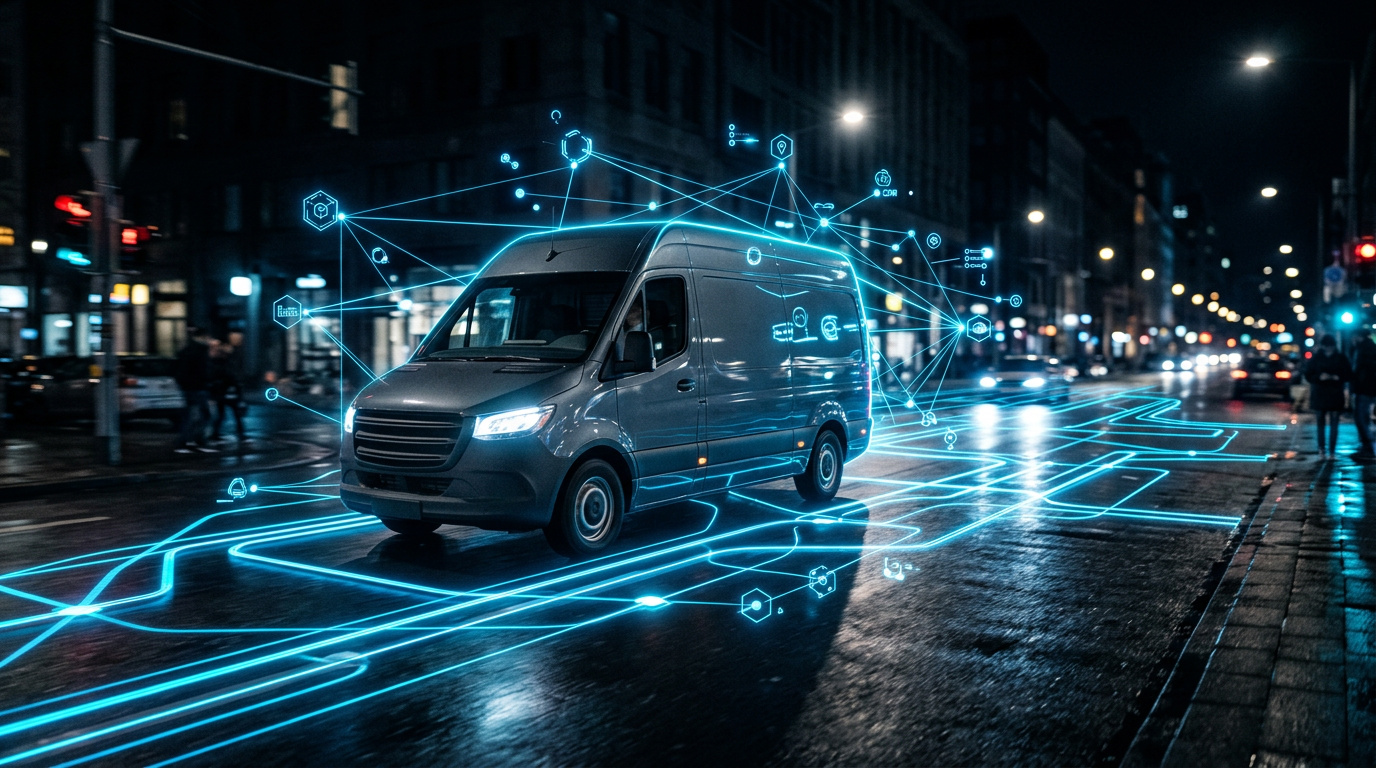
Algorithmic field automation is the systematic deployment of real-time telematic data to route commercial vehicles. For logistics managers, this shifts operational tracking from reactive analog processes into an active edge-computing framework. The immediate use case is eliminating expensive windshield time and halting the bleed of fuel costs by processing live geographic data.
Once upon a time, in another life, before I created the geek lifestyle blog you’re reading now, GeekExtreme, I worked as a driver delivering server racks. I spent my days navigating the heavy, chaotic reality of hauling hardware. You quickly learn the highest hidden tax on a service business is not the price of diesel. It is the cognitive limit of human geographic memory attempting to route live, moving variables.
Consider a plumber finishing a job in one part of town while three open tickets sit across the county, each with a different urgency level. The dispatcher stares at a screen, trying to figure out who goes where next. Without a live data feed, automated dispatch remains a fiction. The team relies entirely on subjective guesswork—someone calculating routes based on where a truck was 45 minutes ago. That bad guess burns fuel and pushes the next appointment further out.
Table of Contents
Treating field vehicles as live computing nodes
Most legacy tracking systems just drop a ping on a map. That is simple visualization, not structural efficiency. To actually change the operational calculus, vehicles must function as live computing nodes reporting back to a spatial solver.
When dispatchers handle analog tasks like mapping customer locations, matching the nearest available technician, and sequencing stops, the workflow degrades rapidly under scale.
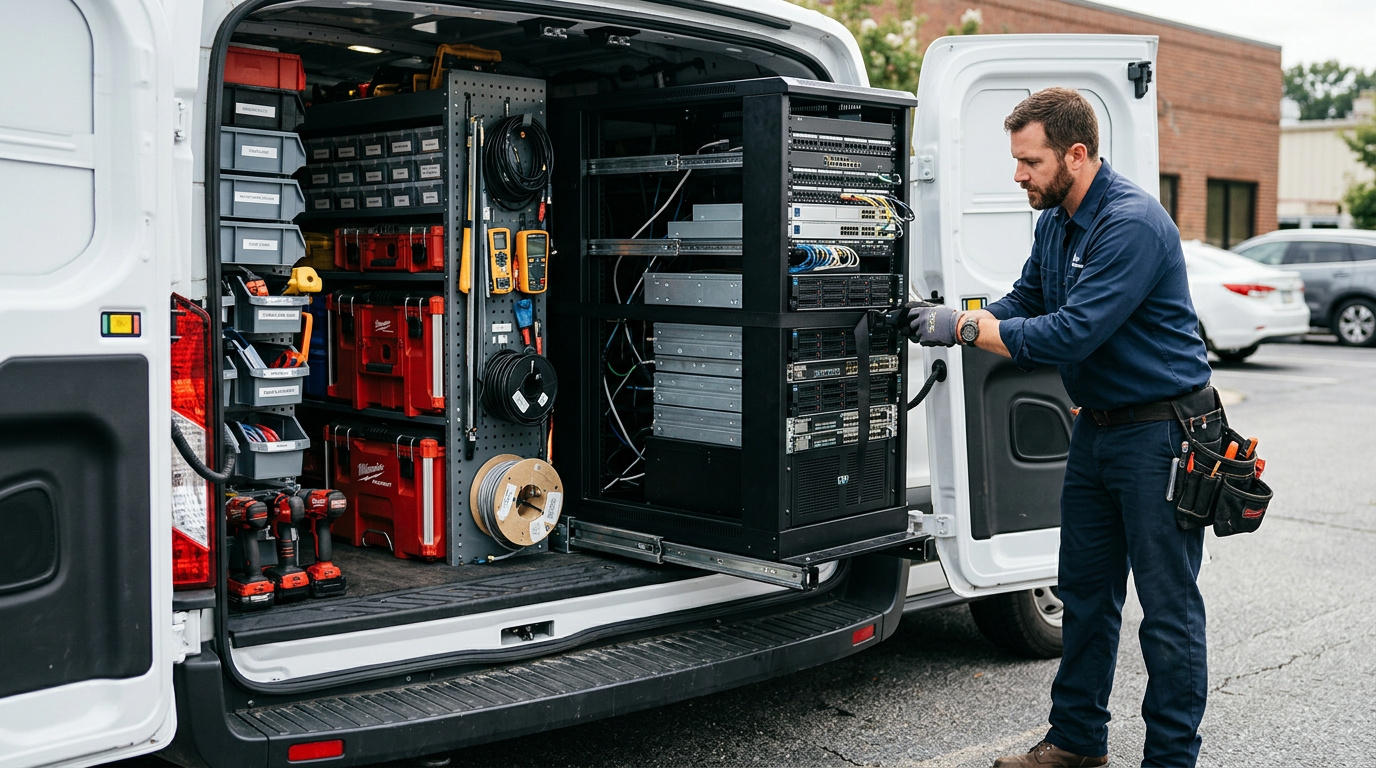
Passing this operational workload to an algorithm reduces cognitive overhead and fundamentally changes the speed of execution. When organizations abandon manual routing, the geographic solver executes a strict sequential workflow: 1. Ingests live field telemetry to establish the exact current coordinates of the asset. 2. Queries the onboard hardware manifest to confirm the technician possesses the mandatory tools for the job. 3. Parses real-time traffic conditions against the localized service level agreement (SLA) for all open tickets. 4. Transmits an optimal geographic pathway directly to the driver’s onboard navigation interface.
AI-powered route optimization fundamentally changes this dynamic, reducing actual drive time by 20 to 35 percent, according to industry reporting.
The financial weight behind this shift is massive. The field service management market sits at $5.10 billion in 2025, according to MarketsandMarkets, with projections putting it at $9.17 billion by 2030. That capital influx proves companies now treat live field data as a baseline requirement, rather than an optional digital upgrade.
Ending the dispatcher-driver blame game
Shared objective data removes friction. The historical adversarial loop between the office and the field evaporates when the routing engine natively accounts for real-time traffic bottlenecks. A dispatcher stops handing down physical impossibilities, and management stops suspecting the driver of stalling.
The data acts as an objective referee.
True optimization matches location with payload
Naive shortest-path algorithms fall apart upon contact with physical reality. Calculating the fastest route means nothing if the physical conditions of the task are ignored.
True geographic matchmaking correlates a driver’s immediate location with the specific technician payload currently loaded in their van. If you are hauling a 600-pound server cabinet, sending a heavy van down a theoretically “faster” road heavily damaged by potholes is a catastrophic local constraint failure.

One of the most expensive failures in service logistics is the repeat visit. A technician arrives, lacks the right part, or misjudges the scope of the problem. That second trip fundamentally doubles the physical cost of the ticket. When the system knows exactly what tools are physically present in the vehicle before firing off the dispatch ping, you eliminate this variable.
According to internal industry checks, about 75% of companies report that AI-driven scheduling directly improves their first-time fix rate.
Curing driver fatigue to boost completion rates
You can push those exact fix rates up by another 10 to 15% through route optimization alone. Technicians simply execute better mechanical work when they are not arriving late or severely fatigued from completely inefficient routing topologies.
The surveillance myth and vindicating drivers
The standard operational objection assumes technicians actively resist granular fleet tracking. Operators usually brace for intense pushback against a perceived surveillance panopticon.
The exact opposite usually happens. Tracking forces management to observe the harsh realities of local traffic. GPS fleet tracking serves as a structural defense mechanism that protects drivers from impossible, hazardous rush-jobs.
“GPS fleet tracking serves as a structural defense mechanism that protects drivers from impossible, hazardous rush-jobs.”
Converting an agonizing 90-minute slog between jobs into a 40-minute drive turns pure windshield time directly back into billable capacity. A technician who drives 90 minutes instead of 40 has lost almost an hour of revenue-generating work. Multiply that across a 5-person crew over a month, and the lost capacity becomes hostile to the operating budget, making it nearly impossible to hit performance KPIs.
An Aberdeen Group study found that organizations tracking these operational KPIs—defining precise targets like first-time fix rates and fuel-burn limits—see 20% higher customer satisfaction alongside 15% higher technician productivity. About 52% of all fleets explicitly report this measurable surge in daily productivity as the primary benefit of GPS tracking. Since many crews operate on performance-based pay tiers, reducing the hidden costs of driving to boost technical output translates straight into higher take-home wages.
Respecting the off-limits data boundary
Integrating telematics into “take-home” fleet vehicles requires hard logical partitioning. Modern routing systems implement strict data privacy controls by cleanly separating personal weekend miles from professional operational tracking. When the employee logs off, the active data stream halts.
Automated communication as structural infrastructure
Commercial vehicles are essentially rolling IoT sensors. Tapping into their live telemetry directly attacks equipment downtime by converting unpredictable breakdowns into slotted schedule maintenance.
AI adoption in field service management has reduced equipment downtime by 30%, largely by feeding maintenance teams live data on vehicle health. When a vehicle hits a diagnostic physical threshold, the monitoring software flags it before an active fault strands a technician mid-route.
When vans stay operational, the schedule survives.
You see these hazard reductions scale outward across larger sectors. Government fleets using GPS tracking have averaged 17% reductions in accident costs and 14% reductions in labor costs, according to the 2025 Fleet Technology Trends Report. These accident reductions are largely a result of acting on vehicle health data proactively—such as swapping worn brakes before they fail mid-route—not just tracking vehicle location. Deploying highly accurate hardware sensors for monitoring moving assets mathematically de-risks the physical fleet.
How a text message saves fleet fuel
Outward-facing data yields internal efficiency. Generating a dynamic ETA instantly calculates an arrival window based on continuous traffic data, destroying the universally despised “between 9 and 12” paradox.
The customer receives a precise text message. By removing the dangerous, time-consuming need for the driver to physically pull over and manually call the customer, this automated update operates as a strict cost-avoidance mechanism that physically blocks asset waste. This highly specific communication mechanically drops the rate of failed appointments. When customers receive extremely accurate arrival information, they physically wait at the door. Consequently, algorithmic route optimization actively defends baseline fuel consumption because your drivers never waste diesel travelling to an empty, locked building.
Reclaiming time and invisible operational revenue
Financial officers hyper-fixate on the upfront capital expenditure of telematics. But the initial hardware investment is rapidly neutralized by an incredibly compressed ROI horizon.
The 2025 Fleet Technology Trends Report notes that average fuel savings from GPS fleet tracking doubled from 8 to 16 percent between 2021 and 2025. Unsurprisingly, 47 percent of fleets hit a statistically positive return on investment in under a year.
The market trajectory proves the underlying math. The global field service management market is projected to reach $23.61 billion by 2035, according to Global Market Insights.
Enterprises are not integrating exact locational tracking to satisfy a digital vanity checklist. They are systematically locating the invisible revenue they were already bleeding out through excess fuel, reactive mechanical maintenance, and highly inefficient human routing.
Frequently Asked Questions
What exactly is algorithmic field automation in logistics?
It is the protocol of using real-time telematic data to route commercial vehicles instead of relying on human guesswork. Vehicles function as live computing nodes that constantly report back to a spatial solver, which then negotiates the optimal route based on immediate traffic conditions and onboard tool manifests.
Why do technicians generally support fleet tracking instead of fighting the surveillance?
Objective telematics put an immediate end to the dispatcher-driver blame game. Instead of management suspecting a driver of stalling, GPS tracking proves the harsh reality of local traffic and structurally protects technicians from physically impossible rush jobs. The system acts as a digital referee that ultimately boosts their technical output and performance-based pay.
How does geographic payload matching differ from standard route optimization?
Naive shortest-path algorithms only calculate the fastest physical route, completely ignoring the harsh realities of the actual cargo. True geographic payload matchmaking correlates a driver’s exact location with the specific hardware currently loaded in their van. It ensures you don’t send a heavy server cabinet down a pothole-ridden shortcut, validating that the fastest route is actually physically viable.
How does sending an automated ETA text message actually save fleet fuel?
Automated text updates destroy the universally despised “between 9 and 12” arrival paradox by giving the customer a highly precise, dynamic arrival window. Because customers actually wait at the door when given an exact timeframe, failed appointment rates drop off a cliff. Your drivers stop wasting expensive diesel travelling to locked, empty buildings.
Is AI route optimization worth the initial telematics hardware expenditure?
Yes, the upfront capital cost is rapidly neutralized by an incredibly compressed ROI horizon. Nearly half of all surveyed fleets hit a statistically positive return on investment in under a year simply by halting the bleed of excess fuel and eliminating useless windshield time. With average fuel savings recently hitting 16 percent, it is an operational necessity rather than a digital vanity project.
Can I deploy fleet tracking on “take-home” vehicles without invading my crew’s privacy?
You can, provided the routing system establishes a hard logical partition to protect employee off-hours. Modern telematics platforms implement strict off-limits data boundaries by cleanly separating personal weekend miles from professional active tracking. The moment the technician logs off for the day, the active data stream completely halts.
What is the “first-time fix rate” and why does smart dispatching improve it?
The first-time fix rate tracks how often a technician successfully resolves a ticket without needing a radically expensive second visit to the site. Companies using AI-driven scheduling see this rate jump because the operational algorithm verifies the van actually has the required tools onboard before dispatching the driver. It prevents technicians from showing up empty-handed just because they were the geographically closest option.